Newsroom
Uniswap Debuts Pools.trade Launchpad on Robinhood Chain
7 August, 2026 / News / AI / 789 reads / Tags: pools, uniswap, launchpad, tokens, percent

The decentralized exchange expands into token creation with dual launch models, permanent liquidity locks and zero platform fees on the emerging Layer 2 network
Uniswap Labs has introduced Pools.trade, a dedicated token launchpad on Robinhood Chain that enables users to create, discover and trade new tokens through a single interface. The platform went live around August 5, 2026, extending the protocol beyond its traditional role as a decentralized exchange into the full lifecycle of token issuance.
Robinhood Chain, an Ethereum Virtual Machine-compatible Layer 2 that launched publicly on July 1, already relies on Uniswap’s v2, v3, v4 and UniswapX protocols as its primary public automated market maker. Pools.trade now vertically integrates token creation with trading on the same network, allowing successful launches to migrate automatically into Uniswap v4 pools.
Two Distinct Launch Pathways
Pools.trade offers creators two methods for deploying tokens. Both approaches mint a fixed supply of one billion tokens and conclude with liquidity placed into a permanently locked Uniswap v4 pool.
Crowd Launch runs for four hours and uses a time-weighted average price bidding system designed to reduce bundling and sniping by bots. Projects must reach a minimum market capitalization or fully diluted valuation of $10,000 to graduate. If the threshold is not met, all contributions are refunded in full.
Instant Launch activates trading immediately via a bonding-curve mechanism and imposes no minimum valuation requirement. Creators can purchase tokens in the same block as the launch, further limiting external sniping opportunities.
The platform itself charges no separate launchpad fee, distinguishing it from many competing services that typically take around 1 percent.
Distribution and Early Market Impact
Tokens launched through Pools.trade appear immediately across the Uniswap web application, wallet, trading API and Launches feed, as well as on third-party platforms including Bitget, Fomo, GMGN and OKX Wallet. This built-in distribution aims to give new assets broad visibility from day one.
Traders discovered earlier versions of the smart contracts before the official interface launched and generated more than $150 million in volume through them. The team supported both test and final contracts during the transition. Within its first day of broader availability, Pools.trade captured approximately half of launchpad volume and 40 percent of new tokens on the chain.
Robinhood Chain has recorded daily decentralized exchange volume near $520 million and seven-day volume of about $2.48 billion, though weekly figures have shown volatility with a recent decline of roughly 33 percent. Stablecoin reserves on the network stand near $598 million. Activity rebounded following the Pools.trade debut, with daily transactions and volumes rising notably.
Broader Context for Decentralized Exchanges
The launch occurs as decentralized exchanges increasingly develop native token launchpads rather than relying solely on trading volume. Controlling issuance helps retain liquidity within a platform’s pools and creates stickier total value locked. Competing platforms such as Bankr and Sushi have also explored partnerships and launch mechanisms, signaling a shift toward vertical integration across the token lifecycle.
Uniswap has emphasized that it does not vet or endorse individual projects launched on Pools.trade. Early tokens including FRONG and POOLS attracted attention but experienced price pressure, and the team clarified that neither is an official platform token. Meme tokens in particular can carry high risk of total value loss and may include additional creator-imposed transaction fees.
UNI, the protocol’s native token, has seen exchange balances decline by about 15.7 percent over the past month while its price rose roughly 47 percent since early July, reaching levels near $4.07 with a market capitalization around $2.54 billion according to various data providers. Lower exchange supply is often associated with reduced immediate selling pressure.
Pools.trade remains in beta. Its long-term ability to attract higher-quality projects beyond short-term speculative activity will determine its impact on both Uniswap’s ecosystem and the broader competitive dynamics among decentralized exchanges on emerging networks.


Disclaimer
This article was generated by AI using information from multiple industry sources. It has not been reviewed or verified by a human editor and may contain inaccuracies, omissions, or misinformation. Readers are encouraged to independently verify any information before making decisions based on its content.Associated articles
Uniswap Governance Votes on V4 Fees and Robinhood Chain Expansion
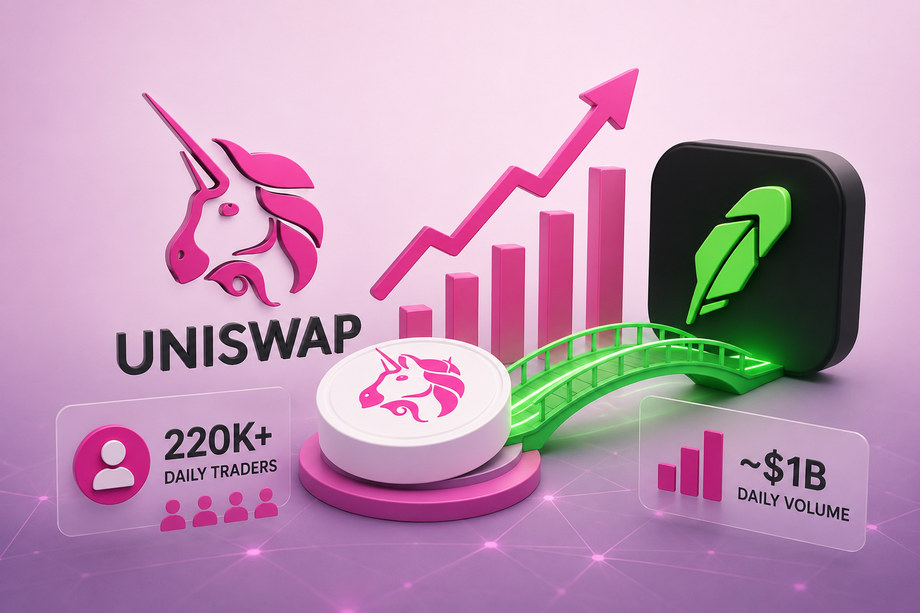
Uniswap Trader Activity Explodes to 220K on Robinhood Chain

Robinhood Chain Tokenized Stocks Surge Fivefold to $70 Million as Trading Volumes Expand

Robinhood Chain Nears $1 Billion TVL Through Uniswap Liquidity Integration
Robinhood Chain Records Strong First Week With Over $70M ETH Bridged
Latest articles
SafePal Discloses Breach Exposing Order Details of Nearly 40,000 Customers
DefiLlama Delays Mobile App Launch Until Apple Removes Fake Phishing Versions
Ethereum Developers Narrow 66 Proposals for 2027 Hegotá Upgrade Focused on Privacy and Censorship Resistance
Galaxy Digital Slashes CLARITY Act Passage Odds to 10% Amid Tight Senate Calendar