Newsroom
US Treasury Proposes Rules Clarifying Stablecoin Issuance Under GENIUS Act
17 August, 2026 / News / AI / Tags: genius, treasury, federal, stablecoins, payment

The department opens a 60-day public comment period on definitions and licensing requirements ahead of the law’s January 2027 effective date
The US Department of the Treasury has issued a notice of proposed rulemaking to implement key provisions of the Guiding and Establishing National Innovation for U.S. Stablecoins Act, known as the GENIUS Act. The proposal focuses on defining when a payment stablecoin is issued, offered, or sold in the United States and establishing the licensing requirements that will apply once the law takes effect.
Signed into law in July 2025, the GENIUS Act creates a federal framework for payment stablecoins. Under the statute, entities will generally be prohibited from issuing a payment stablecoin in the United States beginning January 18, 2027, unless they hold an appropriate federal or state license. A second set of restrictions takes effect on July 18, 2028, limiting the ability of digital asset service providers to offer or sell payment stablecoins to persons in the United States unless those tokens are issued by licensed entities.
Scope of the Proposed Rules
The Treasury proposal centers on Section 3 of the GENIUS Act. It seeks to clarify the geographic and transactional boundaries that determine when stablecoin activity falls under US jurisdiction. Officials aim to define precisely what constitutes issuing a payment stablecoin “in the United States,” a determination that will decide which companies must obtain licenses. The rules also address when a digital asset service provider is considered to have offered or sold a stablecoin to a person located in the country.
Foreign-issued stablecoins receive specific attention. Digital asset platforms generally will not be permitted to make foreign payment stablecoins available to US users unless the issuer can comply with lawful orders from US authorities and operates under a regulatory regime deemed comparable through reciprocal arrangements. The proposal examines how these conditions should apply in practice and what due diligence obligations service providers must meet when relying on representations from overseas issuers.
Treasury Secretary Scott Bessent stated that the department welcomes stakeholder input as it works to deliver regulatory certainty that supports business innovation, reinforces the US dollar’s status as the world’s reserve currency, and maintains the country’s position in the digital asset sector.
Comment Period and Implementation Timeline
Interested parties will have 60 days after the notice appears in the Federal Register to submit comments. Feedback is expected to cover the clarity of key definitions, the treatment of offshore activity, compliance expectations for service providers, and the potential economic effects of the rules. The department previously sought broader input through an advance notice issued in September 2025.
The proposal arrives after federal agencies missed an earlier internal target in July 2026 for completing implementing regulations. Multiple regulators, including the Office of the Comptroller of the Currency, the Federal Deposit Insurance Corporation, and the Federal Reserve, have advanced their own related proposals during 2026. Despite the missed deadline, the statutory effective date of January 18, 2027, remains in place. Final rules are still under development, and transitional periods are typical when new regulatory regimes take effect.
In drafting the proposal, Treasury reviewed longstanding securities law approaches to the issue, offer, and sale of financial instruments, including offshore activities. Officials noted, however, that applying traditional investment regulations too broadly could conflict with the GENIUS Act’s goal of enabling payment stablecoins to function effectively for payments and settlement, including across borders.
Broader Regulatory Context
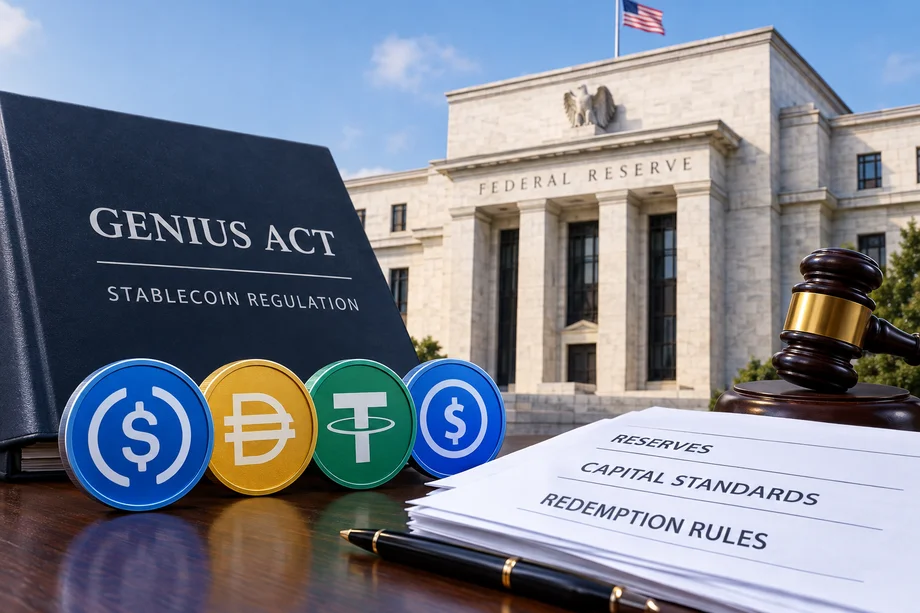
The GENIUS Act establishes reserve, redemption, disclosure, and compliance standards for licensed issuers. It creates pathways for both federally supervised and qualifying state-regulated entities. Separate rulemakings have addressed anti-money laundering requirements, customer identification, capital and liquidity standards, and the process for determining whether state regimes are substantially similar to the federal framework.
Implementation of the stablecoin law is occurring alongside congressional consideration of broader digital asset market structure legislation. That measure, which could affect certain GENIUS Act provisions including the treatment of rewards programs, has faced delays and has not yet advanced to key votes.
The Treasury notice poses numerous specific questions intended to refine the final rules before they are adopted. Industry participants, financial institutions, and other stakeholders are expected to focus particular attention on the treatment of major foreign issuers and the practical application of licensing and distribution restrictions once the January 2027 deadline arrives.
Disclaimer
This article was generated by AI using information from multiple industry sources. It has not been reviewed or verified by a human editor and may contain inaccuracies, omissions, or misinformation. Readers are encouraged to independently verify any information before making decisions based on its content.Tired of the noise?
Let the bots trade for you.
Trade 24/7, without emotion, with data-driven strategies.
Associated articles

OCC Aims for November Finish on GENIUS Act Stablecoin Rules

US Regulators Miss GENIUS Act Deadline, Leaving Stablecoin Framework Incomplete

EU Prepares MiCA Changes to Handle Non-EU Stablecoin Issuers

Singapore Proposes Full Reserves and Interest Ban for Stablecoin Issuers
Federal Reserve Proposes Capital and Redemption Rules for Stablecoin Issuers Under GENIUS Act
Latest articles

SpaceX and Tesla Set Up Committees to Explore Merger That Would Combine Holdings of Over 30,000 Bitcoins

UK Banks Face Thousands of Complaints Over Crypto Transfer Restrictions

Ripple Backs SEC Proposed Crypto Asset Rules After $150 Million Legal Battle

Blockchain.com Introduces Options Trading on Seven Major Crypto Assets