Newsroom
Singapore Proposes Full Reserves and Interest Ban for Stablecoin Issuers
1 September, 2026 / News / AI / Tags: singapore, mas, issuers, stablecoins, consultation
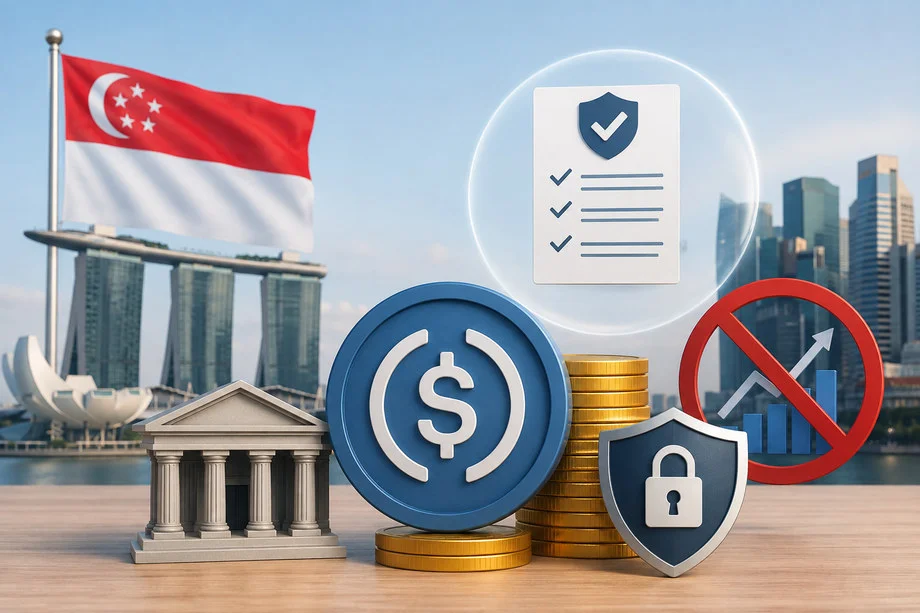
The Monetary Authority of Singapore has opened a consultation on rules requiring 100% reserve backing, prohibiting yields, and allowing limited recognition of certain foreign and jointly issued stablecoins
Singapore’s financial regulator has proposed amendments to the Payment Services Act that would place its stablecoin framework into law. The Monetary Authority of Singapore, or MAS, published the consultation on September 1, seeking feedback on requirements for issuers, reserve standards, and the treatment of tokens linked to foreign entities. Comments are due by October 16.
Core Requirements for Regulated Issuers
Under the proposals, only licensed issuers would be permitted to market their tokens as “MAS-regulated stablecoins.” These tokens must be single-currency instruments pegged to the Singapore dollar or a G10 currency. Issuers would need to maintain segregated reserve assets equal to at least 100% of the circulating supply at all times. The reserves must be held separately from the issuer’s own funds and custodied only with licensed financial institutions.
Holders would gain stronger protections on redemption. Issuers must ensure sufficient reserves and safeguard funds pending redemption, with users able to redeem at par. Additional obligations include capital requirements, regular disclosures, stress testing, and plans for recovery or orderly wind-down. Customer money received before the corresponding tokens are issued would also need to be protected under rules similar to those already applying to other payment service licensees.
Ban on Interest and Yield
The consultation includes a clear prohibition on issuers paying interest or other benefits tied to holdings of regulated stablecoins. MAS stated that stablecoins should function as payment instruments rather than investment products or vehicles for generating returns comparable to bank deposits. The approach is presented as consistent with international practices, including frameworks in the United States and the European Union that also bar yield on stablecoins.
Stablecoins that do not meet the full set of requirements would continue to be treated as digital payment tokens under existing rules and would not be allowed to use the MAS-regulated designation.
Opening to Joint and Foreign Issuance
A notable shift from the 2023 framework concerns multi-jurisdiction tokens. At that time, MAS limited qualifying stablecoins to those issued solely in Singapore, citing difficulties with regulatory equivalence, supervisory cooperation, and practical challenges around tracing reserves and meeting redemption requests across borders.
The new proposals would allow stablecoins jointly issued by a Singapore entity and a foreign issuer to qualify as MAS-regulated, provided associated risks are sufficiently mitigated. MAS is also considering limited recognition of a small number of fully foreign-issued stablecoins that are already supervised under comparable overseas regimes. Recognition would focus on their potential use in cross-border wholesale transactions.
Details on how responsibilities would be divided for jointly issued tokens, the precise criteria for foreign recognition, and any transitional arrangements for existing Singapore-based issuers remain open for comment during the consultation period.
Next Steps
MAS first consulted on stablecoin rules in 2022 and finalized the core framework in 2023. The current exercise seeks to translate those standards into binding legislative amendments while updating policy for developments since then. Subsidiary legislation will be consulted on separately at a later stage. No implementation date has been announced.
The consultation runs until October 16. After reviewing responses, MAS will decide on the final form of the amendments before they proceed through Singapore’s legislative process.
Disclaimer
This article was generated by AI using information from multiple industry sources. It has not been reviewed or verified by a human editor and may contain inaccuracies, omissions, or misinformation. Readers are encouraged to independently verify any information before making decisions based on its content.Tired of the noise?
Let the bots trade for you.
Trade 24/7, without emotion, with data-driven strategies.
Associated articles
Federal Reserve Proposes Capital and Redemption Rules for Stablecoin Issuers Under GENIUS Act

Circle and Hyperliquid Urge EU Adjustments to MiCA Stablecoin and Derivatives Rules

US Treasury Proposes Rules Clarifying Stablecoin Issuance Under GENIUS Act

EU Prepares MiCA Review in 2027 to Address Non-EU Stablecoin Issuers

Russia Places Foreign Stablecoin Freeze Risks on Crypto Investors
Latest articles

SpaceX and Tesla Set Up Committees to Explore Merger That Would Combine Holdings of Over 30,000 Bitcoins
UK Banks Face Thousands of Complaints Over Crypto Transfer Restrictions
Ripple Backs SEC Proposed Crypto Asset Rules After $150 Million Legal Battle

Blockchain.com Introduces Options Trading on Seven Major Crypto Assets