Newsroom
Goldman Sachs Delays Second Fed Rate Hike Forecast to December
1 October, 2026 / News / AI / Tags: pce, inflation, williams, goldman, percent
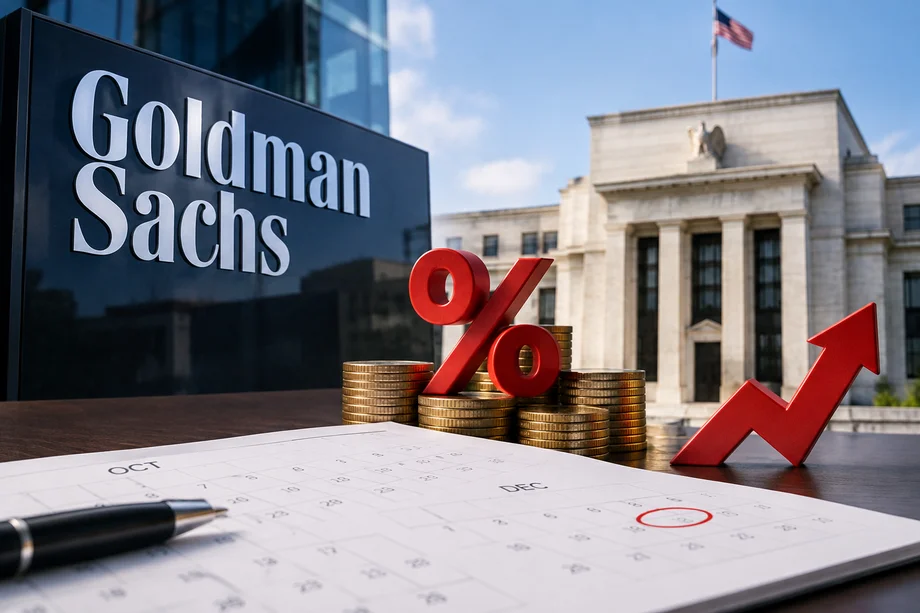
Goldman Sachs has shifted its expectation for a second Federal Reserve rate increase from October to December after August core PCE inflation data came in softer than expected and New York Fed President John Williams signaled caution
Goldman Sachs Revises Outlook Following Soft PCE Release
Goldman Sachs analysts have adjusted their view on the Federal Reserve’s next policy move. The bank now sees an October quarter-point increase as unlikely after the latest core Personal Consumption Expenditures reading disappointed. Instead, it has moved the base case for the next hike to December.
August core PCE rose 0.25 percent from July and 3.01 percent year over year. Both figures fell short of forecasts. Goldman now projects core PCE at 3 percent for the fourth quarter on a year-over-year basis, 0.4 percentage points below the median projection from Fed officials.
Part of the softening reflected methodological changes in the portfolio management component. The data still points to inflation remaining above the Fed’s 2 percent target, but the pace has eased noticeably.
Second-quarter U.S. economic growth was revised higher to 2.2 percent annualized, driven by stronger consumption and investment. The bank trimmed its third-quarter growth estimate slightly to 3.3 percent.
Williams and Barr Comments Shape the Shift
New York Fed President John Williams had already noted no urgency for an immediate next hike in the weeks before the data release. His remarks reinforced the view that more information should guide decisions.
Federal Reserve Board Governor Michael Barr, speaking at the Detroit Economic Club, highlighted rising inflation risks while noting eased employment concerns. Barr cited elevated energy costs, Middle East uncertainty, and AI-related demand as factors keeping prices from falling faster toward target. Only two of the past 20 months showed core PCE readings consistent with 2 percent.
Barr stated in his base case that further policy adjustments are likely to bring inflation down to target in a timely fashion.
Williams continues to treat one additional increase this year as his base case but favors waiting for clearer signals. Barr maintains support for tightening to address inflation risks.
Post-September Hike Context and Market Reaction
The Fed raised its benchmark rate by 25 basis points to a 3.75–4 percent target range at the September 16 meeting. The 12–0 vote reflected officials’ assessment of elevated inflation and resilient domestic spending, alongside strong productivity and investment.
September economic projections showed 16 of 18 participants expecting at least one more quarter-point increase before year-end. The median forecast placed the end-2026 and end-2027 policy rates at 4–4.25 percent.
Following the September decision, market pricing initially assigned an 87 percent probability to the hike. After the softer PCE release, futures markets now assign roughly a one-in-three chance to an October increase, while still anticipating a December move.
September U.S. employment data, due on October 2, will provide the next key input before the next FOMC meeting.
Broader Economic Indicators
Personal incomes rose 0.2 percent in August while personal consumption expenditures increased 0.9 percent. The personal savings rate fell to 4.1 percent, its lowest level since November 2022.
Ten-year U.S. Treasury yields climbed to 5.29 percent, the highest since 2007. The combination of cooling inflation and resilient growth has left analysts divided on whether the Fed needs further tightening.
| Inflation Measure | Latest (August) | Goldman Sachs Q4 Projection | Fed Median |
|---|---|---|---|
| Core PCE (y/y) | 3.01% | 3% | 3.4% |
| Core PCE (m/m) | 0.25% | — | — |
Market participants continue to watch the September jobs report closely. Any softening in labor market data could reinforce the case for patience, while stronger-than-expected figures might keep the door open for additional tightening.

Disclaimer
This article was generated by AI using information from multiple industry sources. It has not been reviewed or verified by a human editor and may contain inaccuracies, omissions, or misinformation. Readers are encouraged to independently verify any information before making decisions based on its content.Tired of the noise?
Let the bots trade for you.
Trade 24/7, without emotion, with data-driven strategies.
Associated articles
Bitcoin Climbs Toward $85,500 as Softer August PCE Data Eases Rate-Hike Pressure
Goldman Sachs Forecasts Another Fed Rate Hike in October After Hawkish Decision
Goldman Sachs Shifts to Expect 25 Basis Point Fed Rate Increase in September

Bitcoin Falls Below $80,000 After Strong US Jobs Report Exceeds Forecasts
Fed Raises Rates 25 Basis Points in First Hike Since 2023
Latest articles

SpaceX and Tesla Set Up Committees to Explore Merger That Would Combine Holdings of Over 30,000 Bitcoins

UK Banks Face Thousands of Complaints Over Crypto Transfer Restrictions
Ripple Backs SEC Proposed Crypto Asset Rules After $150 Million Legal Battle

Blockchain.com Introduces Options Trading on Seven Major Crypto Assets