Newsroom
Federal Reserve Proposes Capital and Redemption Rules for Stablecoin Issuers Under GENIUS Act
25 September, 2026 / News / AI / Tags: genius, proposals, reserve, issuers, stablecoin
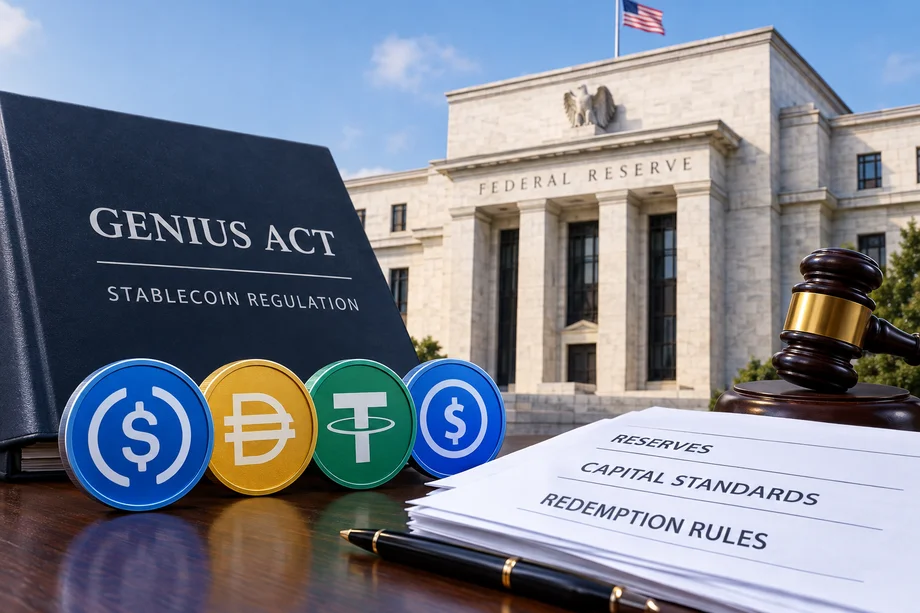
Federal Reserve Board released two proposals to enforce the GENIUS Act, requiring stablecoin issuers it supervises to maintain full one-to-one reserve backing and meet standardized capital standards while setting redemption timelines and bank approval pathways
Fed Advances GENIUS Act Implementation With Detailed Stablecoin Framework
The U.S. Federal Reserve Board on September 24 released two proposals to operationalize the GENIUS Act, the federal law enacted in 2025 that establishes the first comprehensive regulatory structure for dollar-pegged payment stablecoins. These documents address issuers under direct Board supervision and create pathways for regulated banks to participate through subsidiaries.
The GENIUS Act mandates that stablecoin issuers maintain reserves equal to outstanding tokens on a one-to-one basis, with reserves limited to specific high-quality assets such as cash, bank deposits, and short-term U.S. Treasurys. The Fed proposals translate these statutory requirements into supervisory expectations, adding granular capital, risk-management, custody, and reporting obligations.
Reserve Backing, Custody, and Capital Requirements for Issuers
Board-supervised stablecoin issuers must hold permissible assets that fully back each token issued. Eligible reserves include short-term U.S. Treasury bills and other high-quality liquid instruments, with all holdings required to remain separate from the issuer’s other assets. The proposals also establish rules for firms that custody these reserve assets, ensuring secure safekeeping.
Capital standards address operational and credit risks tied to stablecoin operations. The operational-risk charge scales with issuance volume: 2 percent on the first $20 billion in outstanding stablecoins, 1.5 percent on the next $30 billion, and 1 percent on amounts above $50 billion. Additional capital requirements apply for credit and operational risks, alongside broader risk-management standards.
Redemption Mechanics and Transparency Measures
Issuers must generally process redemption requests within two business days. If reserves fall below the required one-to-one threshold, the issuer is required to notify the Fed and either restore full backing through a remediation plan or liquidate reserves and redeem all outstanding stablecoins.
Monthly disclosures must detail outstanding stablecoin balances, reserve values, and compositions. These reports require examination by a registered public accounting firm and certification by the issuer’s chief executive officer and chief financial officer, strengthening accountability and comparability for market participants.
Approval Process for Banks to Issue Stablecoins
A companion proposal outlines an application framework for insured state member banks seeking Fed approval to issue payment stablecoins through subsidiaries. Banks must submit a business plan, financial information, and other supporting documents, including three-year projections. The process includes provisions for appeals, hearings, and final determinations.
Once a filing is deemed substantially complete, the GENIUS Act sets a 120-day timeline for the Fed to decide; failure to act within that period results in deemed approval, with material changes potentially resetting the clock.
Governor Barr Backs Framework but Flags Concerns
Fed Governor Michael Barr expressed support for the proposals and the proposed limits on reserve assets and standardized capital requirements. He called for public feedback on whether the framework adequately addresses interest-rate and foreign-currency risks and emphasized the need for clear universal redemption rights in the final rule.
Barr also raised concerns about an anti-money laundering threshold requiring deficiencies to be deemed “significant or systemic” before the Fed can take supervisory or enforcement action, noting potential effects on the Board’s ability to verify compliant programs.
Public Comment Period and Broader Implementation Context
The proposals are open for public comment for 60 days following publication in the Federal Register. The GENIUS Act is scheduled to take effect on January 18, 2027, or 120 days after final implementing rules are issued by federal regulators, whichever occurs first.
| Proposal Focus | Key Requirements |
|---|---|
| Stablecoin issuers | Full one-to-one reserve backing with eligible assets; operational-risk capital charges scaled by issuance size; risk-management standards; monthly audited disclosures certified by CEO and CFO |
| Reserve custody and bank activities | Rules for safekeeping reserves; clarification of permissible stablecoin-related activities for supervised banks |
| Bank applications | Business plan and financial information submission; appeals, hearings, and final decision procedures; 120-day regulatory clock |
These measures align with parallel efforts by other agencies, including the Office of the Comptroller of the Currency targeting final rules in November and the Treasury’s separate proposals on issuance and offering restrictions.
The framework aims to provide market participants with consistent, verifiable standards for reserve adequacy and operational resilience, while the comment period will inform refinements before the proposals advance to final form.
Disclaimer
This article was generated by AI using information from multiple industry sources. It has not been reviewed or verified by a human editor and may contain inaccuracies, omissions, or misinformation. Readers are encouraged to independently verify any information before making decisions based on its content.Tired of the noise?
Let the bots trade for you.
Trade 24/7, without emotion, with data-driven strategies.
Associated articles

US Regulators Miss GENIUS Act Deadline, Leaving Stablecoin Framework Incomplete

Singapore Proposes Full Reserves and Interest Ban for Stablecoin Issuers

EU Prepares MiCA Changes to Handle Non-EU Stablecoin Issuers

OCC Grants Conditional Approval for World Liberty Trust Bank to Oversee USD1 Stablecoin

US Treasury Proposes Rules Clarifying Stablecoin Issuance Under GENIUS Act
Latest articles

Babylon Labs Advances Proposal for Native Bitcoin Lending on Aave V4

TSMC Posts Record Q3 Profit Surge on AI Chip Demand, Lifts Full-Year Outlook

ASIC Opens Consultation on Capital and Custody Rules for Digital Asset Platforms

GTA 6 Leaker Cyberleek Drops Full Build Plan After Memecoin Collapse, Activates Dead Man’s Switch Threat