Newsroom
Lloyds and Visa Settle $750,000 Using USDC in Cross-Border Pilot
1 October, 2026 / News / AI / Tags: lloyds, visa, pilot, settlement, usdc
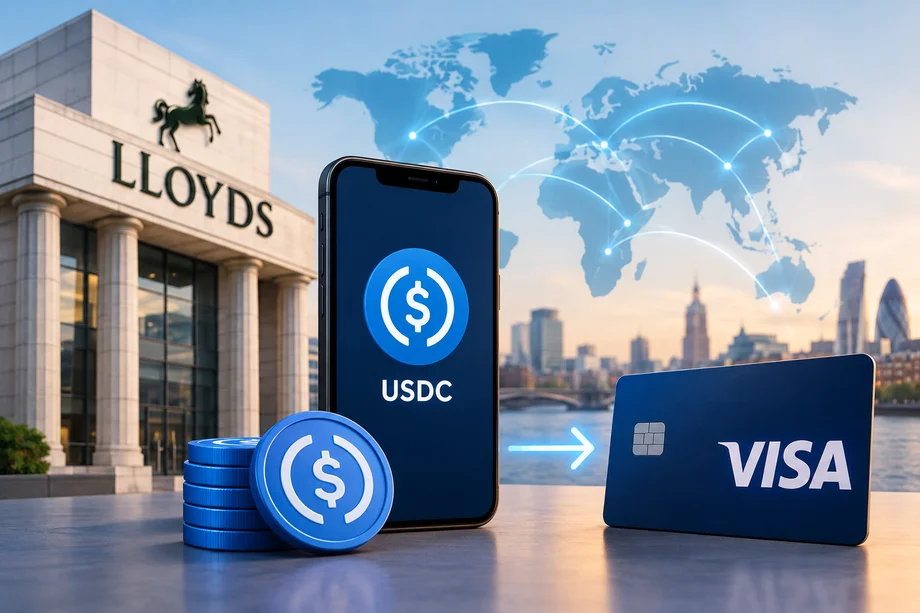
Lloyds Banking Group and Visa have completed a live trial using USDC to handle cross-border payments, with funds moving between institutions in under an hour even on weekends
Lloyds Banking Group and Visa have successfully finished a seven-day pilot that settled $750,000 in real-world U.S. dollar obligations between the bank’s Corporate Markets branch in Jersey and Visa’s operations in the United States. The transaction relied on USDC, the stablecoin issued by Circle, to complete the settlement process.
Pilot Details and Settlement Speed
The trial took place across different blockchain networks. Lloyds acquired the USDC through the UK-regulated exchange Archax and moved the funds using its own node on the Canton Network. Visa handled settlement on a separate public blockchain. This setup allowed the companies to test stablecoin-based settlement without requiring the institutions to operate entirely on the same network.
Funds reached Visa in less than an hour, including during non-business hours and over the weekend. Traditional cross-border settlement can take a full day or longer when transactions begin outside regular banking hours. The pilot focused solely on the institutional settlement process rather than changing how customers pay.
Testing Round-the-Clock Capabilities
The seven-day pilot examined whether stablecoins could enable financial institutions to settle obligations around the clock. Lloyds noted that its treasury operations benefit from greater certainty about when funds arrive and improved visibility into their status. Faster settlement also reduces the amount of liquidity tied up waiting for transactions to complete during weekends and holidays.
Peter Left, head of digital assets at Lloyds Banking Group, described the trial as a move from theory to practice. He said the experience confirmed that digital money could accelerate international payments, increase transparency, and provide businesses with clearer control over fund movements.
Lloyds’ Broader Blockchain Experiments
This USDC pilot forms part of Lloyds’ ongoing work with blockchain-based financial infrastructure. The bank has previously issued tokenized sterling deposits on the Canton Network, completed live transactions under the Bank for International Settlements’ Project Agorá, and tested tokenized deposits alongside Barclays and NatWest. The current trial used a different approach by involving a regulated stablecoin rather than representing commercial bank deposits on-chain.
Visa has similarly expanded its stablecoin settlement infrastructure. The payments company previously tested private stablecoin settlement on the Canton Network with Brale and supports USDC on public blockchains. Its stablecoin card network now includes more than 160 programs, and some participants have already used USDC to meet settlement obligations seven days a week.
Rob Cameron, Visa’s group country manager for the UK and Ireland, said the pilot demonstrates how stablecoins can integrate with existing banking systems to give institutions greater flexibility in choosing when and how they settle funds.
Implications for Institutional Payments
By keeping existing payment products and banking systems in place, the trial showed that stablecoins can support settlement without disrupting current processes. Lloyds’ Corporate Markets branch booked the $750,000 obligation, converted it to USDC via Archax, and completed the transfer to Visa. The companies emphasized that the focus remained on inter-institutional settlement rather than customer-facing payment changes.
The pilot aligns with broader industry efforts to explore stablecoins for 24/7 value movement. Other institutions, including major U.S. banks, are testing similar tokenized deposit networks, while Lloyds continues to evaluate digital assets for moving value between businesses and financial entities. The result provides a concrete example of how blockchain can address delays in cross-border treasury and payment operations.
Disclaimer
This article was generated by AI using information from multiple industry sources. It has not been reviewed or verified by a human editor and may contain inaccuracies, omissions, or misinformation. Readers are encouraged to independently verify any information before making decisions based on its content.Tired of the noise?
Let the bots trade for you.
Trade 24/7, without emotion, with data-driven strategies.
Associated articles

SBI Group and Kyobo Life Complete Direct Yen-Won Stablecoin Cross-Border Pilot

71% of UK Finance Leaders Expect Tokenization to Reshape Financial Services

SWIFT Launches Blockchain Ledger for Tokenized Deposit Pilot with 17 Banks

Visa Partners with Nium for Seven-Day Stablecoin Settlement Pilot in Singapore

Oracle Connects Banks to SWIFT Blockchain Ledger for Tokenized Payments
Latest articles

SpaceX and Tesla Set Up Committees to Explore Merger That Would Combine Holdings of Over 30,000 Bitcoins

UK Banks Face Thousands of Complaints Over Crypto Transfer Restrictions

Ripple Backs SEC Proposed Crypto Asset Rules After $150 Million Legal Battle

Blockchain.com Introduces Options Trading on Seven Major Crypto Assets