Newsroom
Orbs Opens Community Vote on OIP-9 to Form DAO Governance Framework
4 August, 2026 / News / AI / Tags: orbs, community, dao, oip, governance
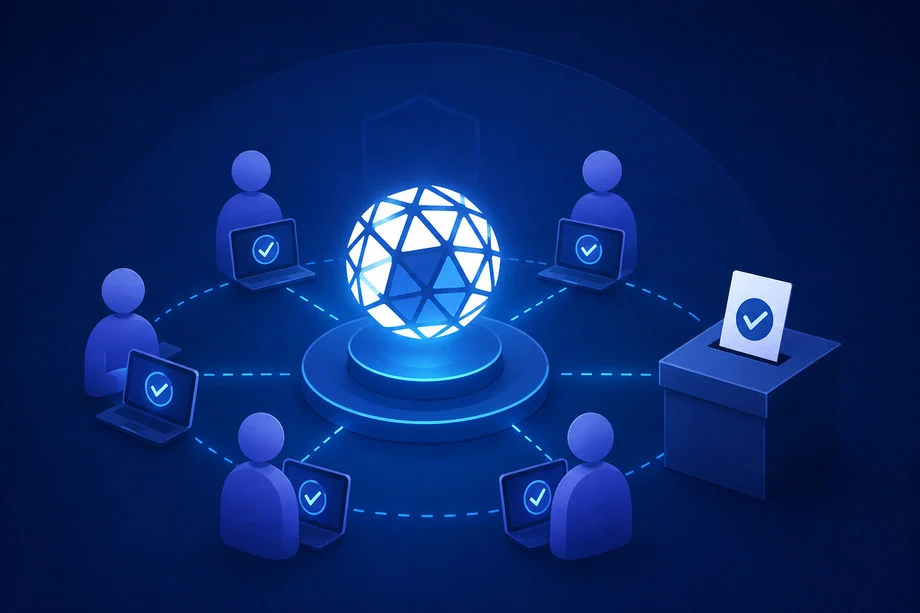
Orbs has started its first formal community governance vote through OIP-9, seeking approval to create the Orbs DAO with defined initial authority and a path for gradual expansion of community control
Orbs, a decentralized Layer-3 blockchain infrastructure built for advanced on-chain trading, has launched OIP-9, its first official community governance proposal. The vote asks eligible participants to approve the creation of the Orbs DAO and its initial governance structure. Approval would grant the community authority over specific protocol areas while establishing a foundation for further decentralization over time.
The move follows more than seven years of protocol development and nearly four years of on-chain governance. During this period the network has developed into a live Layer-3 system that supports decentralized finance applications and execution products across multiple blockchain ecosystems. The proposal formalizes community oversight through a structured, phased process that balances decentralization with operational security.
Voting Eligibility and Decision Process
Governance participation under OIP-9 will initially be limited to holders of tokens staked in the Orbs Proof-of-Stake contract. The DAO is designed to function through community proposals and Snapshot voting. Decisions approved by the community would be carried out via dedicated DAO-controlled multisig wallets.
If the proposal passes, the DAO’s first responsibilities would cover selected network parameters that govern the Proof-of-Stake infrastructure, Guardian certification and revocation, approval of major protocol upgrades, and approval of new protocol deployments and network-level product modules. These areas are intended to provide the community with meaningful influence while keeping the initial scope focused and practical.
Progressive Expansion of Authority
The framework adopts a progressive model rather than transferring all protocol control at once. Community responsibility is expected to grow as the DAO gains operational experience and refines its processes. Later proposals could expand into areas such as protocol revenue, treasury management, liquidity strategies, grants, burn mechanisms, and broader tokenomics.
A limited emergency mechanism is included to support network stability during the transition. The Orbs core team would be able to act when immediate measures are required and community voting is not feasible. Any exercise of these powers would later need ratification through DAO governance to maintain transparency and community oversight.
Link to Future Roadmap
Approval of OIP-9 would also create the governance base for the next phase of the Orbs roadmap, including the planned Season 1 tokenomics proposal. By first defining the DAO’s structure and authority, the project aims to enable future community decisions on protocol economics, network incentives, and ecosystem growth through an increasingly decentralized process.
Orbs operates as a decentralized execution layer that complements EVM-compatible blockchains. It powers protocols such as dLIMIT, dTWAP, Liquidity Hub, and Perpetual Hub, supporting advanced trading execution for decentralized finance. Its Proof-of-Stake architecture and network of decentralized validators are designed to extend smart contract capabilities while preserving security and decentralization.
Disclaimer
This article was generated by AI using information from multiple industry sources. It has not been reviewed or verified by a human editor and may contain inaccuracies, omissions, or misinformation. Readers are encouraged to independently verify any information before making decisions based on its content.Tired of the noise?
Let the bots trade for you.
Trade 24/7, without emotion, with data-driven strategies.
Associated articles
Uniswap Governance Votes on V4 Fees and Robinhood Chain Expansion
Community Accuses Compound Foundation of Misusing DAO Reserves to Secure Governance Control
Starknet Launches Seven-Day Governance Vote on Independent Post-Quantum Layer 1

Compound Token Holders Vote on Proposal 612 to Extend Treasury Delays and Add Cancellation Powers

Polkadot Community Votes on Native DOT-Backed Stablecoin dotUSD
Latest articles

SpaceX and Tesla Set Up Committees to Explore Merger That Would Combine Holdings of Over 30,000 Bitcoins
UK Banks Face Thousands of Complaints Over Crypto Transfer Restrictions
Ripple Backs SEC Proposed Crypto Asset Rules After $150 Million Legal Battle

Blockchain.com Introduces Options Trading on Seven Major Crypto Assets