Newsroom
XRP Ledger Plans Quantum-Resistant Accounts With Unchanged Base Fees
10 November, 2026 / News / AI / Tags: quantum, bytes, resistant, ledger, dsa
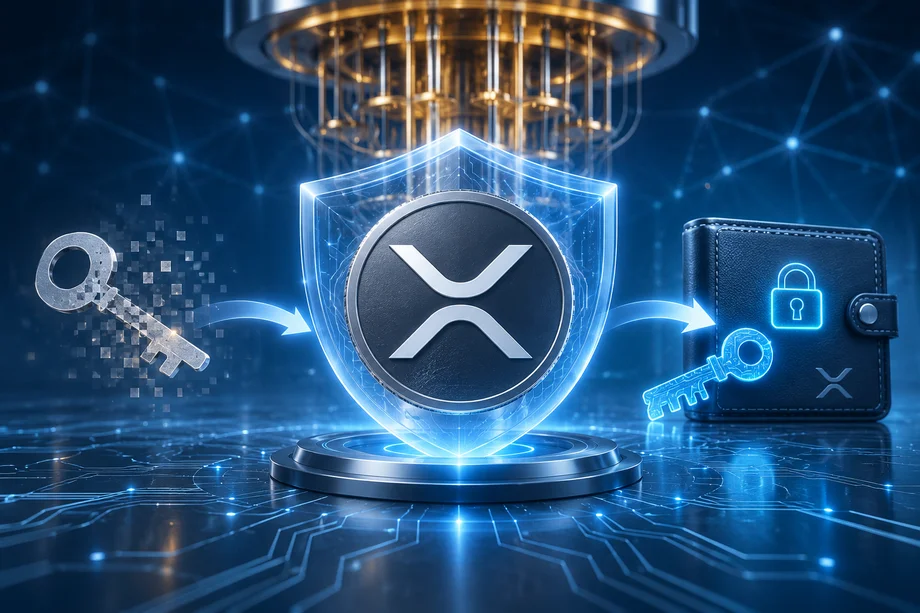
The XRP Ledger Foundation outlines a design allowing users to adopt NIST-approved ML-DSA-44 keys and disable vulnerable credentials, targeting broader protection by 2028 without raising transaction costs
The XRP Ledger Foundation has detailed a proposal to equip user accounts with quantum-resistant signatures, enabling holders to strengthen security against potential future attacks from advanced quantum computers while keeping the network’s base transaction fees unchanged.
The design, included in the Foundation’s updated 2027 protocol roadmap, centers on the ML-DSA-44 digital signature scheme standardized by the U.S. National Institute of Standards and Technology in 2024. Account owners would register a new quantum-resistant signing key and then disable their existing classical master keys. The account address and balances would remain the same, so users would not need to transfer assets to a new wallet.
Why Current Accounts Face Long-Term Risk
On the XRP Ledger, every time an account authorizes a transaction, its public key becomes visible on the blockchain. Current signature methods rely on elliptic-curve cryptography such as secp256k1 and Ed25519. A sufficiently powerful quantum computer running algorithms capable of solving the underlying mathematical problems could, in principle, recover the corresponding private key from that exposed public data.
Any account that has previously sent a payment has already published its public key. The proposed upgrade addresses this permanent exposure by letting owners retire the older credentials once the new key is active. Leaving the original master key enabled would leave an attack path open, so the migration process requires both adding the new key and disabling the old one.
Larger Signatures but Stable Fees
ML-DSA-44 produces substantially larger cryptographic material than the ledger’s current schemes. The public key and signature together occupy 3,732 bytes, compared with roughly 105 bytes for a conventional payment. When transaction history and database overhead are included, the Foundation estimates storage of about 5,331 bytes per protected payment versus a 1,704-byte baseline—roughly three times the current figure.
Despite the increased data size, the proposal leaves the base fee schedule unchanged. XRP Ledger transaction fees are destroyed rather than paid to validators. The additional storage and bandwidth costs would therefore fall on network operators rather than individual users. Developers note that larger payloads will still require evaluation of bandwidth use, signature verification speed, and overall consensus performance.
| Aspect | Current Accounts | After Upgrade |
|---|---|---|
| Signing Method | Elliptic-curve (secp256k1 / Ed25519) | NIST ML-DSA-44 |
| Key + Signature Size | ~105 bytes | 3,732 bytes |
| Estimated Storage per Payment | 1,704 bytes | 5,331 bytes |
| Base Transaction Fee | Standard | Unchanged |
Timeline and Remaining Technical Work
The upgrade remains under development and has not been activated. A migration study is scheduled for the first half of 2027 to examine how existing accounts can transition safely and what steps users would need to take. Development, formal review, and security auditing are expected to follow in late 2027 or 2028.
The Foundation has allocated an estimated $215,000 to $255,000 for technical reviews, an external audit, reference implementation work, and wallet support, in addition to 640 development hours. Across the full set of 24 amendments in the 2027 roadmap, total projected spending ranges from about $5.08 million to $5.74 million.
Technical challenges still need resolution. Differences currently exist in how Python prototypes, server software, and JavaScript implementations generate keys from the same seed. Shared test vectors and consistent key-generation behavior across platforms are required before wider deployment. Full validator performance measurements under quantum-resistant signatures have not yet been published.
The account-level proposal forms part of a wider effort, aligned with Ripple’s stated objective of achieving full quantum-resistant readiness across the XRP Ledger by 2028. That longer-term plan includes algorithm testing, validator benchmarking, and compatible wallet infrastructure. Early adopters are expected to include exchanges, custodians, and institutional holders managing large balances.
Implementation will ultimately depend on validator approval of the relevant amendment, completion of audits, and clear tools that allow users to complete the key migration correctly. Until the classical keys are disabled, accounts that have already transacted remain theoretically exposed to future quantum capabilities.

Disclaimer
This article was generated by AI using information from multiple industry sources. It has not been reviewed or verified by a human editor and may contain inaccuracies, omissions, or misinformation. Readers are encouraged to independently verify any information before making decisions based on its content.Tired of the noise?
Let the bots trade for you.
Trade 24/7, without emotion, with data-driven strategies.
Associated articles

Ripple Maps Four-Stage Path to Shield XRP Ledger From Quantum Risks by 2028

G7 Urges Immediate Shift to Quantum-Resistant Encryption as Crypto Networks Face Upgrade Pressures

AmericanFortress Proposes Quantum-Safe Wallet Scheme Without Fund Migration

Coinbase Urges Immediate Bitcoin Preparations for Quantum Computing Threats

XRP Ledger Developers Propose Zero-Balance Wallets for Stablecoin Use
Latest articles

Alta Secures $80 Million to Develop Blockchain Infrastructure for Banks and Payments

Ripple Prime Leadership Shift: Founder Marc Asch to Depart at Year-End, Noel Kimmel Named Successor

Poland Advances Bill to Include Cryptocurrencies in Sanctions Framework
137 Fake SHIB Tokens Impersonate Ryoshi Deployer to Scam Investors