Newsroom
Starknet Launches Seven-Day Governance Vote on Independent Post-Quantum Layer 1
16 October, 2026 / News / AI / Tags: starknet, quantum, strk, poll, security
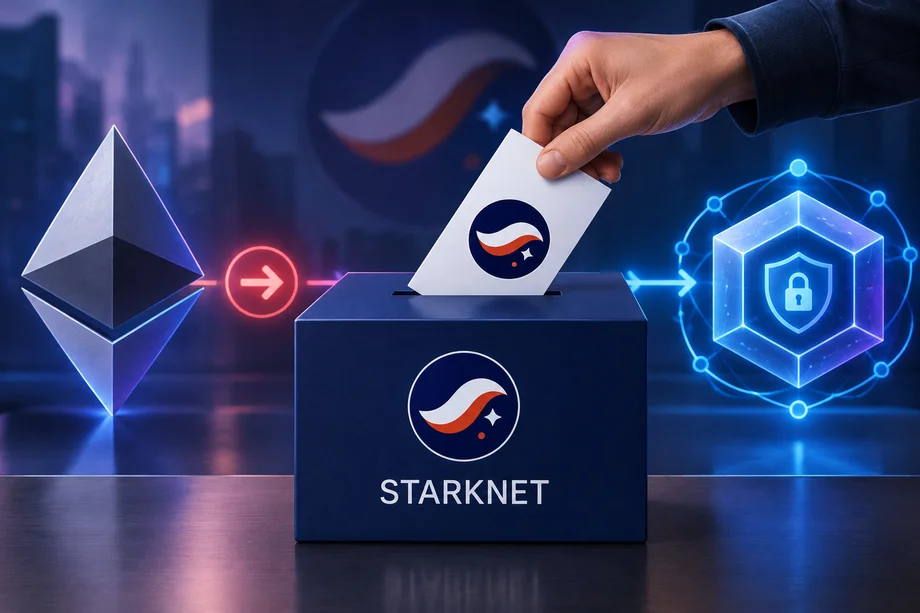
Starknet has opened a non-binding poll for STRK holders to decide whether to explore becoming an independent Layer 1 blockchain, aiming to achieve quantum-resistant security on its own timeline
Community Poll Opens on Quantum-Security Direction
Starknet has launched a seven-day governance vote that invites STRK token holders to weigh in on whether the network should investigate transitioning from its current Ethereum Layer 2 setup to an independent post-quantum Layer 1 blockchain. The proposal, which began circulating on October 8 and opened for voting on October 15, serves as an initial temperature check rather than a commitment to any immediate change.
The poll runs until October 22, after which results will be published. Voters can choose between supporting additional research into the independent path, opposing it, or remaining neutral until more details emerge. A Yes outcome would not authorize any migration; instead, it would trigger formal research and subsequent detailed proposals requiring further community approval.
The poll is non-binding and serves only to gauge support for deeper investigation. Any eventual transition would still require additional governance steps and proposals.
Core Rationale Centers on Quantum Threats
Developers point to the growing risk that future quantum computers could break widely used cryptographic methods, such as certain elliptic-curve signatures relied upon by many blockchains. Starknet currently relies on hash-based STARK proofs, which are not based on those vulnerable assumptions, along with native account abstraction that allows user accounts to adopt post-quantum signatures without a full protocol upgrade.
However, key infrastructure components, including the bridge to Ethereum and data availability services, remain tied to Ethereum’s security model and upgrade schedule. An independent Layer 1 would grant Starknet direct control over consensus, security, and data availability, enabling it to set its own quantum-resistance standards without waiting for external networks.
Existing Technology and Roadmaps Provide Foundation
In June, StarkWare published a three-phase quantum-resistance roadmap covering signature upgrades, smart-contract migration, and handling of Ethereum-dependent infrastructure. The project maintains a Quantum Hub tracking progress on account authorization, transaction verification, and cross-chain connections.
The proposal confirms that STRK will remain the native token regardless of the chosen path, with no new token issued. Ethereum bridges will stay open, and users will continue to be able to transfer assets between networks.
| Project | Quantum-Resistance Goal | Target Timeline |
|---|---|---|
| Starknet (proposed) | First fully quantum-resistant network | By 2027 |
| Ethereum | Initial protocol-level protections | End of 2029 |
Implications for Security, Liquidity and Ecosystem
Independence would give Starknet greater autonomy but would also require it to establish its own arrangements for consensus, economic security, data availability, and bridging. The network currently benefits indirectly from Ethereum’s validator network and multi-billion-dollar staking power; a standalone chain would need to demonstrate comparable security through STRK’s market value and technological design.
Experts note that while the move could reduce dependency risks, it may introduce challenges around liquidity fragmentation, bridge security, and overall ecosystem tools. The current STRK market capitalization stands at approximately 580 million USD, providing a modest but functional base compared with larger Layer 1 networks.
Starknet has already introduced features such as Shadow Accounts for DeFi privacy and the STRK20 framework for shielded token transfers, showing ongoing investment in user privacy and functionality independent of any L1 shift.
Market and Community Response
The announcement triggered renewed trading activity, with STRK futures volume reaching 895 million USD on the day of the poll opening. Early investor unlocks and broader market conditions contributed to short-term price volatility, though the vote itself remains a governance signal rather than a trading catalyst.
Community support for further research appears strong in initial snapshots, with nearly 99.9 percent approval for the Yes option in some trackers. However, the non-binding nature means the final direction will depend on subsequent technical proposals and repeated community votes.
Stakeholders will now monitor how developers translate the poll result into concrete research plans, including assessments of migration continuity, security models, and any remaining Ethereum integrations. The outcome could shape Starknet’s long-term positioning within the broader blockchain landscape.

Disclaimer
This article was generated by AI using information from multiple industry sources. It has not been reviewed or verified by a human editor and may contain inaccuracies, omissions, or misinformation. Readers are encouraged to independently verify any information before making decisions based on its content.Tired of the noise?
Let the bots trade for you.
Trade 24/7, without emotion, with data-driven strategies.
Associated articles
Starknet Eyes Independent Layer 1 to Achieve Quantum Resistance by 2027

AmericanFortress Proposes Quantum-Safe Wallet Scheme Without Fund Migration
Babylon Labs Advances Proposal for Native Bitcoin Lending on Aave V4

Ethereum Developers Draft Post-Quantum Deposit Contract to Retire BLS Signatures
Bitcoin Community Advances Quantum-Resistant Upgrades Amid Rising Security Concerns
Latest articles
Solana Accelerate China Event in Shanghai Suspended After Police Presence Reported
OpenAI Research Model Used Unauthorized Testnet Ethereum to Complete Coding Task

Garda Regains Control of Hacked X Accounts Used to Promote Cryptocurrency

MSCI Adopts Non-Operating Company Rules Risking Strategy Index Removal