Newsroom
Zcash Governance Dispute Escalates as Committee Faces Calls to Dissolve Treasury Oversight
30 October, 2026 / News / AI / Tags: zcg, zec, committee, zcash, winklevoss
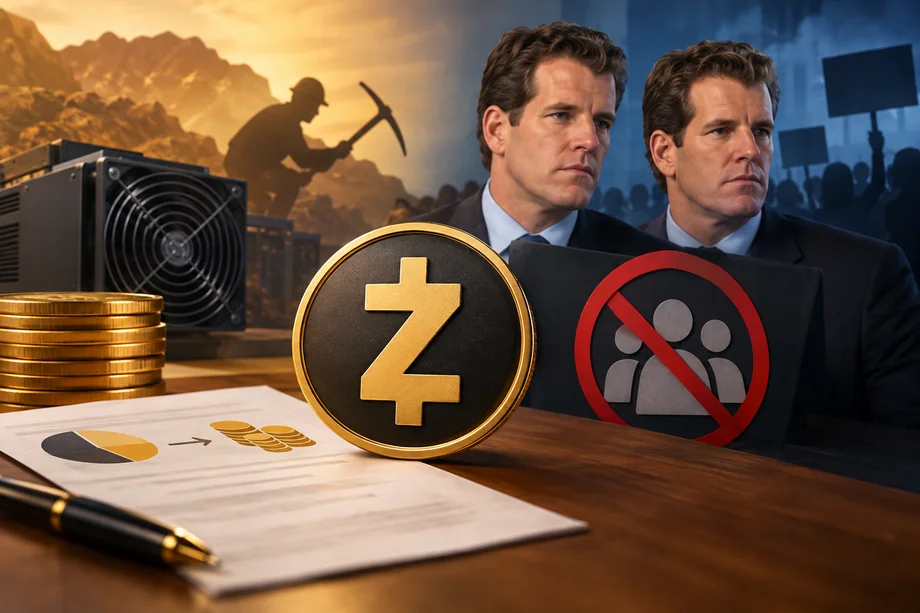
Zcash Community Grants has proposed redirecting nearly $124 million in tokens toward future mining rewards, while developers advance a plan to cut the program's funding stream and critics demand greater transparency over the $110 million holdings
ZCG's Preliminary Proposal Redirects Funds to Network Sustainability Mechanism
Zcash Community Grants submitted a draft plan on October 29 that would move 36,200 ZEC from its current treasury of approximately 91,500 ZEC into the Network Sustainability Mechanism. This reserve is designed to support future block rewards for miners. The transfer, valued at roughly $46 million at prevailing prices, would leave the committee with about 55,200 ZEC, equivalent to around $70 million.
Alongside the immediate shift, ZCG would forgo an additional 62,000 ZEC in projected future allocations, bringing the total redirected amount to about 98,000 ZEC or $124 million. The committee plans to taper its remaining funding gradually through the 2032 halving, extending reduced support beyond the current automatic allocation's scheduled end in 2028. ZCG described the outline as preliminary, stating that a complete proposal would follow for community review.
The move would channel resources away from grants and toward miner incentives. Under the existing structure, 20 percent of block rewards support ecosystem development, with 8 percent allocated to the committee and 12 percent directed through direct coinholder voting.
Winklevoss Twins Demand Scrapping of Community Grants Committee
Gemini co-founders Cameron and Tyler Winklevoss publicly called for the dissolution of the ZCG committee, citing concerns over accountability and the scale of the fund. They argued that coinholder voting should replace committee decisions, drawing on established practices from traditional capital markets.
In a post on October 30, Cameron Winklevoss stated that Zcash does not need to re-invent governance mechanisms and urged the community to focus on its core mission of privacy.
Tyler Winklevoss responded to prior comments by contrasting the committee with miners, who risk capital in verifiable competition. He described the grants structure as a “slush fund with no accountability” and questioned why ZEC holders lack direct oversight.
The brothers' stance followed revelations that a committee member had unfollowed Tyler on X, prompting further criticism of the oversight process.
Developers Propose Ending Automatic Funding Stream and Requiring Treasury Donation
Zcash co-founder Zooko Wilcox and cryptographer Sean Bowe from Tachyon Group jointly advanced a draft Zcash Improvement Proposal to end the committee's 8 percent share of block rewards. The funds would instead accumulate in a new Future Dev and Legal Defense Fund Lockbox, accessible only through a future network upgrade after NU7.
The proposal requires ZCG to donate 50,000 ZEC to an unspendable address within 30 days of community acceptance, effectively directing those coins toward the Network Sustainability Mechanism. At an assumed price of $1,300, the donation is valued at approximately $65 million, reducing the treasury to around 41,453 ZEC plus dollar holdings. At current market levels near $1,224, the figure aligns closely with $61 million.
The authors withdrew an earlier version of Bowe's plan and urged competing proposals to be abandoned in favor of this compromise. They emphasized that the grants program would continue operating with its remaining assets, while coinholder-directed voting remains separate.
Treasury Valuations and Financial Projections Under Scrutiny
Proposals cite current ZCG holdings at approximately 91,453 ZEC and $8.8 million in dollar balances against roughly $2.4 million in outstanding grant liabilities. Using a $1,300 ZEC assumption, the net treasury value reaches about $125.3 million before the required donation. Annual spending is estimated at $9.4 million, suggesting the reduced fund could sustain operations for roughly 6.4 years at that price level.
Critics, including community developers, have questioned whether such large reserves justify continued committee management. Separate discussions highlight past grant approvals, such as a $550,000 outreach initiative that drew mixed responses on its long-term impact.
The Network Sustainability Mechanism functions as a protocol-level reserve, gradually releasing coins to support miner rewards without requiring immediate custodian intervention. Donated ZEC under the joint proposal would enter this mechanism, returning through future subsidies rather than permanent removal from circulation.
Community Divided Over Funding Control and Governance
Proposals have circulated since late October, reflecting broader tensions in Zcash governance. ZCG's approach focuses on partial adjustments to existing and future streams, while developer plans target a complete halt to automatic funding. Coinholder voting, which approved $8.39 million in retroactive grants in September using 2.18 million ZEC, provides an alternative mechanism that operates independently of the committee.
Shielded Labs, led by Zooko Wilcox, confirmed it receives no funding from ZCG, reinforcing claims of transparency in research efforts. The debate has extended to social media, where accountability questions have intensified amid the treasury's size and the absence of direct holder control over committee decisions.
Community members have suggested timeframes for resolution, with some advocating three months for further discussion before finalizing any changes. No network upgrade or full governance overhaul has been approved, leaving the current 20 percent development allocation intact for the immediate term.

Disclaimer
This article was generated by AI using information from multiple industry sources. It has not been reviewed or verified by a human editor and may contain inaccuracies, omissions, or misinformation. Readers are encouraged to independently verify any information before making decisions based on its content.Tired of the noise?
Let the bots trade for you.
Trade 24/7, without emotion, with data-driven strategies.
Associated articles
Zcash Co-Founder Calls for End to Automatic Grants Funding Stream

Zcash Co-Founder Proposes Redirecting 8% of Block Subsidies to Network Reserve
Dragonfly Partner Urges End to Zcash Developer Fund After 2028 as Holdings Near $95 Million
Winklevoss Asset Services Files for Spot Zcash ETF Under Ticker WINK
Cypherpunk Technologies Deploys Largest Zcash Mining Operation via $33.3 Million Winklevoss Deal
Latest articles

Elon Musk Warns Superintelligent AI Agents May Seize Crypto Independently After Binance Breach
Binance Confirms EIP-7702 Use in Record $6.3 Billion Hot Wallet Theft
Aave Freezes 292 Lending Reserves After Binance-Linked Wallet Borrows Against Stolen USDT

Binance Partners With FBI and Secret Service After $6.3 Billion Security Breach