Newsroom
Oracle Connects Banks to SWIFT Blockchain Ledger for Tokenized Payments
29 September, 2026 / News / AI / Tags: swift, oracle, banks, ledger, coordination
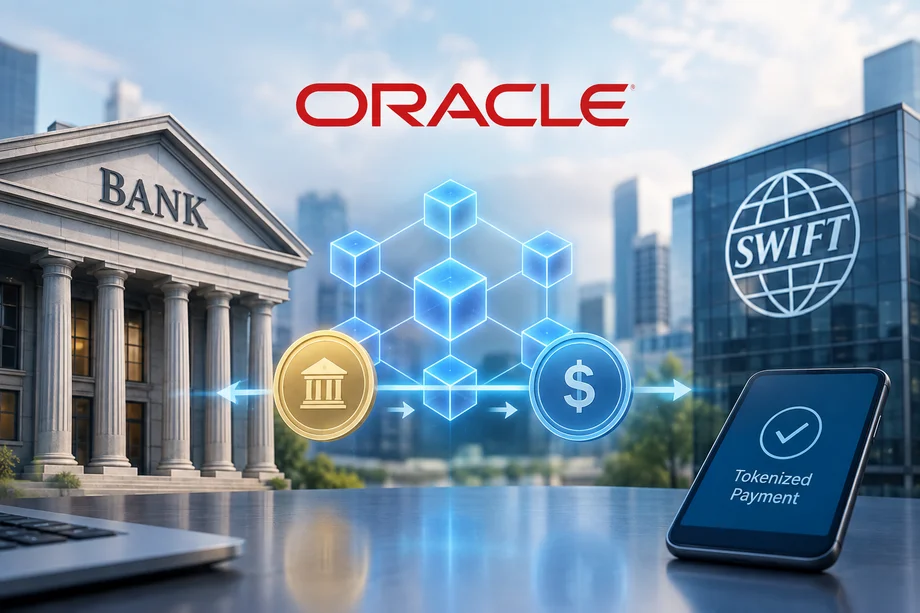
Oracle has integrated its Blockchain Platform with SWIFT’s shared ledger, allowing financial institutions to link existing payment systems and tokenized deposits to cross-border flows while retaining full control over their infrastructure
Oracle Bridges Traditional Banking Infrastructure with SWIFT’s Coordination Layer
Oracle Corporation has introduced an integration between its Blockchain Platform and SWIFT’s blockchain-based ledger. The development enables banks to connect their tokenized deposit systems directly to SWIFT’s shared coordination infrastructure. This approach lets institutions manage both conventional payments and digital asset flows within a unified framework without replacing core banking systems.
Final settlement continues on established rails such as real-time gross settlement or correspondent banking. The integration synchronizes events between the ledger, tokenized deposits, wallets, and existing payment processing, providing a hybrid model that reduces operational disruption.
Oracle announced the capability during Sibos 2026 in Miami. It builds on an earlier Swift Compatible Application certification for payments technology. Several Oracle components, including support for custodial wallets, smart contracts, and event orchestration, remain scheduled for full deployment in fiscal year 2027 and are subject to change.
SWIFT Ledger Moves to Global Pilot Phase
SWIFT announced in July 2026 that its blockchain ledger is ready for initial deployment. Seventeen banks across six continents are now preparing to test live transactions involving tokenized deposits. The system is designed to support round-the-clock cross-border payments and address liquidity constraints created by traditional settlement windows.
SWIFT’s network already connects more than 11,500 institutions across over 200 countries. It delivers 75 percent of payments to destination banks within 10 minutes. The ledger functions as a shared coordination layer where tokenized deposits from different banks can meet for inter-institution payments. Banks continue to manage their own tokenized assets on their systems while routing coordination through the ledger.
Technical Features Supporting Enterprise-Grade Adoption
Oracle’s solution incorporates its Blockchain Platform, Digital Assets Data Nexus, and Oracle Banking Payments. These components handle SWIFT commitment contracts, signing processes, smart contracts, and ISO 20022-based payment instructions. Payment status updates flow back to existing systems, allowing banks to avoid building parallel processes for digital assets.
The Digital Assets Data Nexus adds AI-enabled oversight, configurable wallet and smart-contract controls, KYC and KYB checks, and AML screening. These tools support a growing range of assets, including tokenized deposits, stablecoins, and potential central bank digital currencies, while preserving bank control over liquidity and risk.
The integration maintains final settlement on traditional rails. This design lowers risk for banks by layering coordination on top of systems already familiar to regulators and risk teams.
| Capability | Description |
|---|---|
| Tokenized Deposit Management | Bank-managed wallets and infrastructure connected via ISO 20022 standards |
| Cross-Bank Coordination | SWIFT ledger as shared layer for payment commitments |
| Settlement | Traditional RTGS or correspondent banking rails |
| Compliance | AI oversight, KYC/KYB, AML screening within Digital Assets Data Nexus |
Ripple’s Expanding Institutional Strategy and Interoperability
The Oracle-SWIFT integration occurs against a backdrop of intense interest in cross-border value transfer from multiple vendors. Ripple has broadened its offerings beyond XRP-based payments to include custody services, its RLUSD stablecoin, treasury management, and prime brokerage. This positions Ripple deeper within the financial infrastructure banks are modernizing.
Ripple Payments supports interoperability with SWIFT messaging systems. Financial institutions can combine blockchain settlement with existing communication protocols without abandoning traditional infrastructure. This collaborative approach contrasts with purely competitive narratives between the two entities and offers banks flexible pathways for adoption.
Broader Implications for Global Banking and Digital Asset Integration
The development reflects a broader industry shift toward hybrid payment architectures. Banks can incorporate programmable money and regulated digital assets into workflows that already support 24/7 operations. SWIFT itself views the ledger as potential infrastructure for these future forms of digital value.
By connecting to the existing SWIFT network, Oracle’s solution provides an immediate global distribution path. Institutions already linked to the 11,500-plus member network can test tokenized flows without building separate blockchain infrastructure from scratch. The model emphasizes practical adoption, preserving bank control while enabling smoother cross-border coordination.
Ongoing pilots will determine the pace of real-world uptake. The integration provides banks with a trusted bridge between legacy systems and blockchain coordination, aligning with regulatory expectations for secure and compliant digital asset handling.

Disclaimer
This article was generated by AI using information from multiple industry sources. It has not been reviewed or verified by a human editor and may contain inaccuracies, omissions, or misinformation. Readers are encouraged to independently verify any information before making decisions based on its content.Tired of the noise?
Let the bots trade for you.
Trade 24/7, without emotion, with data-driven strategies.
Associated articles

Taurus Connects Tokenization Platforms to Swift Blockchain Ledger for Bank Tokenized Deposits

IBM Connects Digital Asset Haven to Swift Blockchain for Tokenized Deposits

HSBC and Standard Chartered Complete First Live Tokenized Deposit Deal on Swift Ledger

Mastercard Completes $1.8 Billion BVNK Acquisition to Link Crypto and Traditional Payments
Chainlink Partners With Bottomline to Open Blockchain Settlement for 600-Plus Banks
Latest articles

SkyAI Exits Solana Holdings Completely, Launches $201 Million Share Buyback

Strategy Buys 267 Bitcoin and Raises Preferred Share Buyback Cap to $3 Billion

Dormant 2013 Bitcoin Wallets Shift Over $67 Million After More Than a Decade

Binance Rolls Out AI Pro Tool for Chat-Based Automated Trading Strategies