Newsroom
Greece Joins EU Crypto Rules With Four Providers
29 September, 2026 / News / AI / Tags: greece, hellenic, xenios, bcash, piraeus
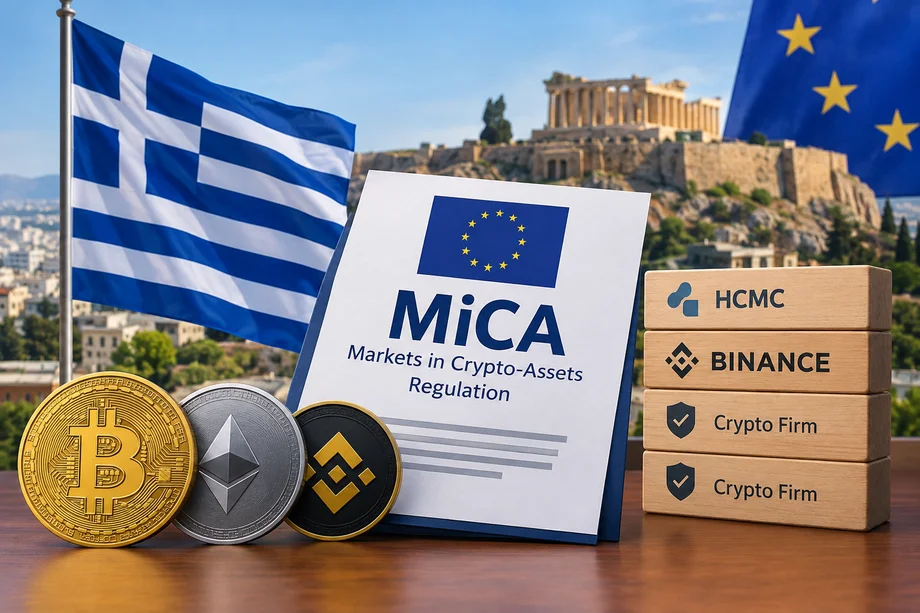
Four crypto firms have appeared on the European register as Greece marks its first entry under the bloc’s markets in crypto-assets framework
Greece Makes First Appearance in EU Register
Greece has become the latest member state to participate in the European Union’s crypto-asset regulatory framework. On September 24, the European Securities and Markets Authority updated its register with four Greek providers, the country’s initial entries.
The additions bring the total number of unique crypto-asset service providers listed across the EU to 359. Six other entities from Germany, France and Slovenia also joined the latest batch.
BCash, Xenios Blockchain Group, Capital Wallet Greece and Piraeus Bank now appear on the register. This development marks Greece’s formal integration into the Markets in Crypto-Assets regulation.
Authorized Services for Each Provider
BCash received approval on June 30 for crypto-to-fiat exchange services. Xenios Blockchain Group and Capital Wallet Greece were authorized on July 22.
Xenios Blockchain Group can receive and transmit crypto-asset orders for clients. Capital Wallet Greece offers custody, crypto-to-fiat exchanges, crypto-to-crypto exchanges, order execution, reception and transmission of orders, and crypto-asset transfers.
Piraeus Bank secured authorization on August 7 from the Bank of Greece. The lender’s permitted activities cover custody and administration of crypto-assets, order execution, reception and transmission of orders, and crypto-asset transfers.
Division of Oversight Between Regulators
Greece has assigned responsibilities for the new providers between two national authorities. The Hellenic Capital Market Commission serves as the competent authority for BCash, Xenios Blockchain Group and Capital Wallet Greece.
The Bank of Greece acts as the competent authority for Piraeus Bank. This arrangement reflects the MiCA framework’s allowance for member states to designate multiple competent authorities and allocate regulatory tasks accordingly.
| Provider | Competent Authority |
|---|---|
| BCash | Hellenic Capital Market Commission |
| Xenios Blockchain Group | Hellenic Capital Market Commission |
| Capital Wallet Greece | Hellenic Capital Market Commission |
| Piraeus Bank | Bank of Greece |
HCMC Denies Reports of Lagarde Intervention
The Hellenic Capital Market Commission has issued a formal denial regarding claims that European Central Bank President Christine Lagarde intervened to block Binance’s application for authorization in Greece.
The commission stated that no official made the reported remarks and that it received no communication about the application from Prime Minister Kyriakos Mitsotakis, his office, the Finance Ministry or other government officials.
When pressed on whether the denial extended to claims involving a vice chair of the commission, the commission confirmed that it did.
Binance withdrew its MiCA application with the Hellenic Capital Market Commission on June 24, before any formal decision was issued. The exchange has since indicated it will pursue authorization through a different European Union member state.
The European Central Bank and the office of Prime Minister Mitsotakis declined to comment on the matter.
MiCA Framework and EU-Wide Access
MiCA establishes harmonized rules for the authorization, supervision, transparency and disclosure of crypto-asset services across the European Union. Authorized providers can offer approved services in other member states after meeting notification requirements.
The transitional period for the regulation ended on July 1, 2026. Providers that had operated under national rules continued until they received authorization or until that date, whichever came first.
The updated register demonstrates continued expansion of the framework. Providers listed can now operate under the EU passporting system, enabling cross-border services once notified.
Disclaimer
This article was generated by AI using information from multiple industry sources. It has not been reviewed or verified by a human editor and may contain inaccuracies, omissions, or misinformation. Readers are encouraged to independently verify any information before making decisions based on its content.Tired of the noise?
Let the bots trade for you.
Trade 24/7, without emotion, with data-driven strategies.
Associated articles
ECB Chief Reportedly Intervened to Halt Binance's EU Crypto License Bid in Greece

Hungary Scraps Crypto Validator Rules as First MiCA License Issued

EU Banks Nearly Double on MiCA Register, Share Hits Nearly 23%

EU MiCA Deadline Sparks Crypto Platform Exits and Surge in Migration Scams

Aave Labs Gains UK FCA Approval for Crypto Payment Expansion
Latest articles

SkyAI Exits Solana Holdings Completely, Launches $201 Million Share Buyback

Strategy Buys 267 Bitcoin and Raises Preferred Share Buyback Cap to $3 Billion

Dormant 2013 Bitcoin Wallets Shift Over $67 Million After More Than a Decade

Binance Rolls Out AI Pro Tool for Chat-Based Automated Trading Strategies