Newsroom
IBM Connects Digital Asset Haven to Swift Blockchain for Tokenized Deposits
25 September, 2026 / News / AI / Tags: ibm, swift, tokenized, banks, ledger
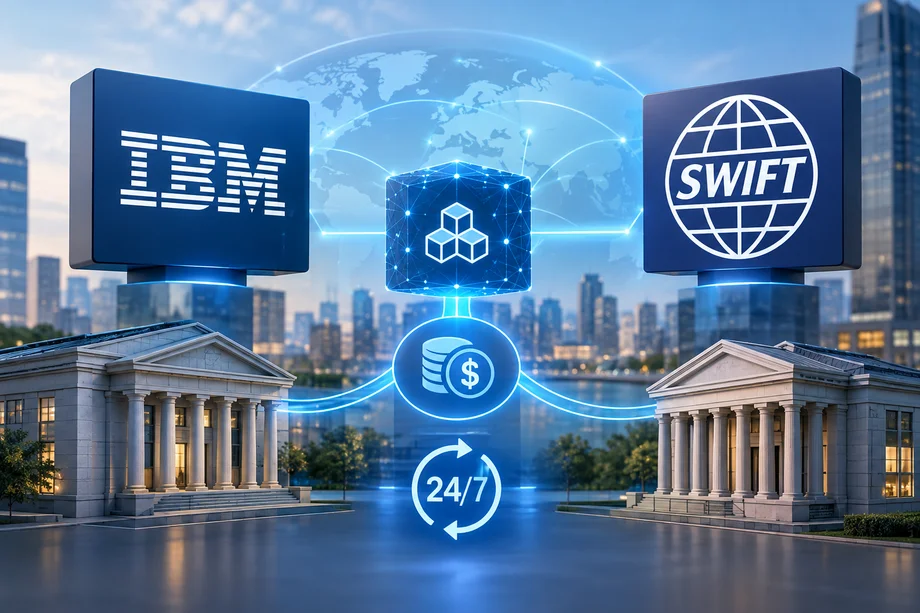
IBM has integrated its Digital Asset Haven platform with Swift’s blockchain ledger, enabling banks to manage tokenized deposit transactions using existing payment messaging while supporting round-the-clock operations and keeping sensitive operations on-premises
Integration Bridges Traditional Banking and Digital Assets
IBM announced the connection between Digital Asset Haven and Swift’s shared ledger on September 24, 2026, through a beta ISO 20022 messaging adapter. The tool allows participating financial institutions to instruct tokenized deposit transactions via standard payment formats already embedded in their core systems. This setup lets banks coordinate digital asset movements on the ledger while completing final settlement through conventional banking infrastructure.
Swift’s architecture separates execution on the blockchain from legal finality in established systems. The ledger records interbank payment commitments and operates on an Ethereum Virtual Machine-compatible framework built on Hyperledger Besu. Participating banks retain control of their assets, funding, and keys throughout the process.
The integration builds on IBM’s existing Digital Asset Haven platform, originally launched in October 2025 to support wallet management, transaction orchestration, governance, and key protection across public and private blockchains. The new adapter extends these capabilities without requiring institutions to overhaul their payment workflows or compliance procedures.
Seventeen Banks Advance Tokenized Deposit Tests
Swift launched its blockchain ledger in July 2026 after nine months of development with more than 40 institutions. Seventeen banks from six continents are now preparing live tokenized deposit transactions. The group includes ANZ, BNP Paribas, BNY, Citi, DBS, First Abu Dhabi Bank, FirstRand, HSBC, Itaú Unibanco, Lloyds Bank, Mashreq, MUFG, OCBC, Standard Chartered, UBS, UOB, and Wells Fargo.
The initial focus centers on 24/7 cross-border payments using bank-issued tokenized deposits. In August, HSBC and Standard Chartered completed the first live interbank transaction on the ledger. Earlier, Taurus, a digital asset infrastructure provider, integrated its custody and tokenization services with the same network, providing additional access routes for banks.
Tokenized deposits issued directly by banks differ from stablecoins, which represent claims on non-bank issuers. The Swift ledger coordinates commitments while banks maintain their existing compliance processes and payment applications.
On-Premises Beta Keeps Operations Secure
Alongside the Swift connection, IBM opened a beta for Digital Asset Haven on IBM Z and LinuxONE hardware. This on-premises deployment lets regulated institutions run the full platform—including stablecoins, tokenized deposits, and other digital assets—entirely within their own data centers. Private keys stay under client control and are protected by embedded Crypto Express hardware security modules.
Confidential computing and environment partitioning isolate production, testing, and development systems. The platform also supports IBM Offline Signing Orchestrator for cold-storage operations and structured key ceremonies for generating root certificate authority keys with audit documentation. The same architecture, APIs, and workflows used in SaaS and Hybrid SaaS versions remain available, enabling seamless transitions between deployment models.
IBM states that qualifying configurations can reach 99.999999% availability, though results depend on the specific hardware and software setup. Institutions can join the waitlist to access the beta, which targets banks, governments, and other regulated entities already operating on mainframe systems.
Payments Modernization Drives Industry Adoption
Three-quarters of financial institutions are modernizing their payments infrastructure, according to J.P. Morgan Payments. Demand for tokenized assets has grown rapidly, with tokenized treasuries and cash equivalents surpassing $7 billion by September 2026 compared with less than $2 billion at the start of 2024.
Tom McPherson, general manager of IBM Z and LinuxONE, noted that the financial services industry is entering an era where tokenized and traditional assets must operate alongside one another. The new IBM-Swift integration and on-premises option are designed to give regulated institutions greater control over digital asset operations while preserving their existing operational frameworks.
IBM plans to begin beta testing with select banks in the fourth quarter of 2026. The Swift ledger will be discussed in more detail at Sibos 2026, where sessions will cover interoperable tokenized money, transaction capabilities, and the implementation roadmap.
| Platform | Deployment | Main Feature |
|---|---|---|
| IBM Swift Ledger | On-premises | Institution-grade tokenized payments with ISO 20022 integration |
| Fireblocks | Cloud-native | MPC custody, multi-asset support |
| Metaco | Cloud-native | Digital asset custody for institutions |
Bank Money Meets Digital Networks
The announcement positions tokenized deposits as a new form of commercial bank money, distinct from stablecoins. By connecting Digital Asset Haven to Swift’s ledger, IBM helps institutions explore programmable settlement and intraday liquidity while relying on familiar messaging standards. The move supports compliance with data residency and audit requirements without forcing wholesale changes to core banking systems.
Banks participating in the pilot can now test 24/7 transfers on the ledger before final settlement occurs on existing rails. The integration also opens pathways for interoperability between permissioned banking networks and public blockchains, including Ethereum.

Disclaimer
This article was generated by AI using information from multiple industry sources. It has not been reviewed or verified by a human editor and may contain inaccuracies, omissions, or misinformation. Readers are encouraged to independently verify any information before making decisions based on its content.Tired of the noise?
Let the bots trade for you.
Trade 24/7, without emotion, with data-driven strategies.
Associated articles

HSBC and Standard Chartered Complete First Live Tokenized Deposit Deal on Swift Ledger

Taurus Connects Tokenization Platforms to Swift Blockchain Ledger for Bank Tokenized Deposits
Oracle Connects Banks to SWIFT Blockchain Ledger for Tokenized Payments
Citi and DBS Complete First Weekend Tokenized USD Payment via Swift Ledger

SWIFT Launches Blockchain Ledger for Tokenized Deposit Pilot with 17 Banks
Latest articles
Babylon Labs Advances Proposal for Native Bitcoin Lending on Aave V4

TSMC Posts Record Q3 Profit Surge on AI Chip Demand, Lifts Full-Year Outlook

ASIC Opens Consultation on Capital and Custody Rules for Digital Asset Platforms

GTA 6 Leaker Cyberleek Drops Full Build Plan After Memecoin Collapse, Activates Dead Man’s Switch Threat