Newsroom
Chainlink Partners With Bottomline to Open Blockchain Settlement for 600-Plus Banks
4 September, 2026 / News / AI / Tags: bottomline, chainlink, swift, banks, messaging
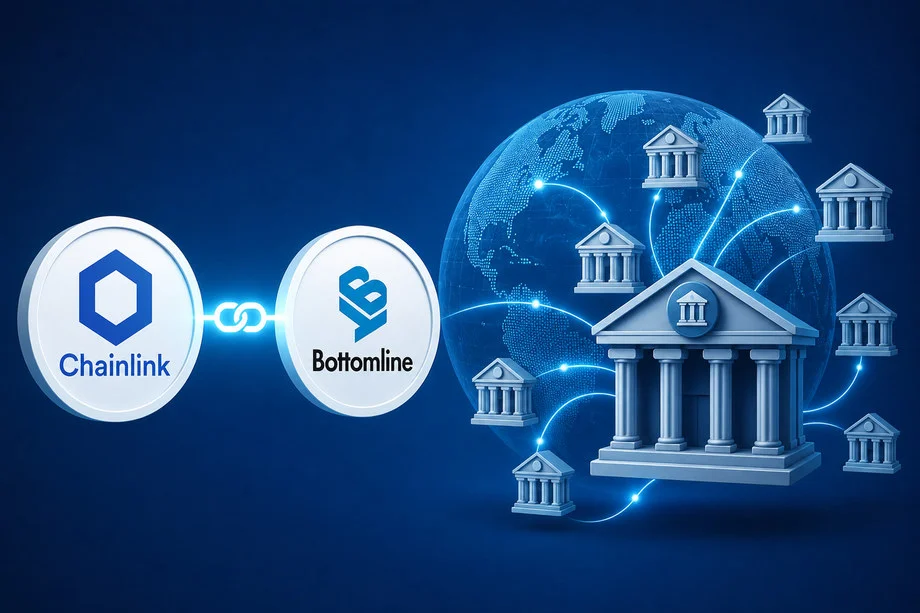
Top SWIFT service provider Bottomline links its $16 trillion payments network to Chainlink infrastructure, letting banks access cross-chain rails while keeping ISO 20022 messaging
Bottomline, one of the three largest providers of SWIFT services, has entered a strategic partnership with Chainlink to give its banking clients a direct route to blockchain-based cross-border and cross-chain payments. The arrangement was announced on September 3, 2026, and centers on connecting Bottomline’s existing payment systems to both public and private blockchains through Chainlink technology.
Bottomline processes more than $16 trillion in payments each year across its platforms. The company serves over 600 banks, approximately 1,200 financial institutions and 10,000 businesses in 92 countries. Its SWIFT connectivity division ranks among the world’s largest service bureaus and handles around 10 million transactions daily. According to company figures, roughly 15 percent of international cross-border transactions on the SWIFT network move through Bottomline’s systems.
How the Integration Works
Under the partnership, participating banks can continue issuing payment instructions in the ISO 20022 format already used across traditional finance. Chainlink’s infrastructure then links those instructions to blockchain settlement. Two Chainlink components carry out the core functions: the Cross-Chain Interoperability Protocol, known as CCIP, moves tokenized value securely across different networks, while the Chainlink Runtime Environment, or CRE, coordinates the full payment workflow from initiation through settlement and operational routing.
The design provides a single, network-agnostic connection rather than requiring separate integrations for each blockchain. Banks therefore retain their current messaging and operational processes while gaining the option to settle on public or permissioned chains. CCIP has been active on mainnet since July 2023 and now links more than 60 blockchain networks.
Scale and Current Status
The partnership creates the technical pathway for blockchain settlement but does not automatically shift Bottomline’s entire payment volume onto distributed ledgers. No specific transaction volumes, fee structures, implementation timelines or lists of participating banks have been disclosed. Individual institutions will decide whether and how extensively to use the new rails. At present the initiative remains at the stage of providing the connection rather than reporting live production volumes equal to the full $16 trillion annual flow.
Bottomline is owned by private-equity firm Thoma Bravo. Its position as a major SWIFT service bureau gives the collaboration reach into an established network of regulated institutions that already handle large institutional payment flows.
Broader Institutional Context
The Bottomline agreement fits into a series of Chainlink engagements with traditional financial infrastructure. Project Pangea involves more than 50 banking institutions across Europe and South Korea that collectively manage over $10 trillion in assets and is focused on same-day foreign-exchange settlement. Separate work has included collaborations with JPMorgan Chase, UBS, ANZ Bank, the Hong Kong Monetary Authority and others on tokenized assets, cross-chain settlement and connections between existing systems and blockchain networks. SWIFT itself has previously tested Chainlink technology for transferring tokenized value while preserving familiar messaging systems.
Cross-border payments remain a primary focus. Such transfers can still require several days to settle and may incur fees exceeding 5 percent of the transfer value as they pass through multiple intermediary banks. The partnership aims to offer an alternative settlement path that keeps banks’ existing controls, visibility and governance frameworks intact.
Industry projections cited in related reporting estimate that the tokenized-asset market could reach roughly $16 trillion by 2030, while cross-border payment volumes are forecast to expand substantially over the same period. The Bottomline integration supplies one additional technical route for institutions exploring those markets without replacing core banking systems.
Market Response
Following the announcement, Chainlink’s LINK token traded higher. Prices were reported in the range of approximately $11.88 to $11.96, reflecting gains of roughly 6 to 7 percent over 24 hours amid rising trading volume. Circulating supply stood near 748 million tokens out of a maximum of 1 billion. Separate developments, including the listing of LINK on certain brokerage platforms, occurred around the same period.
The partnership itself does not guarantee proportional demand for the token from the full payment volume processed by Bottomline. Actual usage will depend on how many of the 600-plus banking clients elect to route activity through the new connection and on the commercial terms ultimately agreed.
Colin Swain, Bottomline’s Global Head of Product for Corporate Solutions, has previously noted that finance teams adopt new payment methods only when those methods deliver the same visibility, controls and governance they obtain from existing processes. The current architecture is structured to meet that requirement by leaving the ISO 20022 messaging layer in place while Chainlink handles the blockchain components underneath.
Banks, payment providers and regulators will ultimately determine the extent of adoption. The technical link now exists between one of the largest SWIFT service networks and Chainlink’s interoperability and orchestration layers, giving more than 600 banking customers the option to explore on-chain settlement without abandoning the systems they already operate.

Disclaimer
This article was generated by AI using information from multiple industry sources. It has not been reviewed or verified by a human editor and may contain inaccuracies, omissions, or misinformation. Readers are encouraged to independently verify any information before making decisions based on its content.Tired of the noise?
Let the bots trade for you.
Trade 24/7, without emotion, with data-driven strategies.
Associated articles

Oracle Connects Banks to SWIFT Blockchain Ledger for Tokenized Payments
Infosys Teams With Chainlink to Expand Institutional Onchain Finance
IBM Connects Digital Asset Haven to Swift Blockchain for Tokenized Deposits

SWIFT Launches Blockchain Ledger for Tokenized Deposit Pilot with 17 Banks

Taurus Connects Tokenization Platforms to Swift Blockchain Ledger for Bank Tokenized Deposits
Latest articles

SkyAI Exits Solana Holdings Completely, Launches $201 Million Share Buyback

Strategy Buys 267 Bitcoin and Raises Preferred Share Buyback Cap to $3 Billion

Dormant 2013 Bitcoin Wallets Shift Over $67 Million After More Than a Decade

Binance Rolls Out AI Pro Tool for Chat-Based Automated Trading Strategies