Newsroom
HSBC and Standard Chartered Complete First Live Tokenized Deposit Deal on Swift Ledger
19 August, 2026 / News / AI / Tags: swift, hsbc, chartered, tokenized, banks

The banks executed a cross-border payment using tokenized deposits on Swift’s new blockchain system, advancing 24/7 interbank settlement while keeping traditional controls intact
HSBC and Standard Chartered have carried out the first live interbank transaction on Swift’s blockchain-based ledger. The deal involved the exchange of payment messages between the two institutions, with resulting obligations recorded as tokenized deposits on each bank’s separate infrastructure before final settlement through existing systems.
Swift’s ledger served as an orchestration layer that matched and netted the obligations. It did not issue or hold the tokens. The arrangement demonstrated that bank-issued digital money can move across independent platforms while remaining within established regulatory, compliance and risk frameworks.
Transaction Details and Mechanics
Payment messages passed through the Swift ledger. Once matched and netted, the obligations were booked on HSBC’s Tokenised Deposit Service and on Standard Chartered’s own tokenized-deposit platform. Final value transfer occurred via the banks’ conventional settlement rails.
The process supports continuous availability rather than the batch windows and correspondent-account chains that have long characterized cross-border payments. By enabling simultaneous debits and credits on a shared ledger, the design aims to reduce the liquidity that banks must lock up at each step of a multi-hop transfer.
Sun added that the pilot addresses practical corporate needs such as moving liquidity globally, improving cash visibility and simplifying the frictions that arise from legacy cross-border systems.
Context of the Swift Pilot
The transaction occurred roughly one month after Swift declared its ledger ready for initial live use. Seventeen banks spanning six continents had signed up to test tokenized-deposit payments. Among them are Citi, BNP Paribas, BNY, Wells Fargo, UBS, MUFG, DBS and ANZ.
Swift processes more than 53 million financial messages daily and supports over 11,500 institutions. Its established network is viewed by participants as a potential catalyst for broader adoption of tokenized deposits, given the scale of existing connectivity.
Mallela described tokenized deposits and stablecoins as complementary. He expects tokenized deposits to dominate wholesale institutional settlement by value within five years, while stablecoins serve retail, remittance and consumer corridors.
Broader Industry Efforts
Banks have expanded their own tokenized-deposit offerings in parallel. HSBC has rolled out its service in Hong Kong, Singapore, the United Kingdom and Luxembourg and has begun offering it to corporate clients in the United States. Standard Chartered has taken part in multi-currency real-value settlement trials under the Bank for International Settlements’ Project Agorá.
Separately, a payments operator owned by major U.S. banks is reported to be preparing a tokenized-deposit network for launch in the first half of 2027 that would link traditional rails with digital-asset infrastructure for continuous settlement.
Executives at participating institutions stress that the shared-ledger approach preserves the supervisory perimeter already applied to commercial-bank deposits. The HSBC–Standard Chartered exchange supplies the first concrete live example of interbank interoperability on the Swift platform, offering a reference point for the remaining pilot banks as they prepare their own transactions.
Disclaimer
This article was generated by AI using information from multiple industry sources. It has not been reviewed or verified by a human editor and may contain inaccuracies, omissions, or misinformation. Readers are encouraged to independently verify any information before making decisions based on its content.Tired of the noise?
Let the bots trade for you.
Trade 24/7, without emotion, with data-driven strategies.
Associated articles
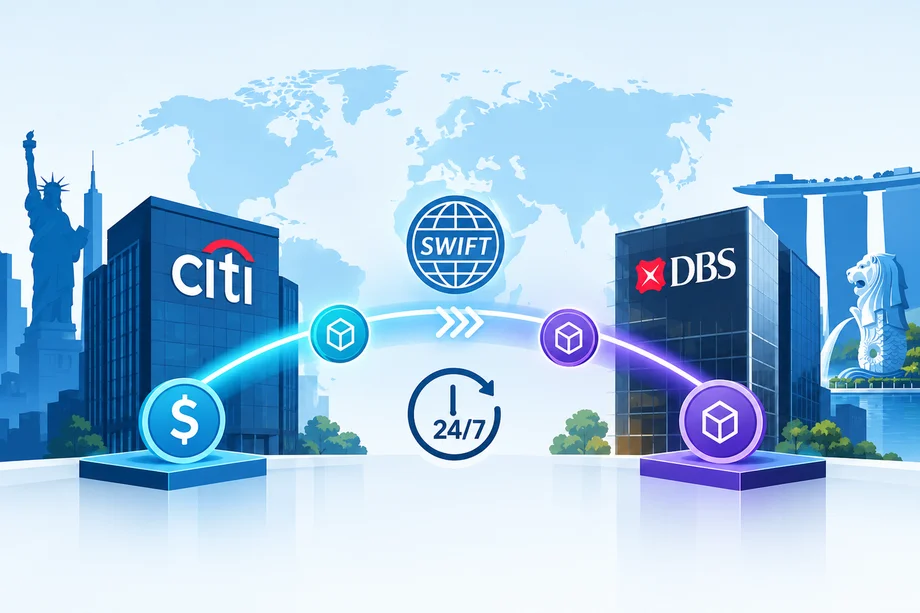
Citi and DBS Complete First Weekend Tokenized USD Payment via Swift Ledger

SWIFT Launches Blockchain Ledger for Tokenized Deposit Pilot with 17 Banks

Taurus Connects Tokenization Platforms to Swift Blockchain Ledger for Bank Tokenized Deposits

IBM Connects Digital Asset Haven to Swift Blockchain for Tokenized Deposits

The Clearing House Selects Quant for US Tokenized Deposit Network
Latest articles

SpaceX and Tesla Set Up Committees to Explore Merger That Would Combine Holdings of Over 30,000 Bitcoins

UK Banks Face Thousands of Complaints Over Crypto Transfer Restrictions

Ripple Backs SEC Proposed Crypto Asset Rules After $150 Million Legal Battle

Blockchain.com Introduces Options Trading on Seven Major Crypto Assets