Newsroom
JPMorgan, Mastercard and Ripple Achieve Historic Cross-Border Tokenized Treasury Settlement on XRP Ledger
8 May, 2026 / News / AI / 356 reads / Tags: tokenized, kinexys, ondo, jpmorgan, mastercard
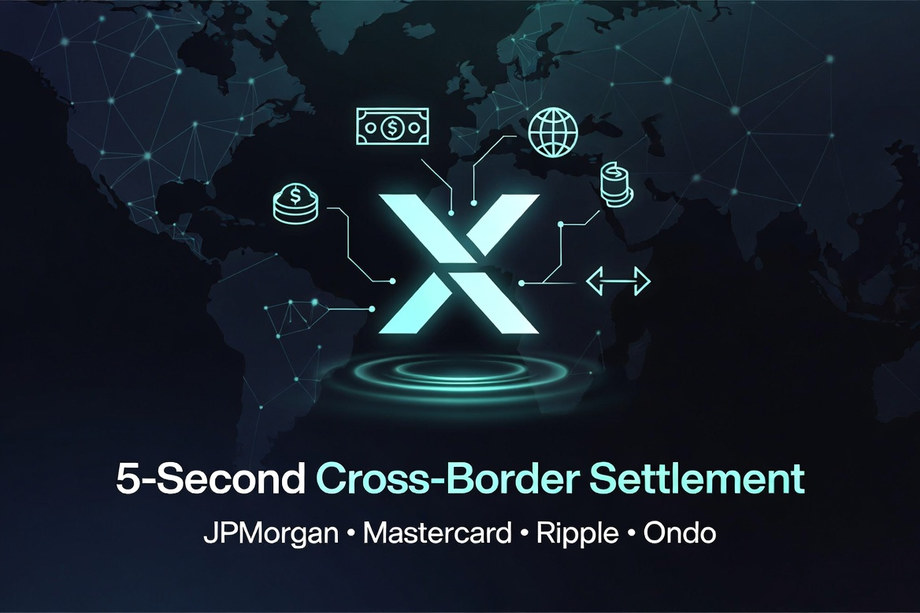
Pilot demonstrates near real-time redemption of tokenized US Treasuries across public blockchain and banking rails in under 5 seconds
- Ondo Finance
- JPMorgan Kinexys
- Mastercard MTN
- Ripple / XRPL
- Under 5-second settlement
- Cross-border to Singapore
- Outside traditional banking hours
- Hybrid blockchain + fiat rails
In a significant milestone for tokenized real-world assets, Ondo Finance, JPMorgan’s Kinexys platform, Mastercard’s Multi-Token Network, and Ripple have successfully completed the first cross-border, cross-bank redemption of a tokenized US Treasury fund using the XRP Ledger.
The pilot transaction involved Ripple redeeming holdings of Ondo’s Short-Term US Government Treasuries (OUSG) directly on the XRP Ledger. Mastercard’s infrastructure routed settlement instructions to JPMorgan’s Kinexys, which executed the fiat leg by delivering US dollars to Ripple’s bank account in Singapore. The entire process occurred in near real-time and outside conventional banking windows.
Technical Execution and Hybrid Model
Ondo processed the redemption of tokenized OUSG on the public XRP Ledger. Mastercard’s Multi-Token Network served as the critical interoperability layer, translating on-chain events into instructions for traditional banking systems. JPMorgan’s Kinexys platform then handled the corresponding USD settlement through established correspondent banking channels.
This hybrid approach—leveraging public blockchain for asset representation while utilizing regulated banking rails for final fiat settlement—demonstrates a practical pathway for institutional adoption of tokenized assets. The transaction completed in under five seconds, highlighting substantial improvements in speed and efficiency compared to traditional cross-border processes that often take days.
Broader Context in Tokenization Boom
Tokenized US Treasuries have emerged as one of the fastest-growing segments in real-world asset (RWA) tokenization. OUSG, launched by Ondo in 2023, has expanded across multiple blockchains including Ethereum, Polygon, Solana, and now prominently features on the XRP Ledger, with approximately $610 million in total value locked.
The pilot builds upon previous collaborations, including a 2025 test between JPMorgan and Ondo that moved tokenized Treasuries between public and permissioned blockchains. It underscores increasing convergence between traditional finance and blockchain technology, with major institutions exploring 24/7 settlement capabilities.
| Aspect | Traditional Settlement | This Pilot |
|---|---|---|
| Time | 1-3 business days | Under 5 seconds |
| Operating Hours | Banking hours only | 24/7 capable |
| Infrastructure | Correspondent banks | Hybrid XRPL + Kinexys |
Implications for Global Finance
This collaboration signals accelerating institutional interest in tokenized assets. With tokenized RWAs (excluding stablecoins) already surpassing $30 billion in on-chain value, projects like this demonstrate practical utility for capital efficiency, reduced settlement risk, and continuous market access.
Ripple’s XRP Ledger has positioned itself as a strong infrastructure for institutional tokenized assets, particularly Treasuries. The network’s design supports high throughput and low costs while accommodating permissioned features attractive to regulated entities.
Industry observers note that such pilots could challenge legacy settlement cycles like T+2, potentially leading to greater capital efficiency by minimizing idle liquidity in correspondent accounts. Regulatory clarity, including recent US banking guidance treating tokenized securities similarly to traditional ones, further supports this momentum.
While challenges remain—including scalability at higher volumes, legal frameworks for ownership, and risk management in smart contract environments—the successful execution involving these major players marks a concrete step toward integrated 24/7 global financial markets.
Disclaimer
This article was generated by AI using information from multiple industry sources. It has not been reviewed or verified by a human editor and may contain inaccuracies, omissions, or misinformation. Readers are encouraged to independently verify any information before making decisions based on its content.Associated articles
Mastercard Completes $1.8 Billion BVNK Acquisition to Link Crypto and Traditional Payments
Ondo Finance Debuts Offchain Network for Faster Private Trading
Ripple Rises to No. 16 on CNBC Disruptor 50 List for 2026
Ripple Invests in Flutterwave Series E at $3.2 Billion Valuation
Mastercard Expands Stablecoin Settlement to Include USDC, PYUSD, and RLUSD
Latest articles
SafePal Discloses Breach Exposing Order Details of Nearly 40,000 Customers
DefiLlama Delays Mobile App Launch Until Apple Removes Fake Phishing Versions
Ethereum Developers Narrow 66 Proposals for 2027 Hegotá Upgrade Focused on Privacy and Censorship Resistance
Galaxy Digital Slashes CLARITY Act Passage Odds to 10% Amid Tight Senate Calendar