Newsroom
Zcash Developers Propose One-Time Viewing Keys to Protect NEAR Intents Swaps from Quantum Risks
19 October, 2026 / News / AI / Tags: zakura, viewing, zec, quantum, zcash
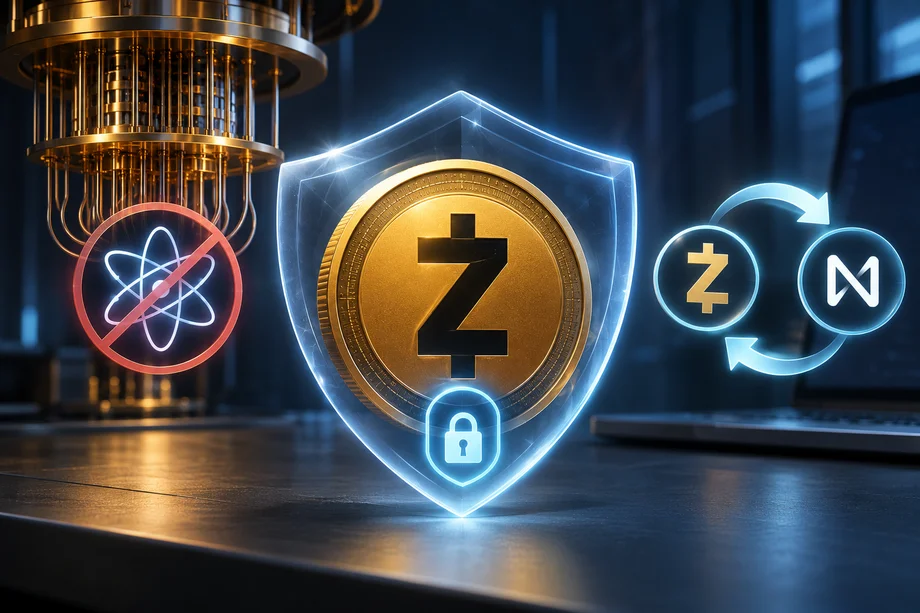
Zakura team designs wallet-level change so each ZEC cross-chain swap uses a unique key, limiting any future quantum recovery of payment history from public refund addresses
Zcash infrastructure developers at Zakura have put forward a technical proposal to strengthen the privacy of ZEC swaps executed through the NEAR Intents cross-chain service against potential future quantum computing attacks. The design assigns a separate incoming viewing key to every individual swap while leaving the user’s spending key unchanged.
The Privacy Exposure in NEAR Intents Swaps
NEAR Intents enables users to exchange assets across blockchains without managing each intermediate step. When a user swaps shielded ZEC for another asset such as USDC, the wallet supplies a refund address so any unused ZEC can be returned. That address is recorded on NEAR’s public blockchain once the deposit is registered and remains visible even if the swap completes without a refund. Swaps in the opposite direction similarly publish the receiving shielded address.
Zcash shielded addresses belonging to the same account normally share a single incoming viewing key. Current classical computers cannot reverse the elliptic-curve mathematics that link a public address to its viewing key. However, a sufficiently powerful quantum computer running Shor’s algorithm could, in theory, recover that key from one exposed address. Possession of the key would allow an attacker to identify every payment received by the account, including amounts and any attached private memos. The exposure concerns transaction privacy rather than control of funds, because spending requires a separate authorization key.
One-Time Viewing Keys Keep Funds in a Single Account
Zakura’s solution generates a distinct incoming viewing key for each swap. The wallet derives the new key from the existing account credentials, a purpose identifier for the swap, and an index, using a keyed hash construction already employed by Zcash’s ZIP 32 derivation system with a separate domain separator. Only the randomized component of the viewing key changes; the authorization and nullifier keys remain the same. Consequently, all funds continue to be controlled by the original spending key and can be spent through the user’s normal account process.
If a quantum attacker later recovered the viewing key associated with one refund address, the information revealed would be limited to payments linked to that specific swap. Linking the key to other addresses would require reversing the hash-based derivation. Creating an entirely new Zcash account for every swap could achieve similar isolation, but the approach creates practical difficulties for hardware wallet users. Keystone currently supports signing only from account index zero, while Ledger devices require separate transactions and approvals when spending from multiple accounts.
To support recovery, the wallet embeds an encrypted note in the change output of an outgoing ZEC swap that records the index used to derive the refund address. Once NEAR completes the swap, any returned ZEC can be spent with the original spending key.
Private Database Queries for Efficient Wallet Recovery
Multiple one-time keys would normally slow wallet restoration because each key must be checked against the blockchain. Zakura proposes private information retrieval (PIR) to locate the relevant transactions without disclosing the wallet’s addresses to the database operator. The system exploits a feature of NEAR’s Zcash bridge in which outgoing transactions use an all-zero outgoing viewing key, allowing them to be indexed by destination address.
During restoration a wallet first downloads filters that identify addresses potentially receiving bridge payments. When a filter indicates a possible match, the wallet submits an encrypted PIR query. The server returns the transaction location without learning which address was requested. The same lattice-based technique is already used by Zakura for transparent wallet lookups and Zcash coinholder voting. For incoming ZEC swaps the wallet checks addresses sequentially and stops after a run of unused ones.
Implementation Timeline and Broader Quantum Work
Software wallets that rely on Zakura’s open-source libraries, including Vizor, could incorporate the one-time viewing key feature within the coming weeks. Hardware wallet support is expected to follow once firmware updates become available. The proposal forms part of a wider set of quantum-resistance efforts under way in the Zcash ecosystem, including plans for post-quantum signature instructions and earlier upgrades that introduced recoverable notes.
As of the latest market data, ZEC traded near $1,171.


Disclaimer
This article was generated by AI using information from multiple industry sources. It has not been reviewed or verified by a human editor and may contain inaccuracies, omissions, or misinformation. Readers are encouraged to independently verify any information before making decisions based on its content.Tired of the noise?
Let the bots trade for you.
Trade 24/7, without emotion, with data-driven strategies.
Associated articles
Zcash Targets January for Quantum-Resistant Signatures on Transparent Payments
Shielded Bitcoin Proposal Aims to Bring Zcash-Style Privacy to Transactions Without Soft Fork
Bitget Hackers Shield $3.9 Million Loot in Zcash Privacy Pool After Blocked Swaps
Zcash Climbs to Eight-Year Peak Near $850 on Grayscale ETF Progress
Grayscale Positions Zcash as Privacy-Focused Challenger to Bitcoin Amid ETF Launch and Research Report
Latest articles
SkyAI Exits Solana Holdings Completely, Launches $201 Million Share Buyback

Strategy Buys 267 Bitcoin and Raises Preferred Share Buyback Cap to $3 Billion
Dormant 2013 Bitcoin Wallets Shift Over $67 Million After More Than a Decade

Binance Rolls Out AI Pro Tool for Chat-Based Automated Trading Strategies