Newsroom
Binance Hackers Route Over $600 Million Through THORChain as Laundering Efforts Widen
28 November, 2026 / News / AI / Tags: thorchain, coinjoin, stolen, trm, swaps
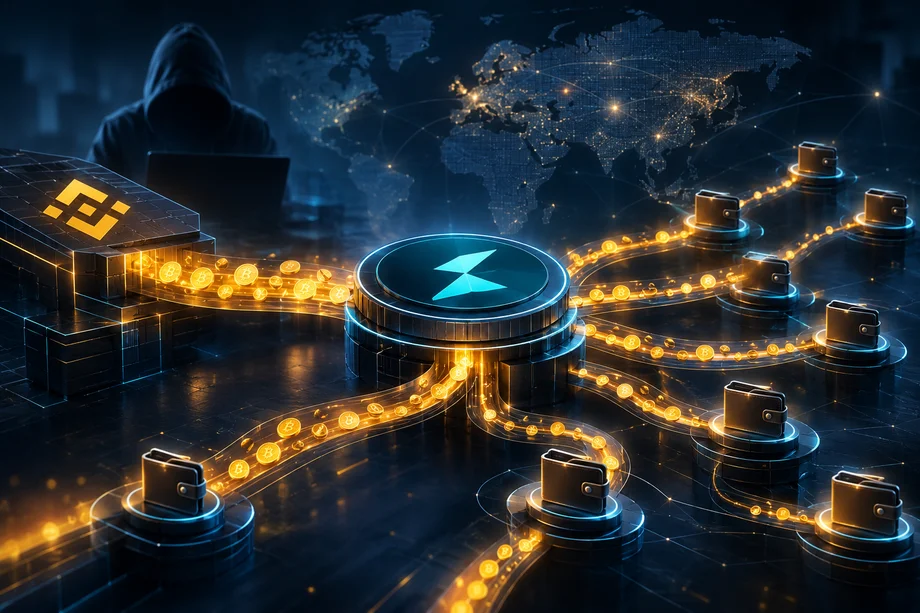
Analytics firms say more than $600 million of funds stolen from Binance has passed through THORChain, and another $342 million through a CoinJoin service. The protocol says it does not run KYC checks or censor transactions
Stolen Funds Move Through Cross-Chain Swaps and Mixing Tools
Hackers linked to North Korea are reportedly using cross-chain swaps and privacy tools to launder crypto taken in the October 29 attack on Binance. Blockchain analytics firms Chainalysis and Elliptic estimate that stolen assets worth more than $600 million have gone through THORChain. A further $342 million is said to have moved through a CoinJoin service. Together, the two routes come to roughly $942 million.
Elliptic cautioned against reading that total as a count of unique stolen assets. The THORChain figure may include funds that entered the network more than once, so the combined number is likely to overstate the amount of distinct stolen crypto involved.
The attackers have not rushed to convert the proceeds into cash. They are instead shifting them through a series of services, which makes the transaction trail harder to follow.
Key Figures in the Binance Hack
| Item | Reported amount |
|---|---|
| Total value taken in the attack | About $6.3 billion |
| Frozen by token issuers, mostly USDT and USDC | About $2.85 billion |
| Passed through THORChain | More than $600 million |
| Passed through a CoinJoin service | $342 million |
| Subject of a US Justice Department forfeiture action | More than $1.1 billion |
| Fees THORChain earned from related swaps (TRM Labs estimate) | At least $1 million |
Why THORChain Is Drawing Scrutiny
THORChain is a decentralized protocol for swapping assets between blockchains. It does not require users to verify their identities and does not filter transactions. That design has made it useful to those trying to move stolen funds without detection.
The FBI published a list of wallet addresses tied to the attackers a few days after the breach. It asked crypto service providers, including the operators of THORChain's network, to block any transaction connected to those addresses. The network has kept processing swaps linked to the laundering activity. TRM Labs estimates it has earned at least $1 million in fees from swaps involving funds connected to the incident. Another report puts that figure at up to $1 million.
This is not the first time the protocol has faced such questions. In September, funds stolen from the exchange Bitget were routed through its cross-chain swaps. Bitget asked the network to block the attacker addresses. THORChain declined, pointing to its permissionless design and comparing it with the Bitcoin and Ethereum networks. It asked whether those blockchains would be held responsible in a similar situation.
CoinJoin Adds a Second Layer of Obfuscation
CoinJoin is a technique that merges crypto from multiple senders into a single transaction. That makes it difficult for investigators to determine where individual coins came from. Elliptic says a pseudonymous figure known only as Kruw has been coordinating the $342 million that moved through the service.
THORChain Co-Founder Defends the Protocol
THORChain co-founder Chad Barraford has defended the network. He says 98% of its trading volume comes from legitimate activity, and that shutting it down would mainly affect ordinary users rather than criminals.
Cashing Out Remains the Hard Part
To turn the stolen assets into usable money, the hackers will still need to pass them through further services. These could include over-the-counter brokers, which exchange digital assets for traditional currencies or other forms of value. Each additional step gives investigators and law enforcement more chances to identify and freeze the funds.
Ari Redbord, Global Head of Policy at TRM Labs, said the attackers do not need to complete many conversions for the operation to pay off.
TRM Labs has estimated that the laundering could continue for months or even years.
Official Response and Attribution
US authorities have blamed hackers linked to North Korea for the attack. North Korea has flatly denied the accusation and called it a political provocation. The US Department of Justice has filed a forfeiture action to recover more than $1.1 billion in cryptocurrency stolen in the hack. Token issuers have already frozen about $2.85 billion of the roughly $6.3 billion taken, mostly in USDT and USDC. The rest remains in circulation.

Disclaimer
This article was generated by AI using information from multiple industry sources. It has not been reviewed or verified by a human editor and may contain inaccuracies, omissions, or misinformation. Readers are encouraged to independently verify any information before making decisions based on its content.Tired of the noise?
Let the bots trade for you.
Trade 24/7, without emotion, with data-driven strategies.
Associated articles
North Korea-Linked Binance Hackers Move Tens of Millions in Stolen Ether After Quiet Period

North Korean Lazarus Group Suspected in $6.3 Billion Binance Hack
FBI Secures Over $1.2 Billion From Record $6.3 Billion Binance Crypto Theft
US Files Civil Claim to Recover Over $1.1 Billion in Cryptocurrency Stolen in Binance Hack

CoinEx Faces Scrutiny Over $3.84 Billion in Iran-Linked Crypto Flows
Latest articles
Binance Auto-Closes WLFI Futures as Open Interest Drops 77% in 90 Minutes

Binance Founder Zhao Weighs Legal Action Over Netflix's Portrayal of Him in FTX Drama
Bybit Withholds Full Postmortem of $1.4 Billion February 2025 Hack
Aon Completes Three Stablecoin Insurance Premium Settlements, Two on Solana