Newsroom
Wyoming Adopts Chainlink for Near Real-Time Onchain Reserve Checks on FRNT Stable Token
2 September, 2026 / News / AI / Tags: frnt, chainlink, wyoming, token, reserve
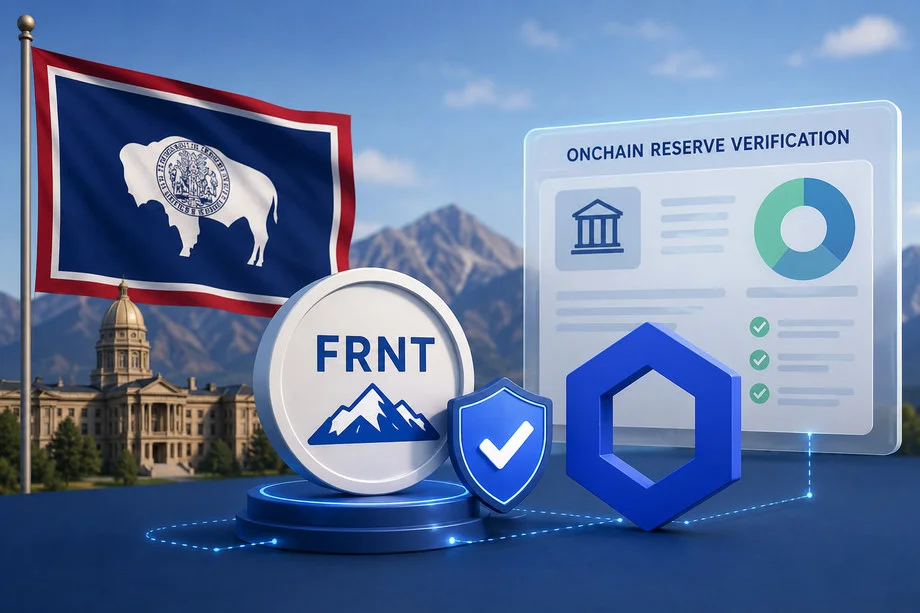
The state expands its Chainlink partnership to deliver continuous verification of reserves backing its official Frontier Stable Token, going beyond federal disclosure rules
The Wyoming Stable Token Commission has adopted Chainlink Proof of Reserve to provide near real-time onchain verification of the assets supporting the Frontier Stable Token, or FRNT. The move builds on the state’s recent switch to Chainlink infrastructure and aims to give regulators, institutions, and users more continuous visibility into the token’s backing.
Expanded Verification System
Wyoming already posts daily reserve attestations for FRNT and meets monthly disclosure rules under the GENIUS Act, which requires reports on reserve composition and outstanding supply backed by independent examination. Officials said the new integration closes gaps that can appear between scheduled reports by publishing verified data onchain almost continuously.
Under the arrangement, The Network Firm examines FRNT’s reserve and token-supply balances according to American Institute of Certified Public Accountants standards. Chainlink Proof of Reserve then makes the verified figures available onchain in near real time. The combination is intended to reduce blind spots and strengthen confidence that every FRNT token remains fully collateralized.
Secure Mint Feature and Prior Infrastructure Shift
The commission is also moving to adopt Chainlink’s Secure Mint capability. That feature requires verified reserves to equal or exceed total FRNT supply before any new tokens can be created. Officials described it as a safeguard against infinite-mint scenarios and a way to give cryptographic assurance that newly issued tokens are backed at the moment of creation.
The latest step follows Wyoming’s full migration of FRNT from LayerZero to Chainlink’s Cross-Chain Interoperability Protocol about two weeks earlier. CCIP is now the token’s exclusive cross-chain infrastructure after a security review. The change consolidates bridging activity through a single protocol.
FRNT Background and Reserve Structure
FRNT launched in January 2026 as the first fiat-backed stable token issued directly by a U.S. state. It is supported by U.S. dollars and short-term U.S. Treasuries. Income earned on the reserves is directed toward diversifying state revenues and funding Wyoming’s School Foundation Program.
The Wyoming Stable Token Commission was created in March 2023 under the Wyoming Stable Token Act and tasked with designing and deploying the public-sector token. Officials present the current verification upgrades as an effort to set a higher bar for transparency in government-issued digital assets while supporting digital payments and tokenized markets.
Chainlink has been integrated into a range of institutional projects involving tokenized assets, stablecoin settlement, and traditional market infrastructure in recent months. Wyoming’s adoption places a state government among the network’s public-sector users of its verification and interoperability tools.

Disclaimer
This article was generated by AI using information from multiple industry sources. It has not been reviewed or verified by a human editor and may contain inaccuracies, omissions, or misinformation. Readers are encouraged to independently verify any information before making decisions based on its content.Tired of the noise?
Let the bots trade for you.
Trade 24/7, without emotion, with data-driven strategies.
Associated articles
Wyoming Migrates State Stablecoin FRNT to Chainlink CCIP After Security Review

MainStreet msUSD Stablecoin Crashes Over 85% After Verification Deal Ends

Tether’s Gold-Backed XAUt Token Secures Shariah Certification

Solv Ditches LayerZero for Chainlink to Secure $700M+ in Tokenized Bitcoin

Chainlink Data Services Launch on Stellar to Power DeFi for $4 Billion RWA Market
Latest articles

SkyAI Exits Solana Holdings Completely, Launches $201 Million Share Buyback

Strategy Buys 267 Bitcoin and Raises Preferred Share Buyback Cap to $3 Billion

Dormant 2013 Bitcoin Wallets Shift Over $67 Million After More Than a Decade

Binance Rolls Out AI Pro Tool for Chat-Based Automated Trading Strategies