Newsroom
Wyoming Migrates State Stablecoin FRNT to Chainlink CCIP After Security Review
19 August, 2026 / News / AI / Tags: frnt, wyoming, chainlink, ccip, layerzero
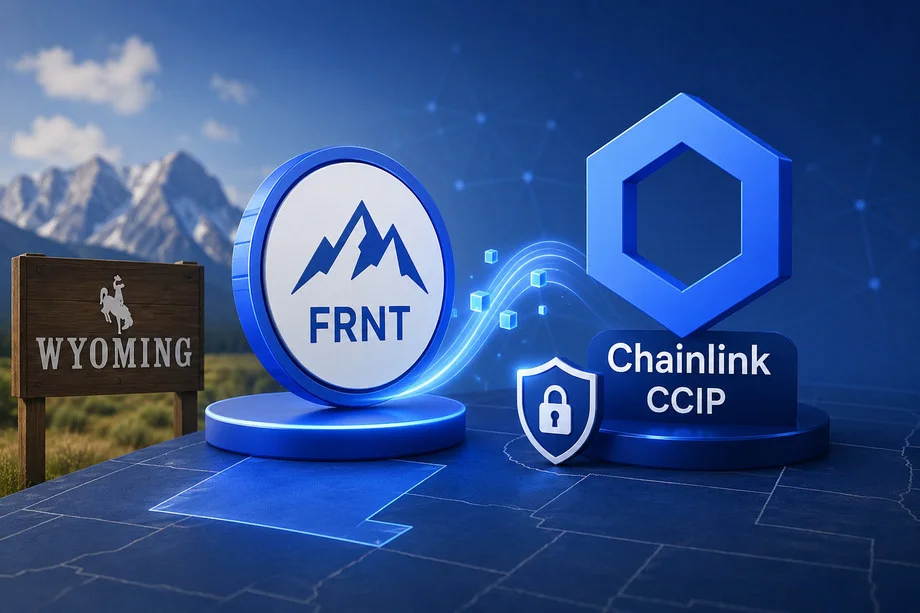
The Wyoming Stable Token Commission completed the shift of its Frontier Stable Token from LayerZero to Chainlink’s protocol on August 18, citing operational and disclosure concerns
The Wyoming Stable Token Commission announced on August 18, 2026, that it has fully migrated its state-backed Frontier Stable Token, known as FRNT, from LayerZero to Chainlink’s Cross-Chain Interoperability Protocol. The move establishes CCIP as the exclusive cross-chain infrastructure for the token under a multiyear contract, while the prior LayerZero implementation is being deprecated.
FRNT holders were not required to take any action during the transition. Bridging for the token will now occur through the new system.
Security Review Prompts the Change
Commission officials said the decision followed a proactive security review that identified concerns with LayerZero’s disclosure practices and operational security. Anthony Apollo, Executive Director of the Wyoming Stable Token Commission, stated that the review led the body to select Chainlink CCIP as the sole option meeting its full set of security and reliability standards.
Apollo further noted that Wyoming is building public-sector financial infrastructure with FRNT and has a duty to protect the people, businesses, and institutions that depend on it. He said the adoption of Chainlink CCIP provides highly secure cross-chain infrastructure meeting the standard citizens deserve.
FRNT’s Role and Multi-Chain Footprint
FRNT is described as the first fully reserved stable token issued by a U.S. public entity. It is a fiat-backed digital dollar designed for payments and settlement among individuals, businesses, and public-sector users. Reserves consist of cash and short-term U.S. Treasury securities, with a statutory requirement for 102 percent overcollateralization. Reserves are managed by Franklin Advisers, and investment income beyond the required level supports Wyoming’s School Foundation Program.
The token operates across eight public blockchains: Arbitrum, Avalanche, Base, Ethereum, Hedera, Optimism, Polygon, and Solana. This multi-chain approach aligns with a November 2023 recommendation from Wyoming’s Select Committee on Blockchain, Financial Technology, and Digital Innovation Technology, which advised a technology-neutral strategy rather than reliance on a single network. The state initially launched FRNT across seven chains before adding Hedera.
FRNT’s capitalization remains below $1 million, making the migration notable primarily for its status as public-sector digital dollar infrastructure rather than for the size of assets involved.
Chainlink CCIP Features Cited
Chainlink CCIP supplies cross-chain transfer functionality supported by a defense-in-depth security model. Features referenced by the Commission and Chainlink include SOC 2 Type 2 institutional certification, built-in risk controls, audited software, active monitoring systems, and a decentralized architecture in which every transaction is validated by a minimum of 16 independent node operators. The protocol rests on the same oracle infrastructure that has processed more than $33 trillion in transaction value across decentralized finance and traditional financial institutions.
Sergey Nazarov, co-founder of Chainlink, commented on the development, noting Wyoming’s consistent leadership in digital asset policy and public-sector blockchain adoption.
Nazarov added that the selection represents another step toward a globally connected onchain financial system and that Chainlink expects to continue working with the Commission as FRNT’s cross-chain use expands.
Market Response and Broader Context
Following the announcement, Chainlink’s LINK token rose more than 3 percent, trading near $9.70. The gain restored double-digit weekly advances for the token after a period of drift above $9.40.
The Wyoming migration occurs amid a series of announced shifts to CCIP by other projects and platforms, including BitGo’s transfer of wrapped Bitcoin infrastructure, Kelp DAO, Solv Protocol, Re, and Kraken. Combined, these announced migrations cover nearly $15 billion in assets. Some of the earlier moves followed an April 2026 incident in which attackers stole approximately 116,500 rsETH, valued at about $292 million at the time, from a LayerZero-powered bridge associated with Kelp DAO.
LayerZero stated that it respected Wyoming’s decision and assisted in ensuring a smooth transition. The company said it had strengthened its security approach in recent months. There is no indication that Wyoming’s former FRNT deployment used the single-verifier configuration linked to the earlier incident.
State officials indicated that the migration provides a framework for other state governments, financial institutions, and asset managers seeking to issue regulated digital assets while meeting institutional security standards. The Commission has not released the full security review or a detailed deprecation schedule for legacy contracts, with further notices expected on the retirement of remaining routes.
 Ethereum2408.4200000024h Change0.69%Since Article6.91%
 ChainLink12.0410000024h Change1.25%Since Article14.06%
 Hedera Hashgraph0.0831000024h Change1.51%Since Article17.64%
 Solana105.2900000024h Change0.17%Since Article23.30%
 Avalanche9.5690000024h Change2.13%Since Article41.18%
 Optimism0.1266000024h Change0.16%Since Article40.67%
 Arbitrum0.2001000024h Change4.22%Since Article123.58%
 Polygon Ecosystem Token0.0927700024h Change0.47%Since Article13.49%
Disclaimer
This article was generated by AI using information from multiple industry sources. It has not been reviewed or verified by a human editor and may contain inaccuracies, omissions, or misinformation. Readers are encouraged to independently verify any information before making decisions based on its content.Tired of the noise?
Let the bots trade for you.
Trade 24/7, without emotion, with data-driven strategies.
Associated articles
Nethermind Ends LayerZero Verifier Role, Joins Chainlink as Node Operator
Wyoming Adopts Chainlink for Near Real-Time Onchain Reserve Checks on FRNT Stable Token

Solv Ditches LayerZero for Chainlink to Secure $700M+ in Tokenized Bitcoin
Chainlink Rolls Out CCIP 2.0 With Institutional Controls and Faster Cross-Chain Speeds

Infosys Teams With Chainlink to Expand Institutional Onchain Finance
Latest articles

SkyAI Exits Solana Holdings Completely, Launches $201 Million Share Buyback

Strategy Buys 267 Bitcoin and Raises Preferred Share Buyback Cap to $3 Billion

Dormant 2013 Bitcoin Wallets Shift Over $67 Million After More Than a Decade

Binance Rolls Out AI Pro Tool for Chat-Based Automated Trading Strategies