Newsroom
Finnish Homes Heat with Bitcoin Miners While BTC Holds Above $70,000
9 November, 2026 / News / AI / Tags: heat, sunbit, kilowatt, electricity, heating
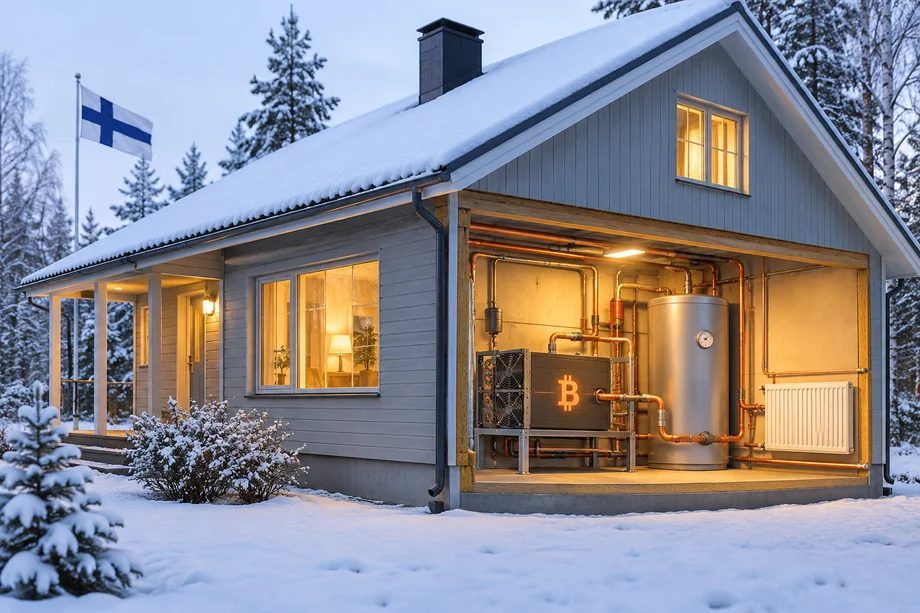
A Finnish startup has installed 30 systems that turn mining heat into residential warmth, with revenue covering power costs under current market conditions
In the Finnish town of Nokia, a 180-square-meter house has fully disconnected from the district heating network. Its rooms are now warmed by a Bitcoin mining machine that sits inside a unit known as a Bitcoin Boiler. Every kilowatt-hour the computer draws is converted into heat, captured in water heated to as much as 60 degrees Celsius and circulated through radiators and underfloor pipes.
The system belongs to the homeowner, who pays the electricity bill and keeps the Bitcoin produced. Finnish company SunBit, which delivered its first production batch in 2025, now operates 30 such installations. Nearly all are in Finland, with one commercial site in the Netherlands. The units have replaced or reduced reliance on oil, gas, wood and district heating across homes and buildings of varying sizes.
How the Bitcoin Boiler Works
SunBit’s systems use liquid-cooled mining hardware, typically a water-cooled Antminer model running specialized firmware. A common configuration draws about 5.3 kilowatts and produces heat that is transferred into a building’s existing hydronic heating loop. Excess heat that the property cannot use is rejected outdoors through a dry cooler, particularly during warmer months.
Installations range from a 200-square-meter house in Kotka that runs the miner alongside an oil boiler as a hybrid setup, to an old manor in Tampere where mining replaced wood heating and maintains a 1,500-liter water tank between 50 and 60 degrees Celsius. A 3,000-square-meter industrial hall in Vimpeli pairs a unit with an air-to-water heat pump and absorbs surplus power from a 30-kilowatt solar array.
The machines are typically placed in a basement or insulated side room because of their noise. Owners can opt for SunBit’s remote monitoring service, which includes continuous optimization around Finland’s spot electricity market and a mobile app, for a 10 percent fee on mining revenue.
The Economics of Mining Heat
Under SunBit’s modeled assumptions, one 495-terahash machine running continuously consumes roughly 46,400 kilowatt-hours a year. At an electricity price of about 11 cents per kilowatt-hour, the annual power cost reaches approximately $5,200.
With Bitcoin near $82,000 and network hashrate around 1,040 exahashes per second, the company estimates the unit can produce about one-twelfth of a Bitcoin annually. After the optional service fee, the owner retains roughly $6,100 in value, creating a modest surplus of about $900 before accounting for the system’s purchase price. Mining pool fees take a further 0.5 percent.
SunBit calculates that mining revenue covers electricity costs when Bitcoin stays above just under $70,000, assuming other variables remain constant. At the time of recent calculations, Bitcoin traded near $81,500. One early customer with a lower-hashrate unit mined approximately 0.039 Bitcoin over a year, worth about $3,160 at prevailing prices, while displacing around 2,000 liters of heating oil.
Installed systems cost roughly $20,000 and upward, with some configurations reaching $20,400 to $31,400. Against an oil-heated house that previously spent about $5,000 a year on 2,300 liters of fuel, modeled payback periods fall in the range of three to six years before maintenance or financing costs, provided current mining conditions hold.
Competition from Heat Pumps and Seasonal Limits
More than half the heat generated by a continuously running miner is often surplus to a typical home’s needs and is dumped outside, especially in summer. Finland’s heating season is long, lasting roughly 100 days of deep winter in the southwest and up to 200 days in Lapland, but the mismatch remains significant.
Heat pumps present a stronger efficiency challenge. They can deliver 2.5 to 3 kilowatt-hours of heat for every kilowatt-hour of electricity, while a miner converts electricity to heat on a one-to-one basis. For a house requiring 25,000 kilowatt-hours of heat annually, an air-to-water heat pump’s running cost is estimated at about $1,100, compared with district heating at roughly $3,170. A miner operated only long enough to meet that heat demand would generate a smaller surplus.
Suomi notes that miners hold an advantage in extreme cold because their heat output does not decline with outdoor temperature. At minus 25 degrees Celsius, the full electrical input still becomes usable heat at up to 60 degrees Celsius, whereas air-source heat pump performance drops.
The Approaching 2028 Halving
Bitcoin’s next programmed reduction in block rewards is expected in spring 2028. The subsidy will fall from 3.125 to 1.5625 Bitcoin per block. SunBit’s payback models do not incorporate this event, as the company declines to forecast future prices or network difficulty.
Holding current assumptions fixed, post-halving mining income would drop from about 13 cents per kilowatt-hour to roughly 7 cents, below the modeled 11-cent electricity price. Heat would then carry a net cost of about 4 cents per kilowatt-hour, comparable to an efficient heat pump under the same electricity assumptions. Maintaining break-even free heat after the cut would require Bitcoin near $131,000, approximately 60 percent higher than recent levels.
A household installing a system in the current winter would therefore enjoy roughly 18 months of today’s margins before the reward reduction takes effect. The heating function itself continues regardless of Bitcoin’s price; only the net cost of the electricity changes.
Larger-scale mining heat recovery already operates in Finland through district heating connections operated by other firms, supplying networks that serve tens of thousands of residents. SunBit’s residential model places ownership of both the mining hardware and the resulting Bitcoin directly with the property owner.
The financial outcome for each installation continues to depend on Bitcoin’s market price, electricity rates, network hashrate growth and the timing of future reward reductions. The systems currently in operation demonstrate one practical application of mining’s unavoidable heat output in a cold-climate residential setting.

Disclaimer
This article was generated by AI using information from multiple industry sources. It has not been reviewed or verified by a human editor and may contain inaccuracies, omissions, or misinformation. Readers are encouraged to independently verify any information before making decisions based on its content.Tired of the noise?
Let the bots trade for you.
Trade 24/7, without emotion, with data-driven strategies.
Associated articles
Heatbit Launches $899 Bitcoin-Mining Water Heater Element for Existing Tanks

Bitcoin Mining Production Dips at CleanSpark and BitFuFu in September as Canaan Holds Steady

JPMorgan Sees Bitcoin Above $85,000 Cost as Potential Relief for Miners

MARA Posts $611 Million Q2 Loss as Bitcoin Price Drop Offsets Higher Mining Output
KuMining Adds Kaspa Cloud Mining to Expand Proof-of-Work Access
Latest articles
Zcash Developers Propose Cutting Block Times to 20 Seconds After NU7

Senator Blumenthal Sets January Deadline for Binance, Tether and Trump Crypto Firms

US Treasury Orders Cutoff of MEXC Global Over $16 Billion in Alleged Illicit Crypto Flows

Nvidia Board Launches Probe Into CEO Jensen Huang Over Foreign Intelligence Reports