Newsroom
ASIC Opens Consultation on Capital and Custody Rules for Digital Asset Platforms
15 October, 2026 / News / AI / Tags: asic, standards, australian, consultation, custody
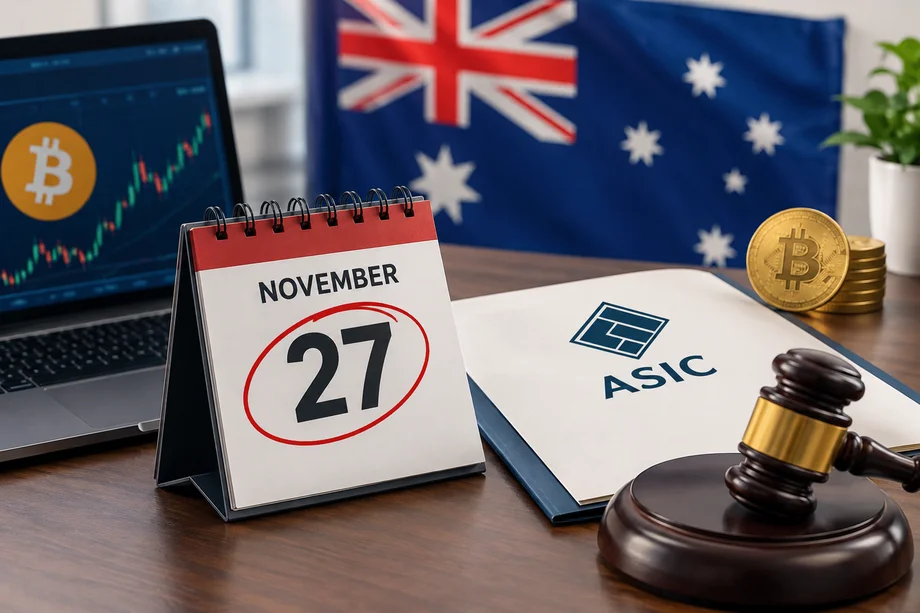
Australia’s securities regulator seeks feedback on proposed standards for crypto platforms ahead of 2027 licensing regime, including net tangible asset thresholds up to A$14 million
The Australian Securities and Investments Commission released Consultation Paper 392 on Thursday, setting out proposed capital, custody, trading and settlement standards for digital asset platforms. The paper forms the detailed rulebook for the Corporations Amendment (Digital Assets Framework) Act 2026, which takes effect on 8 April 2027.
Operators of digital asset platforms and tokenised custody platforms will need an Australian financial services licence, customer disclosure documents and platform rules. They must also meet new asset-holding standards, transactional and settlement standards, and financial resource requirements. The consultation closes at 5pm AEDT on 27 November 2026.
Scope of the New Regime
The Digital Assets Framework Act creates two new categories of financial product. Digital asset platforms involve holding digital tokens on behalf of clients and providing related platform services. Tokenised custody platforms record underlying assets held for clients in the form of digital tokens.
The proposed guidance applies to operators of both types of platform and to other entities providing financial services in relation to them. It also covers existing Australian financial services licensees, market participants, payments providers and businesses that use or deal with digital assets. ASIC has proposed a streamlined licensing pathway for firms that already hold an Australian financial services licence or that previously applied under Information Sheet 225.
Kirkland said the approach rests on the principle of same activity, same risk, same regulatory outcome, with the aim of aligning Australia with comparable overseas jurisdictions. Bringing these platforms into the financial services framework is intended to give consumers greater confidence when trading digital assets.
Proposed Capital Requirements
A central element of the consultation is the set of net tangible asset requirements for platform operators. ASIC has put forward three alternative models. Under the most stringent option, operators that do not meet qualifying third-party custody conditions would need to hold the greater of A$14 million (approximately USD 9.7 million) in net tangible assets or 10 per cent of average annual revenue. Figures are to be indexed annually to the consumer price index.
Operators that satisfy third-party custody conditions could face a lower base threshold, such as A$200,000, combined with calculations linked to the value of assets held or revenue. Other models include an A$7 million threshold for certain operators that do not hold underlying assets classified as financial products, or activity-based add-ons that increase the requirement according to the services offered, such as acting as an agent or operating a trading venue.
The proposals also include cash-flow forecasting obligations and tailored audit requirements. ASIC has indicated that the requirements are adapted from existing Australian financial services licence standards to reduce the risk of regulatory arbitrage.
Custody, Trading and Settlement Standards
Draft asset-holding standards set minimum requirements for the safeguarding and administration of client assets and money. These cover governance, segregation, reconciliation, use of third-party custodians and data reporting to ASIC. Quarterly reporting of wallet structures and addresses that hold customer assets is among the measures under consideration, with certain records to be retained for seven years.
Transactional and settlement standards address trading activities, including proposed restrictions on platforms trading for their own account to manage conflicts of interest. ASIC is also seeking views on the conditions under which offshore custody arrangements would be permitted, including safeguards if an overseas parent or related company fails.
Path to Implementation
The consultation package includes draft regulatory guidance, draft asset-holding standards, draft transactional and settlement standards, and draft financial requirements. Preliminary legal instruments are provided for illustrative purposes and may change.
ASIC recorded more than 140 applications from businesses seeking to provide digital asset-related financial services under the earlier Information Sheet 225 framework and associated no-action position. That position, updated and extended through 2025 and 2026, confirmed that certain stablecoins, wrapped tokens, tokenised securities and digital asset wallets fall within the existing financial product regime.
Final standards and guidance are targeted for publication in March 2027. The new law takes effect on 8 April 2027. Operators will have until 7 October 2027 to lodge licence applications and may continue operating while applications are assessed.
Industry groups have indicated they will examine the capital models in detail, particularly the proportionality of thresholds across businesses of different sizes and the concessions available where third-party custody is used.
Disclaimer
This article was generated by AI using information from multiple industry sources. It has not been reviewed or verified by a human editor and may contain inaccuracies, omissions, or misinformation. Readers are encouraged to independently verify any information before making decisions based on its content.Tired of the noise?
Let the bots trade for you.
Trade 24/7, without emotion, with data-driven strategies.
Associated articles

Australia Imposes Sept. 30 Licensing Deadline on Crypto Firms Facing Penalties

Russia’s Central Bank Issues Draft Rules for Organized Crypto Trading Ahead of September Framework

Australia Proposes Extending CFD Rules to Crypto-Settled Derivatives

SEC Proposes Crypto Custody Framework for Investment Advisers and Funds

Circle Secures OCC Approval for National Trust Bank
Latest articles

Babylon Labs Advances Proposal for Native Bitcoin Lending on Aave V4

TSMC Posts Record Q3 Profit Surge on AI Chip Demand, Lifts Full-Year Outlook

GTA 6 Leaker Cyberleek Drops Full Build Plan After Memecoin Collapse, Activates Dead Man’s Switch Threat

EBA Designates USDC as First Significant E-Money Token Under MiCA Rules