Newsroom
House Committee Set to Advance Strategic Bitcoin Reserve Legislation on Wednesday
15 September, 2026 / News / AI / Tags: bitcoin, would, reserve, stockpile, enactment
The House Financial Services Committee will mark up H.R. 8957 on September 16, seeking to codify a federal Bitcoin reserve with a 20-year holding rule
The U.S. House Financial Services Committee is scheduled to conduct a markup of H.R. 8957, the American Reserve Modernization Act of 2026, on September 16 at 10:00 a.m. ET. The legislation aims to place the federal Strategic Bitcoin Reserve into statute and establish long-term rules for government-held Bitcoin.
Republican Rep. Nick Begich of Alaska introduced the bill in May, with Democratic Rep. Jared Golden of Maine among its cosponsors. The measure was referred to the Financial Services Committee and appears on the panel’s calendar for full committee consideration of various measures.
Core Provisions of the Reserve Framework
H.R. 8957 would require the Treasury secretary to establish a Strategic Bitcoin Reserve within 180 days of enactment. A separate Digital Asset Stockpile would manage non-Bitcoin digital assets held by the federal government.
Qualifying Bitcoin, defined as assets finally forfeited through criminal or civil proceedings or received in satisfaction of certain civil monetary penalties, would be placed in the Bitcoin reserve. Non-Bitcoin assets would enter the stockpile, where the Treasury secretary would have discretion to sell, exchange, or convert them. Proceeds could only increase Bitcoin holdings in the reserve or reduce the national debt.
Federal agencies would have 60 days after enactment to provide a complete accounting of Bitcoin and other digital assets they hold or control. Once Treasury certifies the reserve and stockpile as operational, agencies would transfer applicable holdings within 30 days under procedures ensuring traceability and auditability. Until then, agencies would generally retain custody but could not dispose of Bitcoin except in limited cases involving national security, court orders, or returns to identifiable crime victims.
20-Year Holding Requirement and Transparency Rules
Bitcoin placed in the reserve would face a minimum holding period of 20 years. Existing holdings would remain for at least 20 years from enactment, while later acquisitions would be locked from the date of deposit. During this period, the assets could not be sold, swapped, auctioned, encumbered, or otherwise disposed of.
Two years before the minimum period ends, the Treasury secretary would submit recommendations to Congress on whether to continue holding the Bitcoin or allow a gradual release. After the holding period expires, the secretary could recommend selling up to 10 percent of the reserve during any two-year period.
The bill would also mandate quarterly proof-of-reserve reports published on an official Treasury website. These reports would disclose total holdings and transactions while demonstrating control of the relevant private keys through public cryptographic attestations. An independent third-party auditor with expertise in such attestations would review the reports, and the Comptroller General would provide oversight.
Budget-Neutral Acquisition Study and State Participation
Treasury and Commerce would examine options such as converting assets from the Digital Asset Stockpile, using discretionary surplus remittances from Federal Reserve Banks, revaluing gold certificates, or receiving Bitcoin through forfeitures, penalties, or settlements. Other potential sources include tax payments, tariff revenue, voluntary contributions, gifts, and cooperative programs with states, private entities, or international partners.
Any mechanism identified as budget neutral could not require new appropriations, impose net costs on taxpayers, or increase the national debt. The bill explicitly states that the study does not authorize borrowing, new taxation, or deficit spending to acquire Bitcoin.
States could voluntarily place their Bitcoin holdings in segregated accounts within the federal reserve while retaining title to the assets and any related forks or airdrops. Participating states would enter agreements with Treasury covering security, access, and custody responsibilities.
Relation to Existing Executive Policy
President Donald Trump established a Strategic Bitcoin Reserve through an executive order in March 2025. That order directed the capitalization of the reserve primarily with finally forfeited government Bitcoin and stated that deposited Bitcoin should not be sold. H.R. 8957 would move the policy into statute, potentially making it more durable across administrations.
The legislation also affirms that it cannot authorize federal seizure or confiscation of lawfully acquired Bitcoin. It protects the rights of individuals, businesses, and organizations to purchase, hold, transfer, or dispose of Bitcoin and other digital assets, including self-custody of private keys.
Committee approval of the markup would advance the bill within the House but would not constitute final passage. Further steps would include consideration by the full House and Senate before any potential enactment.

Disclaimer
This article was generated by AI using information from multiple industry sources. It has not been reviewed or verified by a human editor and may contain inaccuracies, omissions, or misinformation. Readers are encouraged to independently verify any information before making decisions based on its content.Tired of the noise?
Let the bots trade for you.
Trade 24/7, without emotion, with data-driven strategies.
Associated articles
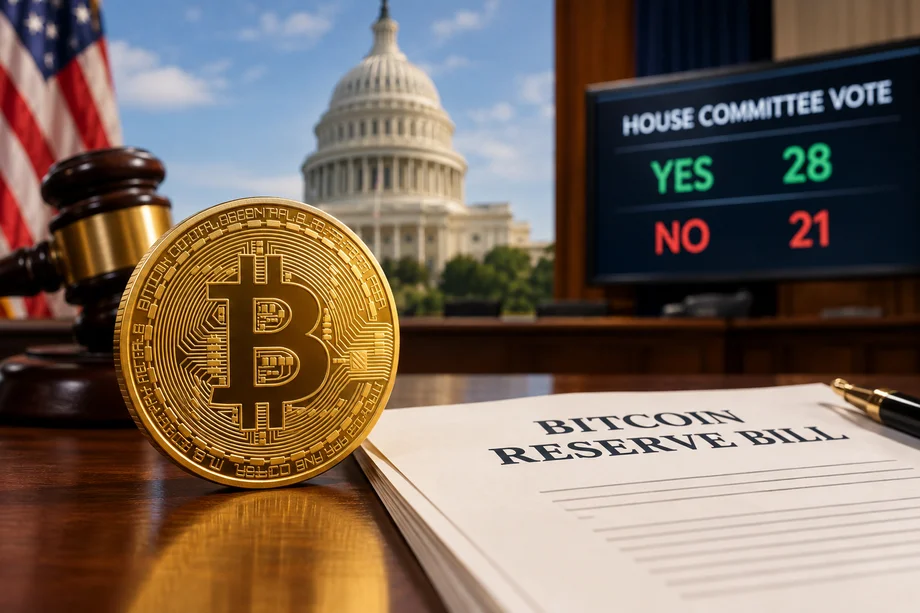
House Panel Advances Bill to Codify Strategic Bitcoin Reserve in 28-21 Vote

Bitget CEO Expects Bitcoin Near Current Levels by Year-End, Skeptical of US Buys

US Government Transfers Small Alameda Bitcoin Holding Amid Ongoing Asset Management

Trump Administration Weighs Global Push for Dollar Stablecoins to Bolster Reserve Status

Housing Bill with CBDC Ban Becomes Law Without Trump Signature
Latest articles

Canada Launches Consultation on Stablecoin Rules With Yield Ban Intact

Chainlink Unveils CustodySync to Unlock Institutional Access to DeFi Lending

BNB Standard Rings Nasdaq Opening Bell to Mark Rebrand and New CEO

Verizon Raises 2026 Outlook After Strong Subscriber Gains and $2 Billion AWS AI Deal