Newsroom
House Panel Advances Bill to Codify Strategic Bitcoin Reserve in 28-21 Vote
17 September, 2026 / News / AI / Tags: bitcoin, reserve, would, study, treasury
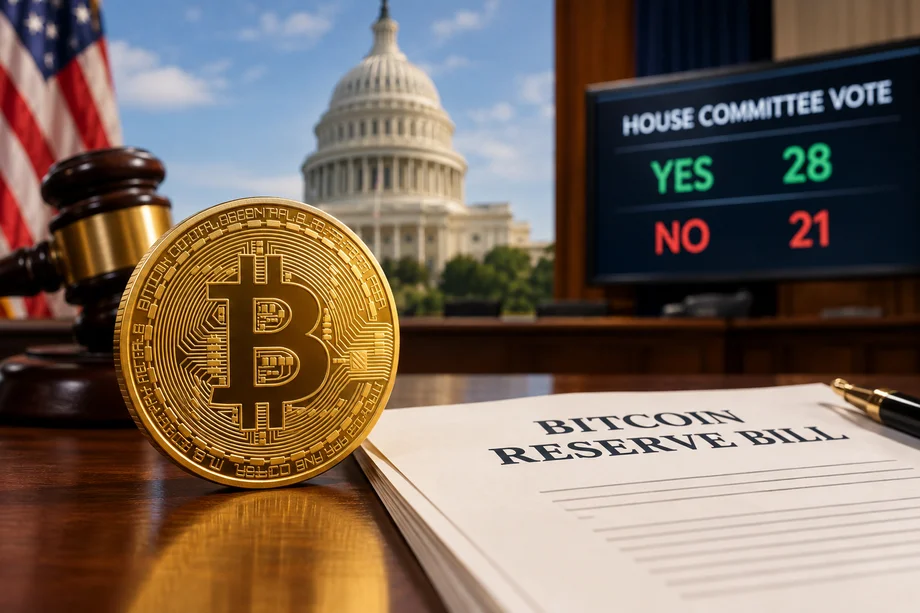
The House Financial Services Committee approved legislation on a party-line basis to place federal Bitcoin holdings under Treasury control with a 20-year minimum holding period
The U.S. House Financial Services Committee advanced the American Reserve Modernization Act of 2026 on September 16, voting 28-21 to report the amended bill favorably. The measure, designated H.R. 8957, seeks to establish a statutory Strategic Bitcoin Reserve and a separate Digital Asset Stockpile within the Treasury Department.
All 28 votes in favor came from Republicans, while all 21 votes against came from Democrats. The panel first adopted a substitute amendment offered by Rep. Bryan Steil of Wisconsin by voice vote and rejected an amendment from Ranking Member Maxine Waters of California on a 21-28 tally.
Key Provisions of the Legislation
Introduced in May by Rep. Nick Begich of Alaska with Rep. Jared Golden of Maine as co-lead, the bill would centralize custody of federally held Bitcoin under the Treasury. Qualifying Bitcoin, including assets obtained through criminal or civil forfeiture, would be transferred into the Strategic Bitcoin Reserve. A parallel Digital Asset Stockpile would cover other digital assets.
Once deposited, Bitcoin in the reserve could not be sold, swapped, auctioned, encumbered or otherwise disposed of for a minimum of 20 years from enactment. Two years before that period ends, the Treasury would submit recommendations to Congress on continued holding or controlled release. After the 20-year mark, the Treasury secretary could recommend selling up to 10 percent of reserve assets in any two-year window, taking into account factors such as the national deficit and potential market effects.
The legislation requires federal agencies to provide a complete accounting of their Bitcoin and other digital asset holdings within 60 days of enactment and annually thereafter. Qualifying assets would transfer to Treasury custody where practicable. An annual public proof-of-reserve report detailing holdings, transactions and control of private keys would be required, verified by an independent third-party auditor with cryptographic expertise. The U.S. Comptroller General would provide ongoing oversight.
The committee-approved text differs from the original bill in several respects. Proof-of-reserve reporting was changed from quarterly to annual. Provisions that would have examined acquisition of additional Bitcoin through Federal Reserve remittances, gold certificate revaluation or tariff revenue were removed. The substitute limits study options to asset swaps, forfeitures and cooperative arrangements with states or other partners.
No Mandatory Purchases, Budget-Neutral Study Required
The bill does not authorize or require the government to purchase a fixed quantity of Bitcoin. Within 180 days of enactment, the Treasury and Commerce departments must study the risks, costs and potential benefits of acquiring additional Bitcoin through budget-neutral methods. The study explicitly prohibits financing through borrowing, new taxes, deficit spending or pledging federal assets as collateral.
This approach contrasts with separate legislation previously advanced by Begich and Sen. Cynthia Lummis that would have directed annual purchases aiming for one million Bitcoin over five years. The current measure focuses on securing existing holdings rather than mandating new acquisitions.
States would gain a voluntary option to store their own Bitcoin in segregated accounts within the Strategic Bitcoin Reserve while retaining legal title to the assets and any related forked or airdropped tokens. Participating states would cover the costs of the service.
Path from Executive Order to Statute
The legislation builds on an executive order signed by President Donald Trump in March 2025 that directed the creation of a Strategic Bitcoin Reserve funded primarily by finally forfeited Bitcoin and a separate Digital Asset Stockpile. The order instructed agencies to account for holdings and explore budget-neutral acquisition strategies. Codifying the framework in statute would prevent simple rescission by a future executive action and require congressional action for major changes.
Public estimates of federal Bitcoin holdings have varied. On-chain analytics have pointed to figures near 325,000 Bitcoin across addresses associated with the U.S. government, though these remain unofficial and do not constitute a reconciled Treasury accounting. The bill would require formal disclosure following independent audit once the reserve is established.
Next Steps in Congress
Committee approval places the amended bill on the House legislative calendar. It must still pass the full House, clear the Senate in identical form and receive the president’s signature before taking effect. No floor vote date has been scheduled. If enacted, Treasury would face deadlines to establish the reserve and stockpile within 180 days, complete the acquisition study in the same timeframe, and set up the voluntary state program within one year.
Supporters described the measure as addressing cybersecurity vulnerabilities and inconsistent accounting for seized digital assets. The party-line vote indicated continued partisan division over the policy’s scope and implications.

Disclaimer
This article was generated by AI using information from multiple industry sources. It has not been reviewed or verified by a human editor and may contain inaccuracies, omissions, or misinformation. Readers are encouraged to independently verify any information before making decisions based on its content.Tired of the noise?
Let the bots trade for you.
Trade 24/7, without emotion, with data-driven strategies.
Associated articles

House Committee Set to Advance Strategic Bitcoin Reserve Legislation on Wednesday
House Tax Panel Advances First Federal Crypto Tax Framework After Senate Setback

CLARITY Act Nears Senate Action as US Crypto Rules Face Final Hurdles

Trump Urges Senate to Advance CLARITY Act in Critical Week

FLEOA Backs CLARITY Act With Calls for Stronger DeFi Rules Ahead of Senate Vote
Latest articles

SpaceX Seeks $40 Billion Debt Package for Nvidia AI Chips Amid Orbital Compute Push

Hunter Biden Demands Market Makers Buy Back and Burn LAPTOP Tokens After Launch Crash

Circle and Tereina Integrate USDC and EURC Into SAP Enterprise Payment Systems

Tether Partners With Kazakhstan Central Bank on Tenge Stablecoin and Tokenization Study