Newsroom
Trump Administration Weighs Global Push for Dollar Stablecoins to Bolster Reserve Status
24 September, 2026 / News / AI / Tags: dollar, stablecoins, treasury, international, stablecoin
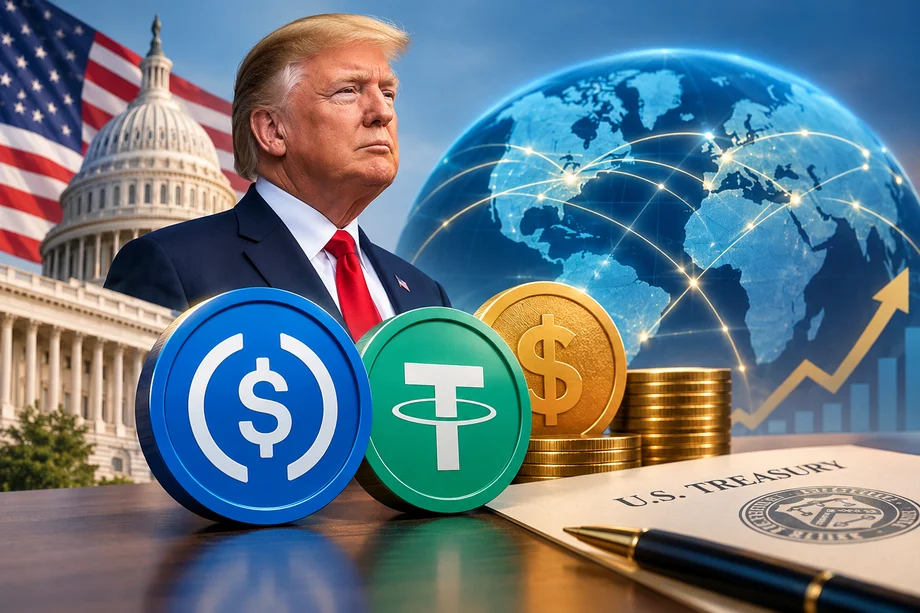
Officials are reviewing public-private partnerships to expand overseas use of USD-backed tokens and lift demand for U.S. Treasuries amid rising national debt
The Trump administration is examining an initiative to promote dollar-denominated stablecoins outside the United States. The effort would rely on joint ventures with private firms and involve key federal agencies, according to people familiar with the discussions. The goal is to strengthen the dollar’s position as the world’s primary reserve currency while creating additional demand for U.S. Treasury securities.
Agencies under consideration for roles include the Treasury Department, the State Department and the U.S. International Development Finance Corporation. No specific countries, private partners, funding levels or launch timelines have been disclosed. The proposal remains under review and has not been formalized as an official program.
Link to Treasury Demand and Existing Policy
Dollar-backed stablecoins are digital tokens designed to maintain a one-to-one value with the U.S. dollar. Issuers typically hold reserves in cash, short-term Treasuries and related instruments to support redemptions. Under the GENIUS Act, signed into law in 2025, permitted payment stablecoin issuers must maintain full reserves in eligible assets that include U.S. dollars and short-term government securities.
Treasury officials have repeatedly connected regulated stablecoin growth to greater demand for government debt. Treasury Secretary Scott Bessent has described dollar-backed stablecoins as a mechanism that supports the dollar’s dominance in foreign-exchange markets and expands access to the dollar economy. In recent remarks, Treasury Deputy Secretary Francis Brooke noted that stablecoin providers already hold nearly $200 billion in Treasury bills and other short-maturity securities.
The overall stablecoin market stands near $300 billion, with Tether’s USDT and Circle’s USDC accounting for the large majority of that total. Aggregate holdings by major issuers already place the sector among the larger private holders of U.S. sovereign debt.
Potential Role of Public-Private Partnerships
The reported approach centers on public-private partnerships rather than direct government issuance of digital dollars. The International Development Finance Corporation, whose investment capacity was expanded by Congress in late 2025 to a $205 billion ceiling, has authority to make equity investments, loans and guarantees alongside private companies in international projects. Any future stablecoin-related commitment would still require standard due diligence, internal approvals and congressional notification.
Officials have framed wider overseas adoption of dollar stablecoins as a modern channel for extending the currency’s reach. Users converting local currency into reserve-backed tokens create corresponding demand for the dollar assets that back those tokens. Policymakers have noted that growth driven by offshore users who previously held limited dollar assets could produce incremental purchases of short-term Treasuries.
The United States national debt recently surpassed $40 trillion. Greater structural demand for Treasuries from stablecoin reserves could, in theory, ease financing pressures, though the scale of any effect would depend on actual adoption rates, reserve composition and whether users are shifting from existing dollar holdings or from other currencies.
International Context and Competing Digital Currencies
The discussions occur as other major economies advance their own digital currency projects. China has expanded use of the digital yuan, which has recorded substantial cumulative transaction volumes and features in cross-border settlement platforms. The European Central Bank is preparing a digital euro pilot expected to begin in the second half of 2027, with the stated aim of reducing reliance on non-European payment systems.
U.S. officials have previously stated that privately issued dollar stablecoins can help maintain the greenback’s international role in the face of these developments. Former White House crypto adviser David Sacks earlier described stablecoins as a means to extend dollar dominance and potentially generate substantial additional demand for U.S. government debt.
Risks Identified by International Institutions
Wider adoption of dollar-pegged stablecoins carries potential challenges for emerging-market economies. The International Monetary Fund and the Bank for International Settlements have warned that rapid growth in USD-backed tokens could accelerate capital outflows during periods of stress, place pressure on domestic currencies and reduce the ability of local authorities to monitor or influence financial flows.
Because stablecoins settle on blockchain networks, they can move outside traditional banking channels. If such tokens gain traction in everyday payments and savings in countries with current-account deficits, local monetary policy transmission and financial stability could face new constraints. U.S. officials have not detailed how any promotional initiative would address these concerns.
Domestic considerations also remain relevant. Expanded stablecoin use has long raised questions about possible shifts of deposits away from commercial banks, though the GENIUS Act framework includes reserve and supervisory requirements intended to mitigate certain risks.
Current Status
The overseas stablecoin initiative is still at the discussion stage. Treasury continues to implement GENIUS Act rules, including a recent notice of proposed rulemaking on issuance, offering and sale of payment stablecoins. Main statutory restrictions are expected to take effect in January 2027 unless earlier regulations accelerate the timeline.
No agency has announced concrete projects, partner selections or target markets. The administration’s broader policy direction, set out in 2025, already prioritizes growth of legitimate dollar-backed stablecoins. Whether the latest discussions produce formal joint ventures will depend on further internal review and coordination among the Treasury, State Department and International Development Finance Corporation.
Disclaimer
This article was generated by AI using information from multiple industry sources. It has not been reviewed or verified by a human editor and may contain inaccuracies, omissions, or misinformation. Readers are encouraged to independently verify any information before making decisions based on its content.Tired of the noise?
Let the bots trade for you.
Trade 24/7, without emotion, with data-driven strategies.
Associated articles

IMF Examines Stablecoins in Fixed Exchange Rate Systems

BIS Warns $316 Billion Stablecoin Market Threatens Global Monetary System

US Treasury Proposes Rules Clarifying Stablecoin Issuance Under GENIUS Act

G20 Finance Leaders Commit to Clearer Rules for Digital Assets to Foster Innovation

Bank of Korea Study Links Dollar Stablecoin Demand to Local Currency Weakness
Latest articles

Google Rolls Out Gemini 4 Argon AI Model With Cybersecurity Focus and Competitive Pricing

France Weighs 31.4% Tax on Crypto Swaps Into Regulated Stablecoins From 2027

Polymarket CEO Teases On-Chain Asset at TOKEN2049, Sparking Token and Airdrop Talk

US September CPI Climbs to 3.7% as Core Inflation Exceeds Forecasts