Newsroom
Ethereum Foundation and Open Anonymity Project Launch zkAPI for Private AI Payments on Mainnet
2 October, 2026 / News / AI / Tags: zkapi, metered, anonymity, vault, foundation
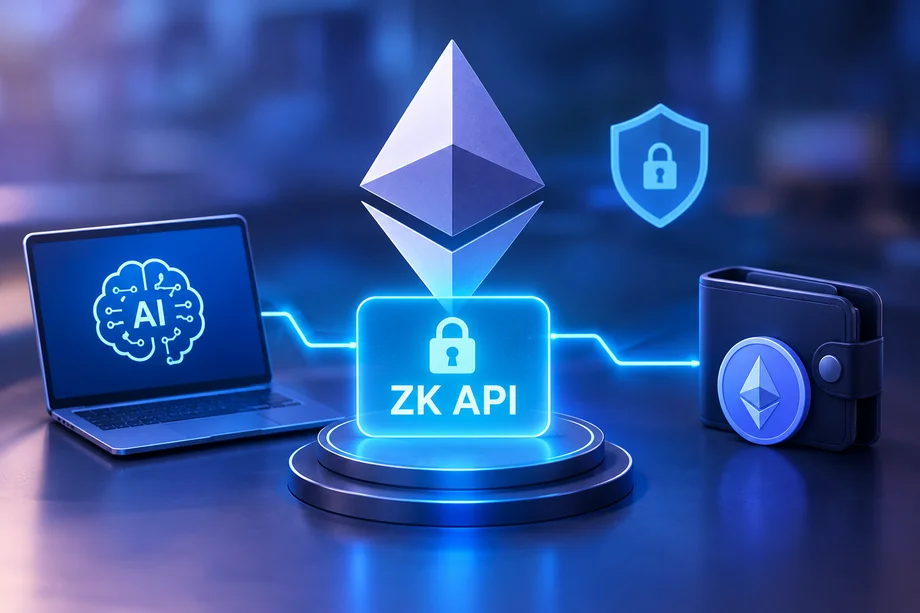
A new zero-knowledge system lets users fund and authorize metered API access, including AI services, without linking payments to their identities
The Ethereum Foundation, working with the Open Anonymity Project, has brought zkAPI live on Ethereum mainnet. The system enables users to pay for artificial intelligence models and other metered application programming interfaces while keeping billing identities separate from the requests themselves.
Announced on October 1, 2026, zkAPI turns an earlier research design into a functioning mainnet tool. Users deposit supported tokens such as ETH or USDC into a vault contract. Those deposits convert into private notes that can be spent through zero-knowledge proofs without revealing which deposit or user is involved.
How the Payment Separation Works
After a single ordinary deposit transaction, the user’s balance exists as digital cash that only the owner can spend. Software running on the user’s device generates a zero-knowledge proof showing that a funded note covers a proposed spend and has not been used before. The proof reveals neither the specific note nor the depositor’s identity.
A server verifies the proof and issues a temporary API key carrying a predefined spending limit. The user then sends prompts or requests directly to the service provider using that key. When the key expires, the provider supplies a signed usage receipt. The payment layer deducts the actual consumption from the private balance rather than the reserved amount.
Two cryptographic elements secure the process. Deposits appear as commitments inside a Merkle tree, allowing a proof to confirm membership without identifying any particular entry. Each spend produces a nullifier, a one-way serial number derived from the note’s secret. Attempted double-spending surfaces as a duplicate nullifier and nothing more.
The system also supports a simpler proxy mode in which the zkAPI server relays traffic. The preferred runtime-key approach keeps content and payment paths fully separate so that no intermediary ever views both.
Immediate Use Cases and Integration
Primary focus rests on AI inference because prompts often contain sensitive personal, financial or professional details. The same contracts and client can support additional metered services, including blockchain RPC queries, image and video generation jobs, VPN bandwidth and payments between autonomous agents.
Developers receive a local client, a software development kit and a browser-based chat interface. Existing applications that already speak the OpenAI or Ollama APIs can point at localhost and continue operating without code changes. Funds remain under user control inside an on-chain vault; balances can be closed and withdrawn even if every supporting server disappears.
Ken Liu, a Stanford computer science PhD candidate involved with the Open Anonymity Project, described the release as a generalization of earlier unlinkable inference work that also abstracts payments away. He added that more infrastructure should exist where privacy and sovereignty form the foundation and people retain control.
Known Limitations
zkAPI separates payment identity from service usage but does not conceal prompt contents or network metadata. Providers still receive the text of requests and can observe IP addresses, timing patterns or repeated conversational details. Users who require stronger network protection may route traffic through Tor and open a fresh circuit for each session.
Content-based linkage remains possible when the same personal facts, writing style or conversation history reappear across sessions. Standalone queries improve privacy at the cost of reduced context. Local or trusted-execution-environment models can mitigate some of this leakage by generating requests from shared memory rather than raw user text.
The project characterizes the current implementation as experimental. Cryptographic components include Groth16 proofs on the BN254 curve, Poseidon hashing and a 32-level Merkle tree. Server-side verification occurs off-chain, while the vault contract itself checks proofs for deposits, closures and emergency escapes.
Origins and Current Status
The design originated in a February 2026 research note by Ethereum Foundation researcher Davide Crapis and Ethereum co-founder Vitalik Buterin that proposed zero-knowledge API usage credits. The Open Anonymity Project collaborated with the Foundation’s dAI team to turn the concept into client software, servers and mainnet contracts.
Vittorio Rivabella, AI coordinator at the Foundation’s dAI team, confirmed that deposits into the vault allow zero-knowledge proofs to demonstrate available credit without disclosing the underlying notes. Temporary keys carry spending limits, prompts travel directly to providers, and settlement occurs through the separate payment layer.
zkAPI is operational on Ethereum mainnet today, with a corresponding Sepolia test deployment available for experimentation. The vault currently holds USDC credits, and documentation, GitHub repositories and a live browser chat interface have been released for developers and users.

Disclaimer
This article was generated by AI using information from multiple industry sources. It has not been reviewed or verified by a human editor and may contain inaccuracies, omissions, or misinformation. Readers are encouraged to independently verify any information before making decisions based on its content.Tired of the noise?
Let the bots trade for you.
Trade 24/7, without emotion, with data-driven strategies.
Associated articles

Vitalik Buterin Tests Three-Layer Setup to Protect Personal Data in Remote AI Queries
Aztec Labs Relaunches zk.money Privacy Wallet on Ethereum Layer 2 After Three-Year Hiatus

Vitalik Buterin Unveils Privacy Mode for AI Agents Combining Tor and zkAPI

AmericanFortress Proposes Quantum-Safe Wallet Scheme Without Fund Migration

MoonPay Launches PayBox Vault for Crypto Transactions in ChatGPT and Claude
Latest articles

CoinDCX Confirms Losses After Suspicious $16M Transfers From 2025 Hack Wallets

Robinhood Secures Dubai License for Crypto and Stock Trading, Middle East Launch Delayed to 2027

CZ Warns Crypto Users Over Two Critical PHP Vulnerabilities

Bybit Fintech FZE Receives VARA Licence for Dubai Spot Trading