Newsroom
Canada's OSFI Confirms Tokenized Deposits Share Legal Status with Traditional Bank Deposits
12 September, 2026 / News / AI / Tags: osfi, deposits, institutions, tokenized, legal
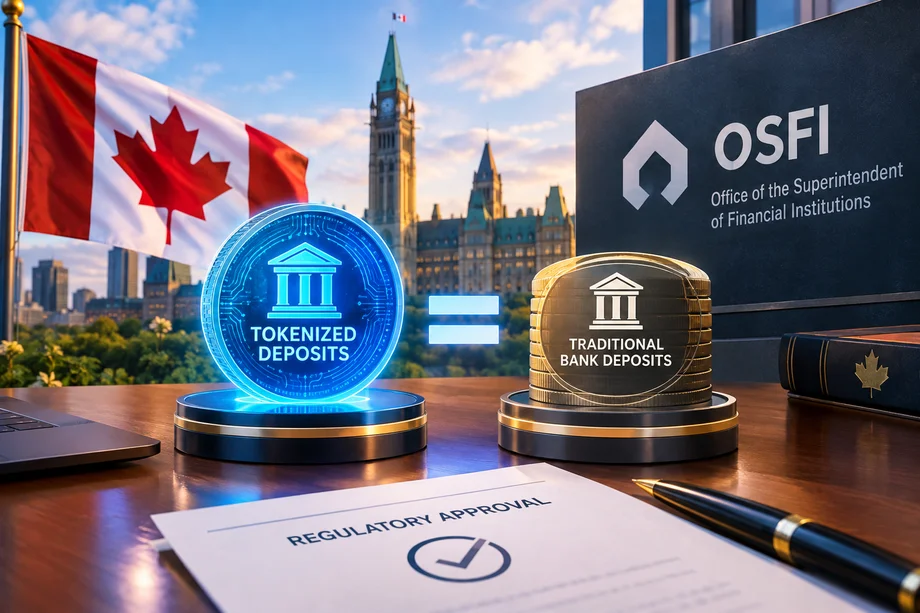
Canada’s banking regulator clarified on September 10 that tokenized deposits carry the same legal standing as conventional deposits under a technology-neutral approach, while existing risk rules continue to apply
Canada’s Office of the Superintendent of Financial Institutions issued a formal statement on September 10, 2026, confirming that tokenized and other digitally represented deposits are not legally distinct from traditional bank deposits. The clarification removes a key source of uncertainty for federally regulated financial institutions exploring blockchain-based deposit products.
OSFI stated that the underlying technology of a financial product or service does not determine its legal nature. The regulator focuses on the substance of the product rather than the method of construction or delivery. As a result, recording a deposit as a token on a distributed ledger does not create a separate legal category.
The statement applies to institutions governed by federal legislation including the Bank Act, the Trust and Loan Companies Act, and the Insurance Companies Act. OSFI described the position as technology-neutral and noted that advances in digital financial technology are enabling institutions and their third-party providers to develop such products.
Existing Compliance Requirements Remain in Force
The clarification does not relax supervisory expectations. Federally regulated institutions remain fully responsible for ensuring that innovative activities, including those carried out by third parties on their behalf, comply with all applicable laws and regulations.
Institutions must continue to meet OSFI’s existing guidance on technology and cyber risk management under guideline B-13 and third-party risk management under guideline B-10. Banks are expected to consult their OSFI lead supervisors before launching any novel products or services and to obtain legal advice where appropriate.
Tokenized deposits represent a direct claim on the issuing bank and retain the legal characteristics of conventional deposits. Their value and status derive from the bank’s creditworthiness rather than from the ledger technology used to record them. This distinguishes them from stablecoins, which typically rely on separate reserve arrangements.
2027 Crypto-Asset Capital Framework Published Concurrently
Alongside the deposit statement, OSFI released its final Capital and Liquidity Treatment of Crypto-asset Exposures (Banking) Guideline for 2027. The framework sets out how banks must hold capital and manage liquidity for crypto-asset exposures.
Qualifying tokenized deposits that preserve the same legal rights as traditional deposits, including claims in insolvency and redeemability at par in fiat currency, fall into Group 1a. These instruments generally receive the same credit-risk treatment as conventional deposits, consistent with Basel Committee standards for tokenized traditional assets.
The guideline takes effect on November 1, 2026, for institutions with a fiscal year ending October 31, and on January 1, 2027, for those with a fiscal year ending December 31. OSFI indicated it will continue to monitor market developments and may adjust the framework as evidence and international standards evolve.
Implications for Canadian Banks
By confirming that no new regulatory classification is required, the statement provides federally regulated institutions with greater certainty to explore tokenized deposit products for payments, settlement and treasury operations. Banks can now assess these offerings under the existing legal and prudential framework rather than waiting for specialized legislation.
Institutions must still demonstrate robust operational controls, cyber resilience and third-party oversight. Supervisory engagement prior to launch remains a core expectation. The combined announcements signal that Canada is integrating distributed-ledger technology into regulated banking activity while maintaining established safety and soundness standards.
Disclaimer
This article was generated by AI using information from multiple industry sources. It has not been reviewed or verified by a human editor and may contain inaccuracies, omissions, or misinformation. Readers are encouraged to independently verify any information before making decisions based on its content.Tired of the noise?
Let the bots trade for you.
Trade 24/7, without emotion, with data-driven strategies.
Associated articles

Canada’s Big Six Banks Launch Pilot for Shared Tokenized CAD Deposits

US State Banking Groups Form BankChain Alliance for 2027 Nationwide Blockchain Network

Oracle Connects Banks to SWIFT Blockchain Ledger for Tokenized Payments

IBM Connects Digital Asset Haven to Swift Blockchain for Tokenized Deposits

Itaú Unibanco Joins Brazil Pilot to Tokenize Bonds and Investment Funds
Latest articles

Singapore, Malaysia and Thailand Central Banks Expand BLOOM for Cross-Border Digital Money Settlement

Heatbit Launches $899 Bitcoin-Mining Water Heater Element for Existing Tanks

Underdog Partners With Zerohash for Crypto and Stablecoin Account Funding

Chainlink Teams With LG CNS to Advance Korean Stablecoins and Tokenization