Newsroom
Zcash Mining Delivers Up to Four Times Bitcoin Revenue Per Unit of Power
12 September, 2026 / News / AI / Tags: zcash, mining, grayscale, zec, megawatt
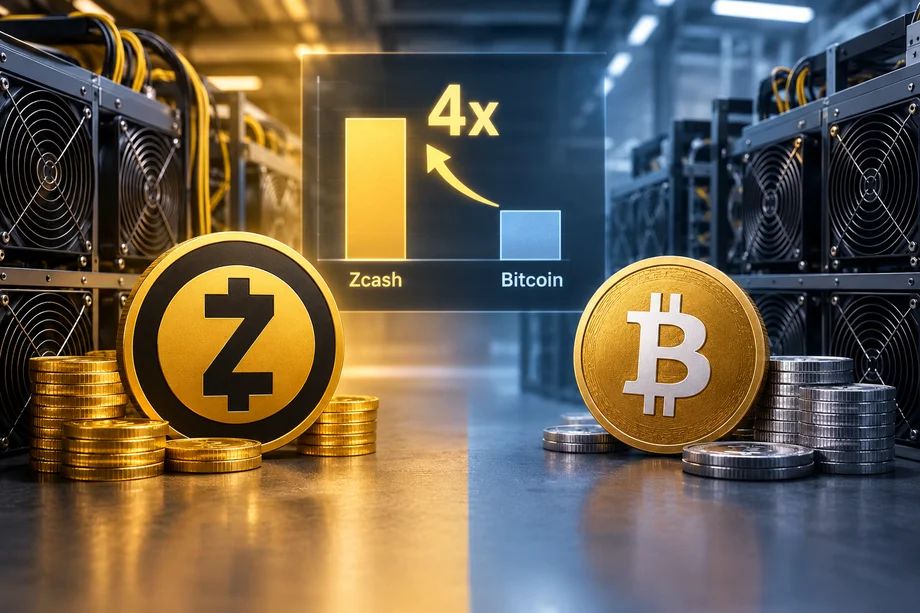
Grayscale analysis shows Zcash machines generating roughly double the daily revenue of comparable Bitcoin hardware, with even larger advantages measured by electricity use amid a sharp ZEC price rally and new ETF access
Zcash mining has become substantially more lucrative than Bitcoin mining on both a per-machine and per-megawatt-hour basis in 2026, according to estimates from Grayscale Research. While the Bitcoin network continues to generate far higher total daily rewards due to its much larger scale, individual Zcash operators are capturing stronger returns relative to their equipment and power consumption.
Grayscale Research Director Zach Pandl estimated that Zcash miners collectively earn about $2 million in daily revenue, compared with roughly $35 million across the Bitcoin network. On a per-rig basis, a typical Zcash mining machine produces about twice the daily revenue of a comparable Bitcoin unit. When measured by electricity consumption, the advantage widens further: Zcash mining generates approximately four times as much revenue per megawatt-hour.
Price Rally and ETF Launch Fuel Mining Interest
The shift in mining economics stems largely from ZEC’s strong price performance this year. The privacy-focused cryptocurrency climbed above $1,000 for the first time on September 4, following gains that lifted its market capitalization into the tens of billions of dollars. Earlier data showed ZEC trading near $1,180 with a market value around $20 billion in early September, though prices later fluctuated near $1,093 amid broader market moves.
Supporting the price advance was the conversion of Grayscale’s Zcash Trust into an exchange-traded product. The fund, trading under the ticker ZCSH on NYSE Arca, listed on August 25 and quickly attracted significant inflows. Assets under management surpassed $500 million within two weeks of the debut, including a substantial contribution of ZEC tokens from an affiliate of Grayscale’s parent company.
Higher ZEC prices directly increase the dollar value of block rewards paid to miners. This has encouraged operators to expand capacity, driving total Zcash mining activity more than 2.5 times higher since the beginning of 2026.
Hardware Economics Favor Specialized Zcash Rigs
Detailed comparisons of specific mining equipment illustrate the disparity. Data cited in recent reports showed a Bitmain Z15 Pro dedicated to Zcash generating around $727 per megawatt-hour in August, later easing slightly to about $708 as more machines joined the network. By contrast, a leading Bitcoin machine such as the Bitmain S23 Pro returned roughly $179 per megawatt-hour over a similar period, while an older S21 Pro managed about $113.
In some analyses, Zcash mining revenue per unit of electricity has even exceeded returns available from certain artificial intelligence and high-performance computing cloud services. One earlier assessment placed AI colocation revenue near $223 per megawatt-hour, still well below peak Zcash figures.
Zcash relies on the Equihash algorithm, while Bitcoin uses SHA-256. As a result, mining hardware is not interchangeable. Operators cannot simply redirect the same machines from one network to the other when relative profitability changes.
Network Growth and Competitive Pressures
Rising participation is already affecting individual margins. As the Zcash solrate increases faster than the token price in some periods, each miner’s share of the fixed monthly block rewards shrinks. The network issues roughly 43,800 ZEC per month in rewards, and higher difficulty automatically adjusts as more hash power comes online.
Several companies have moved aggressively into the space. Cypherpunk Technologies, backed by Cameron and Tyler Winklevoss, invested more than $33 million to build what it described as the world’s largest Zcash mining fleet, accounting for a significant share of network capacity. Foundry USA launched an institutional-grade Zcash mining pool that rapidly captured nearly 30 percent of mining share. Other firms linked to major industry groups have acquired power capacity specifically for Zcash operations.
Grayscale’s figures measure gross revenue rather than net profit. Actual returns for any operator depend on electricity rates, equipment costs, cooling, maintenance, facility expenses, and mining pool fees. Continued growth in network hash rate will raise difficulty further, potentially compressing per-machine revenue unless ZEC prices or transaction fees rise in tandem.
Broader Context for Proof-of-Work Mining
The attractiveness of Zcash mining arrives as some Bitcoin operators face tighter conditions. Bitcoin’s price retreated from recent highs near $82,000 and traded around $77,000 in early September, while network difficulty was expected to increase. Several publicly listed mining companies have reported declining revenues and guided for softer results in subsequent quarters. A number of firms have also redirected power capacity toward artificial intelligence compute contracts.
Zcash follows a scarcity model similar to Bitcoin, with a maximum supply of 21 million coins and scheduled reductions in block rewards. Lower future issuance will require higher token prices, greater fee revenue, or more efficient hardware to maintain current profitability levels for miners.
At present valuations, Grayscale views Zcash mining as remaining attractive, with the influx of new computing power reinforcing the network’s security. The combination of specialized hardware economics, strong recent price action, and institutional product access has created a distinct opportunity within the proof-of-work mining sector.


Disclaimer
This article was generated by AI using information from multiple industry sources. It has not been reviewed or verified by a human editor and may contain inaccuracies, omissions, or misinformation. Readers are encouraged to independently verify any information before making decisions based on its content.Tired of the noise?
Let the bots trade for you.
Trade 24/7, without emotion, with data-driven strategies.
Associated articles

Bitcoin Enters First Hashrate Bear Market as Miners Pivot to AI
Cypherpunk Technologies Deploys Largest Zcash Mining Operation via $33.3 Million Winklevoss Deal

Fidelity Defends Bitcoin Security After Halvings

Grayscale Positions Zcash as Privacy-Focused Challenger to Bitcoin Amid ETF Launch and Research Report

Bitcoin Mining Difficulty Drops 10% in Second Largest Fall of 2026
Latest articles

CoinDCX Confirms Losses After Suspicious $16M Transfers From 2025 Hack Wallets

Robinhood Secures Dubai License for Crypto and Stock Trading, Middle East Launch Delayed to 2027

CZ Warns Crypto Users Over Two Critical PHP Vulnerabilities

Bybit Fintech FZE Receives VARA Licence for Dubai Spot Trading