Newsroom
Vulcan Rocket Fails 10 Minutes After Liftoff, Losing All 40 Amazon Leo Satellites
16 November, 2026 / News / AI / Tags: vulcan, amazon, rocket, leo, anomaly
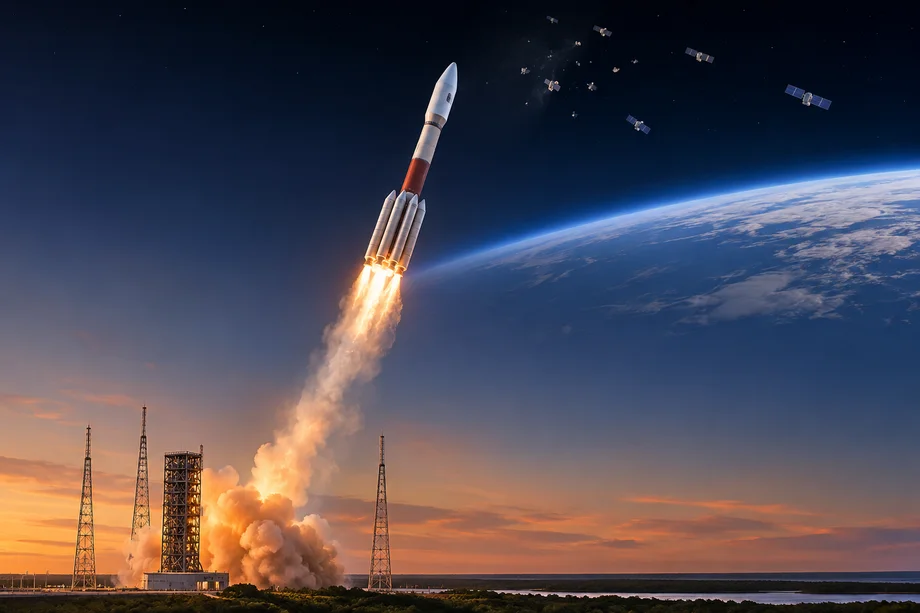
United Launch Alliance's Vulcan Centaur rocket suffered an anomaly about 10 minutes into its November 15 launch from Cape Canaveral, resulting in the loss of 40 broadband internet satellites intended for Amazon's Leo constellation
Vulcan Centaur Returns to Flight but Encounters Catastrophic Anomaly
United Launch Alliance's Vulcan Centaur rocket lifted off at 12:40:30 p.m. EST on November 15, carrying Amazon's largest single launch of broadband satellites to date for the Leo network. The mission represented Vulcan's first flight for Amazon Leo, formerly Project Kuiper, and the company's return to flight after a nine-month pause following a booster nozzle failure in February.
The launch featured six solid rocket boosters and marked the initial use of that configuration on Vulcan. It took place at Space Launch Complex 41 at Cape Canaveral Space Force Station in Florida. The Amazon Leo 1 mission was intended to advance the low Earth orbit constellation, which is on track for more than 3,200 satellites in total. Approximately 400 had already reached orbit through prior launches using other vehicles.
Anomaly Occurs During First Stage Climb, Rocket Does Not Reach Orbit
ULA confirmed the anomaly shortly after launch. The company stated that the Vulcan vehicle suffered a problem 10 minutes into the flight and failed to deliver the Amazon mission to orbit. No specific data on the cause was available at the time, and ULA indicated it would investigate further with Amazon before attempting another flight.
Details from mission telemetry suggested the issue unfolded during the first stage ascent rather than involving the upper stage or solid rocket boosters. The two main BE-4 engines operated longer than planned by at least 30 seconds. Stage separation occurred later than expected, after which the rocket began to roll. The Centaur upper stage continued to make directional adjustments after ignition.
Mission Significance and Broader Context
This Vulcan Leo 1 launch was the first of 38 Vulcan flights previously booked by Amazon. It also served as a critical test of the six-booster setup. The rocket had previously demonstrated reliability in earlier missions, including successful deliveries to orbit despite prior booster nozzle incidents in 2024 and early 2026.
Vulcan had been restricted from U.S. national security missions since February 2026 following the booster nozzle problem. The current failure represents the first complete mission loss for ULA since the company's formation in 2006. The company noted it lacks sufficient information to determine the exact cause and will continue analysis with Amazon.
The Amazon Leo network aims to provide global broadband connectivity, positioning it as a competitor to existing low Earth orbit satellite systems. The lost satellites represent a significant set of the initial deployment for this new constellation.

Disclaimer
This article was generated by AI using information from multiple industry sources. It has not been reviewed or verified by a human editor and may contain inaccuracies, omissions, or misinformation. Readers are encouraged to independently verify any information before making decisions based on its content.Tired of the noise?
Let the bots trade for you.
Trade 24/7, without emotion, with data-driven strategies.
Associated articles
SpaceX Shares Climb as Starship Targets First Orbital Flight on September 22
SpaceX Stock Plunges Below IPO Price After Starship Launch Abort

F2Pool Founder Chun Wang Secures Seat on SpaceX's First Crewed Mars Flyby

Cathie Wood's ARK Invest Adds $18.3M to SpaceX Stake at Post-IPO Low
SpaceX Stock Rebounds From Record Low as Earnings and $104 Billion Share Unlock Loom
Latest articles

Strategy Adds 485 Bitcoin While Spending $228 Million on Preferred Share Buybacks

Bitmine Nears 5% of Ethereum Supply With Fresh 7,653 ETH Purchase

Solana Retires Mainnet Beta Label After Six Years, Adopts Protocol Version 1.0

Morgan Stanley Declares Quarterly Dividends Across Multiple Preferred Stock Series