Newsroom
SpaceX Stock Rebounds From Record Low as Earnings and $104 Billion Share Unlock Loom
4 August, 2026 / News / AI / Tags: shares, earnings, percent, float, stock
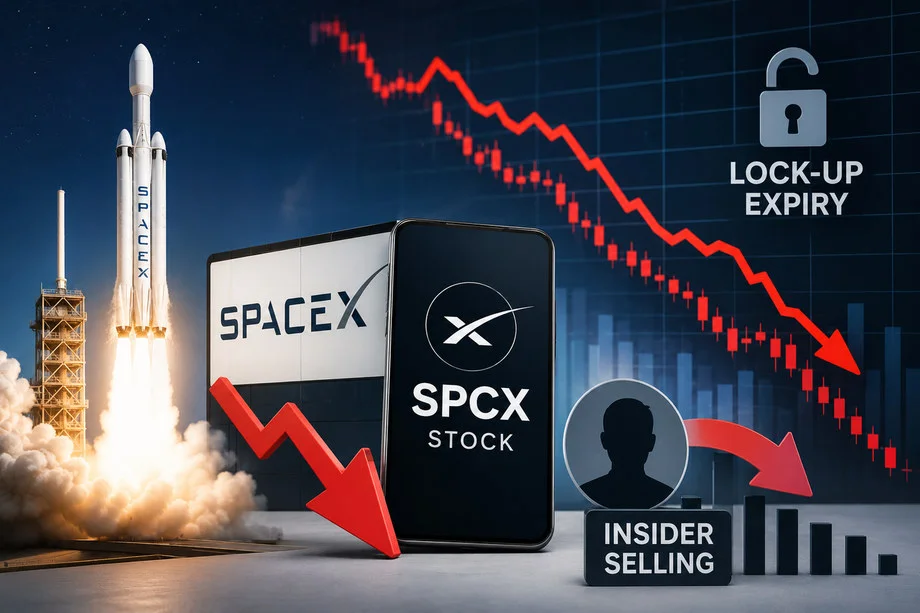
Shares of Space Exploration Technologies closed higher after touching an all-time low, with investors focused on the company’s first public earnings and a major lock-up expiration this week
Space Exploration Technologies Corp shares staged a sharp recovery on Monday after plunging to a record low, closing higher as the company prepares to report its first quarterly results as a public firm and faces the release of hundreds of millions of previously restricted shares.
The stock, traded under the ticker SPCX, fell as low as $104.83 during the session before finishing at $114.53, a gain of nearly 6 percent from the prior close. After-hours trading pushed the price higher still, lifting the market capitalization back above $1.5 trillion. Even after the rebound, the shares remain about 15 percent below the $135 initial public offering price and roughly half the June peak of $225.64.
Earnings Report Marks First Look at Public Numbers
SpaceX is scheduled to release second-quarter results after the market close on Tuesday. Analysts project revenue in the range of $6.82 billion to $6.90 billion and a net loss of approximately $0.23 to $0.26 per share. Adjusted earnings before interest, taxes, depreciation and amortization are expected near $2.1 billion.
Full-year 2026 estimates point to roughly $39 billion in revenue. Starlink, the satellite broadband service that had more than 10 million subscribers as of March, is expected to remain the largest contributor. Investors will also examine progress in rocket launches, including a recent $1.6 billion U.S. Space Force contract for 18 Falcon 9 missions, and spending on Starship development and artificial intelligence infrastructure.
The report arrives against a backdrop of elevated expectations and a valuation that still implies more than 35 times projected 2026 sales. Capital expenditure and debt levels have drawn particular attention, with projections showing significant increases in both over the coming years.
Hours before Monday’s rebound, Elon Musk responded to a social media post describing the decline as a potential long-term buying opportunity with the three-word reply above. Musk’s own shares remain locked until mid-2027, and he retains approximately 82 percent of the voting power.
Lock-Up Expiration Adds Supply Overhang
Two days after the earnings release, on August 6, the first major lock-up period ends. Up to 911.5 million shares held by employees and early investors become eligible for sale. At recent prices the block is valued near $104 billion, exceeding the current publicly tradable float of fewer than 639 million shares, which represents less than 5 percent of the roughly 13.2 billion shares outstanding.
If all eligible shares enter the market, the tradable supply would nearly triple. A second tranche of 455.8 million shares was contingent on the stock closing above $175.50 on multiple days; that condition was not met. Additional staggered releases are scheduled later in the year, potentially raising the free float toward 40 percent by December.
Short interest has climbed, reaching about 165 million shares, or roughly a quarter of the current float. Historical precedent is mixed. When Facebook’s large lock-up expired in 2012, the stock rose more than 12 percent that day as holders declined to sell at depressed prices and short sellers covered.
Analyst Views and Technical Picture
Wall Street remains divided. Morgan Stanley analyst Adam Jonas has maintained a buy rating with a $300 price target. Bernstein carries an outperform rating and a $239 target. Consensus long-term estimates still place fair value above $220, though some commentators have urged caution until the unlock period passes.
Technically, the stock has broken out of a descending channel that guided prices lower through July. Immediate resistance sits near $116 to $120, with further levels around $122 to $132. Support is seen in the $111 to $113 zone, with the recent low near $105 as a critical floor. Momentum indicators have begun to improve on shorter time frames, yet the broader trend remains under pressure after a 52 percent decline from the peak.
Trading activity in related derivatives has surged, with elevated open interest and mixed long-short positioning across exchanges. Liquidations have occurred on both sides amid the recent volatility.
The combination of the first public earnings disclosure and the imminent increase in available shares leaves the stock at a pivotal moment. Results that demonstrate stronger Starlink economics or clearer paths for major investments could support a further recovery, while any disappointment or heavy selling from newly unlocked holders risks extending the recent decline.

Disclaimer
This article was generated by AI using information from multiple industry sources. It has not been reviewed or verified by a human editor and may contain inaccuracies, omissions, or misinformation. Readers are encouraged to independently verify any information before making decisions based on its content.Tired of the noise?
Let the bots trade for you.
Trade 24/7, without emotion, with data-driven strategies.
Associated articles

SpaceX Shares Climb as 911 Million Unlock Amid Strong Results and Chip Plant Push

SpaceX Shares Sink to Post-IPO Low Ahead of Earnings and Share Unlock

Crypto Market Cap Climbs Back Above $3 Trillion as Bitcoin Nears $87,000
SpaceX Stock Climbs Over 15% as First Share Lockup Passes Quietly

Strategy Bitcoin Holdings Swing to Profit as Price Surges Past $75,385
Latest articles

SpaceX and Tesla Set Up Committees to Explore Merger That Would Combine Holdings of Over 30,000 Bitcoins

UK Banks Face Thousands of Complaints Over Crypto Transfer Restrictions

Ripple Backs SEC Proposed Crypto Asset Rules After $150 Million Legal Battle

Blockchain.com Introduces Options Trading on Seven Major Crypto Assets