Newsroom
SpaceX Shares Climb as Starship Targets First Orbital Flight on September 22
17 September, 2026 / News / AI / Tags: starship, flight, spacex, starlink, satellites

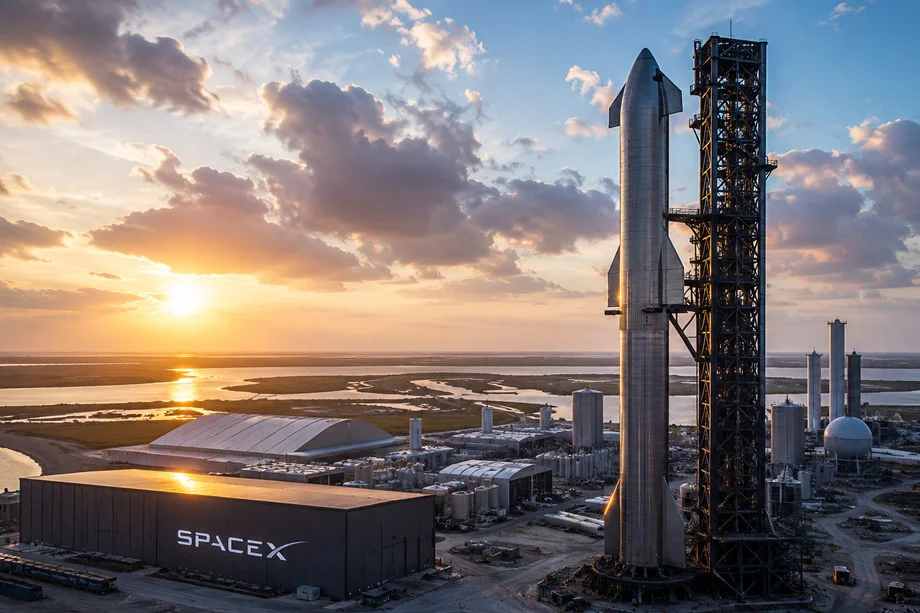
SpaceX stock advanced more than 5% after the company confirmed a September 22 launch window for Starship Flight 14, its first planned orbital mission carrying operational Starlink satellites
Shares of SpaceX advanced sharply in Wednesday trading following confirmation that Starship Flight 14 is targeted for September 22. The mission marks the vehicle’s first attempt to reach a stable orbit and deploy a working payload of Starlink satellites.
Intraday trading saw the stock rise as much as 5.89% to $151.94, lifting the company’s market capitalization above the $2 trillion mark from the prior close of $143.49. Shares later settled near $150.88 at the close, up 5.15% on the day, with after-hours trading pushing the price to $152.33. Trading volume exceeded the recent average as investors responded to the updated launch schedule.
Mission Profile for Flight 14
The 75-minute launch window opens shortly after 8 a.m. Eastern time from Starbase in South Texas, subject to regulatory clearance. Starship is expected to reach an altitude of approximately 275 kilometers, complete about six orbits of Earth, and remain in flight for roughly 10 hours before a planned splashdown in the Pacific Ocean west of Chile.
The Super Heavy booster is scheduled to return to the Gulf of Mexico. Neither stage is planned for recovery or catch on this flight. The upper stage will carry 26 Starlink Version 3 satellites, the first operational batch the vehicle has flown. Three of the satellites are equipped with cameras to document the heat shield after deployment.
All 13 earlier Starship flights remained suborbital. The September 22 attempt is therefore viewed as a critical step in moving the program from developmental testing toward revenue-generating operations.
Investor Focus on Revenue Potential
Market participants have linked the stock’s move to the prospect that Starship can begin generating commercial returns through Starlink capacity. ARK Invest’s Cathie Wood reiterated projections that a single fully loaded Starship flight could produce around $1 billion in revenue based on estimated capacity of 61 terabits per second and Starlink’s reported earnings per unit of bandwidth.
At a theoretical cadence of 10,000 flights per year, the resulting annual revenue figure would reach $10 trillion by 2030 under those assumptions. Wood has described SpaceX’s initial public offering valuation of $1.75 trillion as attractive on that long-term basis. Separate commentary has also pointed to the company’s AI computing segment, which reports contracts including roughly $1.25 billion per month from Anthropic and about $920 million per month from Google later this year, as an additional growth driver that could support higher overall valuations.
Of 34 analysts tracked for the stock, 26 currently rate it a buy. The average price target stands at $232.07, with individual targets ranging from $75 to $800.
Additional Launch Activity
On the same day the Starship schedule was confirmed, SpaceX successfully flew a Falcon 9 rocket carrying the classified USSF-259 mission for the U.S. Space Force from Vandenberg Space Force Base. The flight used booster B1097 on its 13th mission. Payload details remain undisclosed, though the mission is consistent with national-security work involving the company’s Starshield platform.
SpaceX continues to operate its launch, satellite internet, and computing businesses as distinct segments. The company is scheduled to report its next quarterly results around November 3. Investors are also monitoring future share-unlock dates that could increase available supply.
The September 22 flight remains the near-term focal point. Success would demonstrate orbital insertion and payload deployment capabilities that earlier tests did not achieve, while any delay or anomaly would return attention to the technical challenges still facing the Starship program.

Disclaimer
This article was generated by AI using information from multiple industry sources. It has not been reviewed or verified by a human editor and may contain inaccuracies, omissions, or misinformation. Readers are encouraged to independently verify any information before making decisions based on its content.Tired of the noise?
Let the bots trade for you.
Trade 24/7, without emotion, with data-driven strategies.
Associated articles

Morgan Stanley Reaffirms $300 Target for SpaceX Shares as Stock Climbs on AI Valuation Case

SpaceX Reports Record $14.6 Billion Revenue in Q3 as AI Division Surges Past Starlink

SpaceX Stock Plunges Below IPO Price After Starship Launch Abort

Cathie Wood's ARK Invest Adds $18.3M to SpaceX Stake at Post-IPO Low
SpaceX to Invest $100 Billion in Louisiana Spaceport, Aiming for World's Largest Launch Site
Latest articles

Zcash Co-Founder Proposes Redirecting 8% of Block Subsidies to Network Reserve

Bitcoin Monte Carlo Simulations Point to Median Value of $1.03 Million in 2033

S&P Global Completes Acquisition of OpenZeppelin Smart Contract Security Firm

Franklin Templeton Files Two ETFs to Convert US Stock Dividends into Bitcoin