Newsroom
Visa Survey Shows Bank-Level Protections Could Lift US Stablecoin Use to 56%
23 September, 2026 / News / AI / Tags: visa, stablecoins, percent, willingness, insurance
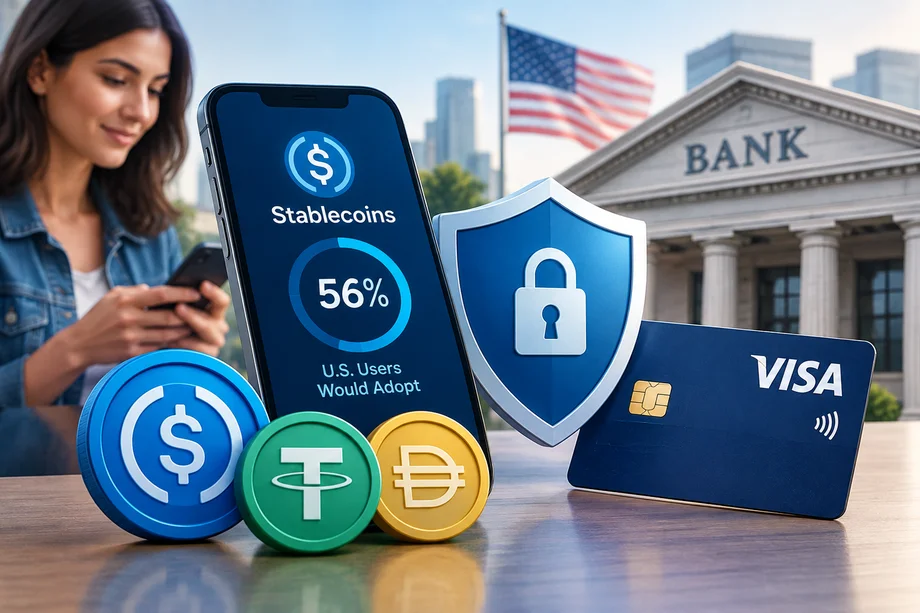
A new Visa report finds American interest in stablecoins for international transfers rises sharply when fraud protection and deposit insurance are added in a hypothetical scenario
Visa’s Money Travels 2026 report indicates that stronger consumer safeguards could meaningfully expand willingness to use stablecoins for cross-border payments among US consumers. The payments network released survey results showing that current adoption intention stands at 36 percent, climbing to 56 percent if bank-level fraud protection and deposit insurance were available.
The findings come from research conducted by Morning Consult between February 24 and March 2. The firm polled 45,445 participants across 20 markets, including 2,192 adults in the United States. Respondents expressed interest in faster and lower-cost methods for sending money abroad, pointing to unmet demand for improved international payment options.
Trust in Providers Outweighs Technology
Trust emerged as a central factor. Nearly two-thirds of US respondents, or 64 percent, said confidence in a payment method depends more on the entity offering it than on the underlying technology. Willingness to use stablecoins increased from 36 percent to 45 percent when the assets were presented as services from an existing financial provider.
About 61 percent of those surveyed said they would trust a traditional bank with digital currency services, while 60 percent favored a global payments company. Awareness remains limited: 56 percent of Americans reported they had never heard of stablecoins, and many who were familiar with the term incorrectly assumed the assets experience price swings similar to those of more volatile cryptocurrencies.
Security concerns also rank high. Among American remitters, 36 percent said they had encountered a scam while making cross-border payments, and 44 percent expressed worry about AI-generated deepfake scams that impersonate relatives.
Similar Patterns Appear Outside the United States
The increase in willingness when protections are added was not confined to the US market. In Latin America, openness to using stablecoins for international transfers rose from 34 percent to 74 percent under the same hypothetical conditions featuring bank-style safeguards.
Visa stressed that the scenario is hypothetical and does not indicate that Federal Deposit Insurance Corporation coverage or equivalent fraud protections currently exist for stablecoins or are expected to be introduced in the near term. Stablecoins, which are digital tokens typically pegged to the US dollar, lack the deposit insurance and fraud protections attached to traditional bank accounts.
Visa Expands Stablecoin Settlement Infrastructure
Visa continues to build supporting systems for stablecoin transactions. The company reported that its annualized stablecoin settlement volume now exceeds $20 billion, a sharp rise from the $3.5 billion run rate recorded when it began settling transactions in USD Coin on the Solana network last December. In August, Visa Direct expanded to include stablecoin payouts through the crypto platform Zerohash.
Broader market data show continued growth. BlackRock estimated that the stablecoin market capitalization surpassed $300 billion this month, with more than $11 trillion in adjusted transaction volume recorded last year. US dollar-pegged tokens such as USDC and USDT remain the largest, holding a combined market value of approximately $260 billion according to other recent figures. The asset manager has projected that AI-powered agents could support the next phase of adoption.
| Region | Current Willingness | With Bank-Level Protections |
|---|---|---|
| United States | 36% | 56% |
| Latin America | 34% | 74% |
Regulatory Developments in the US and Europe
The survey arrives as the United States prepares for the Guiding and Establishing National Innovation for US Stablecoins Act, known as the GENIUS Act. The legislation awaits final rules from financial regulators and is expected to take effect in January 2027. The measure is not anticipated to require FDIC-style insurance for stablecoins, though it aims to establish clearer operational guidelines and measures addressing illicit activity.
In Europe, the European System of Central Banks has called for adjustments to reserve requirements under the Markets in Crypto-Assets regulation. MiCA rules for stablecoins began enforcement in June 2024 and currently mandate that issuers hold at least 30 percent of reserves as bank deposits, or 60 percent for tokens classified as significant. The central banks group proposed shifting to specific liquidity thresholds instead, citing potential risks to banks if large numbers of users withdraw deposits simultaneously.
Payments infrastructure firm Decta reported that the combined market capitalization of MiCA-compliant euro-pegged stablecoins more than doubled between 2025 and 2026 as the transition period approached its end. Despite regional regulatory progress, dollar-pegged tokens continue to dominate global stablecoin activity.
Disclaimer
This article was generated by AI using information from multiple industry sources. It has not been reviewed or verified by a human editor and may contain inaccuracies, omissions, or misinformation. Readers are encouraged to independently verify any information before making decisions based on its content.Tired of the noise?
Let the bots trade for you.
Trade 24/7, without emotion, with data-driven strategies.
Associated articles

Nearly Half of Asia Pacific Consumers Eye Stablecoins as Affluent Investors Hold Crypto

BIS Warns $316 Billion Stablecoin Market Threatens Global Monetary System
European Stablecoin Issuers Push for Regulated USD Tokens Amid Global Trade Needs
Tether CEO Defends Stablecoins as BIS Pushes Tokenized Bank Deposits

Major Banks Advance Plans for Stablecoin Issuance Amid Rising Competition
Latest articles

Bumble Agrees to $1.3 Billion Take-Private Deal with Ithaca Holdings

Interactive Brokers Launches Ethereum Staking to Boost Client Rewards on Holdings

Sberbank Receives Approval to Trade Bitcoin and Ether

S&P Dow Jones Executes First On-Chain OTC Swap Referencing Tokenized Index on Canton