Newsroom
Tether CEO Defends Stablecoins as BIS Pushes Tokenized Bank Deposits
31 August, 2026 / News / AI / Tags: ndez, stablecoins, ardoino, deposits, bis
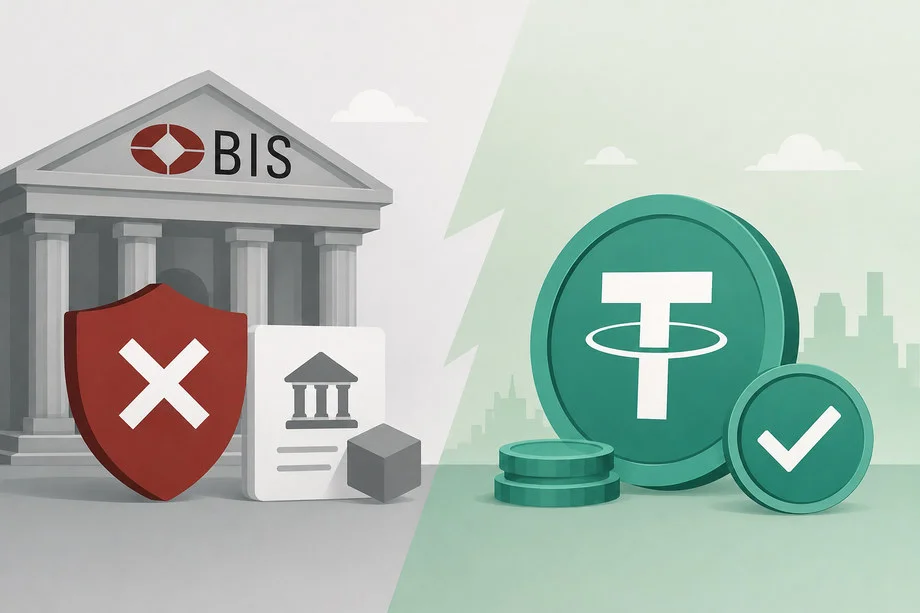
Paolo Ardoino challenges the Bank for International Settlements after its chief argued stablecoins lack credibility for large-scale payments and favored tokenized deposits instead
Tether CEO Paolo Ardoino has pushed back against recent comments from the Bank for International Settlements, insisting that fully reserved stablecoins offer a safer alternative to tokenized bank deposits. The exchange follows remarks by BIS General Manager Pablo Hernández de Cos at the Federal Reserve’s Jackson Hole Economic Symposium, where he said stablecoins in their current form do not function as a credible means of payment at scale.
BIS Concerns Over Stablecoin Shortcomings
Hernández de Cos told the symposium on August 28 that stablecoins fall short on several foundational properties of money. He pointed to problems with redeemability at par, interoperability across platforms and blockchains, and financial integrity, noting that controls against money laundering and terrorist financing are difficult to apply consistently when balances sit largely in self-custodied wallets.
He also raised issues of monetary sovereignty, warning that widespread use of dollar-pegged stablecoins outside the United States could contribute to digital dollarization and weaken domestic policy control in other countries. In his view, tokenized bank deposits provide a more direct route to capturing the benefits of tokenization while keeping the existing monetary system intact.
Under the BIS model, tokenized deposits remain liabilities of commercial banks and settle through central bank accounts. This structure, Hernández de Cos argued, helps preserve the “singleness” of money because different bank liabilities stay redeemable at par. By contrast, a holder of one stablecoin who needs to pay someone accepting only another may have to trade in secondary markets where prices can deviate from the dollar peg, especially during stress.
Hernández de Cos said the two forms of digital money could ultimately coexist, with tokenized deposits handling most everyday and wholesale payments and stablecoins limited to more specialized roles under clear rules.
Ardoino’s Response on Reserves and Safety
Ardoino rejected the premise that tokenized deposits represent a superior form of money. He argued that stablecoins, when fully backed by highly liquid assets such as U.S. Treasuries, expose what he described as the weaknesses of fractional-reserve banking.
Commercial banks typically hold only a portion of their liabilities in liquid assets, while properly designed stablecoins can maintain near-complete reserve coverage. Ardoino said this difference makes stablecoins a higher-quality alternative for savers.
He added that the growing use of stablecoins, particularly in emerging markets for both domestic and cross-border commerce, underscores their practical value. Ardoino framed the current period as one in which users may increasingly recognize the relative safety of fully reserved digital dollars and shift savings accordingly.
Banking Sector Pushback and Regulatory Debate
The disagreement coincides with rising concern among traditional banks about potential deposit outflows. In the United States, banking groups have urged lawmakers to tighten provisions in the Digital Asset Market Clarity Act that could allow certain rewards on stablecoin balances. Industry associations have warned that such incentives might pull funds from bank accounts and reduce the capital available for lending.
Hernández de Cos himself noted a related macroeconomic effect: while stablecoin demand for government securities could lower sovereign borrowing costs, a shift of deposits away from banks could raise funding costs for lenders and, ultimately, borrowing rates for households and firms.
Major banks are already advancing tokenized deposit projects. A group including JPMorgan Chase, Bank of America, Citigroup and Wells Fargo is developing a shared deposit token network through The Clearing House, with a targeted launch in the first half of 2027. SWIFT has also launched a blockchain-based shared ledger involving major global banks to support tokenized deposits for round-the-clock cross-border payments. Some smaller institutions are testing hybrid models that function as deposits within a closed network and as stablecoins when transferred outside it.
Hernández de Cos acknowledged that tokenized deposits still face practical hurdles. No fully interoperable multi-bank or cross-border framework currently exists, and most systems remain confined to permissioned platforms. Some designs, he noted, already resemble bank-issued stablecoins.
Broader Implications for Digital Money
The exchange between the BIS and Tether’s chief underscores a deeper contest over the architecture of future digital payments. Central banks and commercial banks favor models that keep money within the regulated two-tier system anchored by central bank settlement. Stablecoin issuers argue that transparent, fully reserved digital dollars already deliver superior safety and accessibility, especially where traditional banking services are limited or costly.
As both approaches continue to develop, the relative growth of stablecoins and tokenized deposits will test whether users prioritize the reserve quality of private digital dollars or the institutional safeguards of bank liabilities settled in central bank money.
Disclaimer
This article was generated by AI using information from multiple industry sources. It has not been reviewed or verified by a human editor and may contain inaccuracies, omissions, or misinformation. Readers are encouraged to independently verify any information before making decisions based on its content.Tired of the noise?
Let the bots trade for you.
Trade 24/7, without emotion, with data-driven strategies.
Associated articles
BIS Chief Questions Stablecoins for Large-Scale Payments, Favors Tokenized Deposits

ECB and EU Central Banks Urge Removal of MiCA Bank Deposit Rules for Stablecoins

BIS Warns $316 Billion Stablecoin Market Threatens Global Monetary System

Bank of England Considers Volume Guardrails as Alternative to Stablecoin Holding Limits

UK Banks Complete First Interbank Tokenized Deposit Transfers
Latest articles

SpaceX and Tesla Set Up Committees to Explore Merger That Would Combine Holdings of Over 30,000 Bitcoins
UK Banks Face Thousands of Complaints Over Crypto Transfer Restrictions
Ripple Backs SEC Proposed Crypto Asset Rules After $150 Million Legal Battle

Blockchain.com Introduces Options Trading on Seven Major Crypto Assets