Newsroom
Utah Brings Felony Charges Against Kalshi and Co-Founders Over Sports Contracts
29 October, 2026 / News / AI / Tags: utah, gambling, kalshi, sports, felony
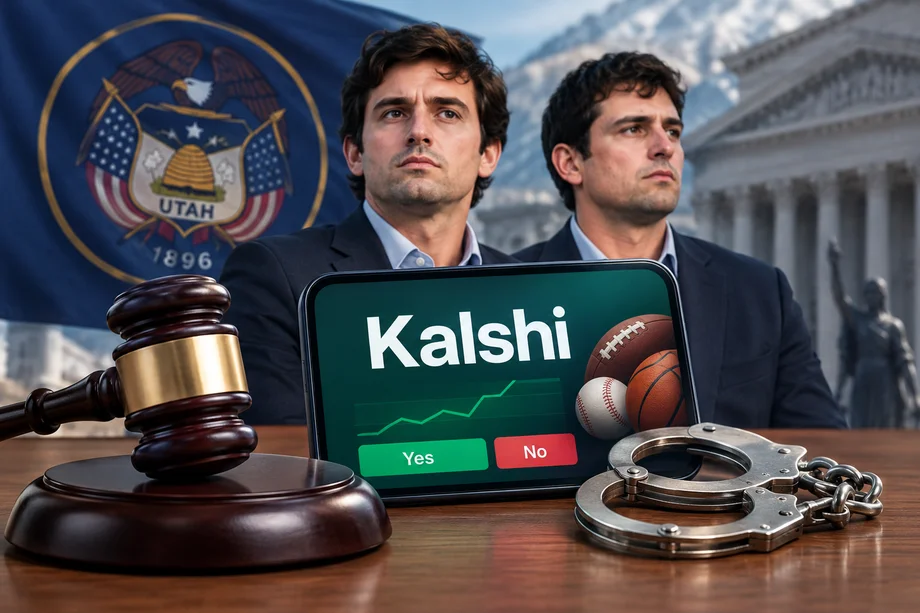
State prosecutors accuse the prediction-market platform of promoting illegal online gambling after an undercover agent placed a dozen sports wagers from Utah
Utah authorities filed 14 criminal charges on October 28 against prediction-market operator KalshiEX LLC and its two co-founders, alleging the company promoted illegal online gambling inside the state. The case centers on sports-related event contracts offered on the federally regulated platform and arrives one day after the Commodity Futures Trading Commission sued Utah to block similar enforcement efforts.
Details of the Charges and Undercover Investigation
Prosecutors in Utah’s Third Judicial District Court in Salt Lake County charged KalshiEX LLC, Chief Executive Officer Tarek Mansour and Chief Operating Officer Luana Lopes Lara with one count of pattern of unlawful activity, a second-degree felony; 12 counts of online gambling promotion, each a third-degree felony; and one count of general gambling promotion, a Class A misdemeanor.
The case rests on activity by Special Agent Scott Eggerman of the Utah Attorney General’s Office. In September, Eggerman opened an account using a Utah residential address, a local telephone number and a debit card issued in the state. After the platform’s geolocation system confirmed he was inside Utah, he placed 12 wagers on professional and college sports contests, including NFL, NCAA football, Major League Baseball, MLS and NHL games. The agent risked a total of $114.87 and recorded a net loss of $25.10. Prosecutors say Kalshi collected fees ranging from a few cents to less than a dollar on each transaction.
The state issued summonses rather than arrest warrants. Mansour and Lopes Lara are expected to respond in Salt Lake County court. Maximum penalties under Utah law include up to 15 years in prison and a $10,000 fine for a second-degree felony, up to five years and a $5,000 fine for each third-degree felony, and up to 364 days in jail plus a $2,500 fine for the misdemeanor.
Parallel Civil Action and Federal Pushback
The criminal filing follows a civil lawsuit Utah filed on October 20. That complaint seeks an injunction barring Utah residents from accessing Kalshi’s sports, election and other event contracts and asks for recovery of alleged unlawful fees. State estimates place those fees between $30.6 million and $61.2 million based on more than three billion wagers tied to Utah accounts through mid-October.
On October 27 the Commodity Futures Trading Commission sued Utah in federal court, asking judges to halt state enforcement actions against CFTC-registered exchanges. Agency Chairman Michael Selig has argued that Congress granted the CFTC exclusive authority over event contracts that serve hedging, investment and price-discovery purposes. The CFTC has pursued similar suits against roughly ten states and has filed supporting briefs in multiple federal appeals courts.
Kalshi maintains that its sports contracts are federally regulated derivatives, not gambling subject to state licensing or prohibition. The company previously sued Utah officials, arguing that the Commodity Exchange Act preempts state gambling laws. In August, U.S. District Judge Robert Shelby rejected that claim, holding that federal law does not block Utah from enforcing its anti-gambling statutes. The Tenth Circuit Court of Appeals later denied Kalshi’s request for an emergency stay, allowing state enforcement to continue while the appeal remains pending.
Broader Conflict Over Prediction Markets
Utah is one of only two states whose constitutions expressly ban gambling. The state has long treated sports wagering as illegal, and officials have described Kalshi’s platform as an online casino operating under a different name. Other states, including Arizona, have also pursued criminal or civil actions against the company; a federal judge later blocked Arizona’s prosecution.
Federal appeals courts have reached divergent conclusions on whether state gambling laws can reach CFTC-regulated event contracts. The Third Circuit has limited state authority in one case involving New Jersey, while the Sixth and Ninth Circuits have upheld state restrictions in matters involving Ohio, Tennessee and Nevada. New Jersey has petitioned the U.S. Supreme Court to resolve the split; dozens of other states support that request.
Kalshi continues to operate as a designated contract market under CFTC oversight, offering contracts on elections, economic data, weather and sports outcomes. The company has said it will contest the Utah charges in court. The criminal case, the parallel civil suit, the CFTC’s federal challenge and Kalshi’s pending Tenth Circuit appeal now form overlapping tracks that will determine how prediction markets interact with state gambling prohibitions.
Disclaimer
This article was generated by AI using information from multiple industry sources. It has not been reviewed or verified by a human editor and may contain inaccuracies, omissions, or misinformation. Readers are encouraged to independently verify any information before making decisions based on its content.Tired of the noise?
Let the bots trade for you.
Trade 24/7, without emotion, with data-driven strategies.
Associated articles
Utah Sues Kalshi and Susquehanna Firms Over Alleged Illegal Prediction Market Betting
New Jersey Petitions Supreme Court Over Regulation of Sports Contracts on Prediction Markets

CFTC Warns Prediction Markets Against American-Style Gambling Odds

Washington Court Blocks Kalshi Sports Contracts in Escalating Federal-State Regulatory Clash

Judge Denies Kalshi Bid to Block New York Gambling Law Enforcement
Latest articles

Curve Finance Deploys StableSwap on Stellar in First Native Non-EVM Launch

Binance Schedules PREDICT Token Debut on Alpha and Spot Markets for October 30

Ondo Intelligent Portfolios Expand to Solana with Seven Tokenized Strategies

Polygon Labs Extends Open Money Stack to Solana for Unified Bank and Crypto Payments