Newsroom
New Jersey Petitions Supreme Court Over Regulation of Sports Contracts on Prediction Markets
2 September, 2026 / News / AI / Tags: sports, jersey, kalshi, court, supreme
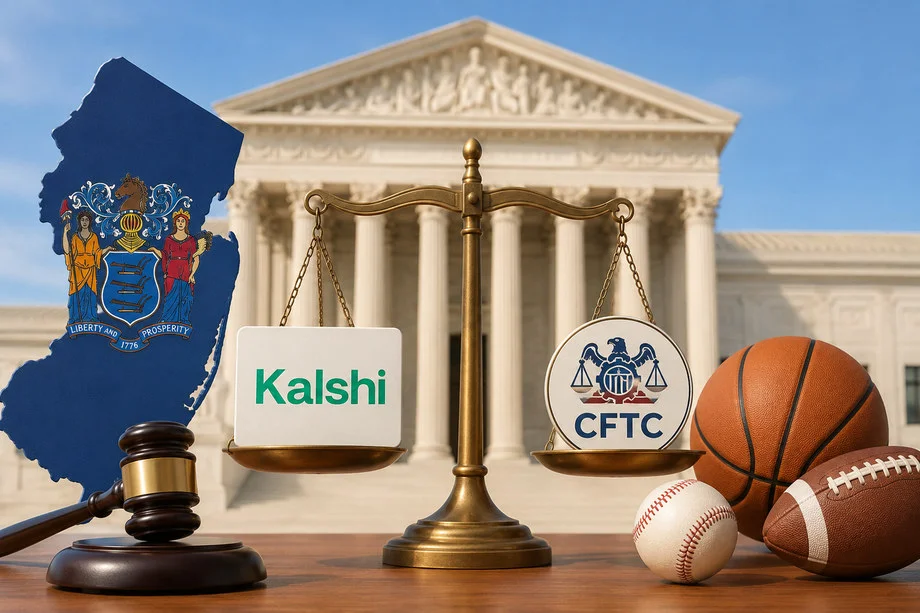
State officials ask justices to clarify whether federal derivatives law bars states from enforcing gambling rules against CFTC-registered platforms offering sports event contracts
New Jersey’s attorney general and gaming regulators have asked the U.S. Supreme Court to review a lower-court decision that limited the state’s ability to enforce its sports-betting laws against prediction-market operator Kalshi. The petition, filed this week, seeks a definitive ruling on whether the Commodity Exchange Act and the 2010 Dodd-Frank Act preempt state authority when sports contracts are traded on markets registered with the Commodity Futures Trading Commission.
The Core Legal Dispute
Attorney General Jennifer Davenport and the interim director of the Division of Gaming Enforcement petitioned for a writ of certiorari challenging an April ruling by the U.S. Court of Appeals for the Third Circuit. In that 2-1 decision, the panel concluded that Kalshi had a reasonable likelihood of success on its claim that federal law displaces New Jersey’s gambling regulations for the company’s sports-related event contracts.
The petition frames the question as whether Dodd-Frank preempted states from regulating sports bets occurring within their borders when those bets appear on CFTC-registered markets. New Jersey maintains that Congress never clearly authorized federally supervised exchanges to offer sports wagering nationwide while ignoring state licensing, consumer-protection, and enforcement requirements.
State officials argue that sports wagering has long been an area of traditional state authority. Treating event contracts on sporting outcomes as “swaps” under federal derivatives rules, they contend, would represent an extraordinary expansion of federal power without explicit congressional direction.
Conflicting Appellate Decisions
The New Jersey filing arrives amid a clear split among federal appeals courts. The Third Circuit’s ruling effectively shields Kalshi’s sports contracts from New Jersey enforcement. In contrast, the Ninth Circuit recently held that the Commodity Exchange Act likely does not preempt state gaming regulations in a case involving Nevada. That decision allowed state authorities to proceed against prediction-market sports products.
A CFTC spokesman previously described the Ninth Circuit outcome as one that called for resolution by the Supreme Court. Similar enforcement actions and lawsuits have emerged in more than 20 states, creating a patchwork of conflicting rules for the same category of contracts.
Kalshi operates as a designated contract market under CFTC oversight and classifies its sports offerings as event contracts governed by federal derivatives law. New Jersey and other states view the same products as sports bets that require state licensing and compliance with local consumer-protection standards.
Company Response and Broader Implications
Kalshi has rejected the need for Supreme Court intervention at this stage. A company spokesperson stated that the firm remains confident in the lower-court rulings and that prediction markets should not be subject to regulation by 50 different state authorities.
New Jersey officials have noted that a complete victory for the preemption argument could carry wider consequences. Because federal law restricts swap trading to CFTC-registered markets, a ruling that places sports contracts fully under federal exclusive jurisdiction might render sports wagering illegal outside those registered platforms, even in states that have legalized and regulated it.
The Supreme Court is not obligated to accept the case. Justices typically consider factors such as circuit splits and the national importance of the legal question before granting review. Kalshi will have an opportunity to respond to the petition before the Court decides whether to hear the matter.
Sports-related contracts have represented a substantial share of trading activity on major prediction platforms. The outcome of the jurisdictional dispute will therefore affect both the operational scope of these markets and the balance of regulatory authority between federal commodities oversight and state gambling control.
Disclaimer
This article was generated by AI using information from multiple industry sources. It has not been reviewed or verified by a human editor and may contain inaccuracies, omissions, or misinformation. Readers are encouraged to independently verify any information before making decisions based on its content.Tired of the noise?
Let the bots trade for you.
Trade 24/7, without emotion, with data-driven strategies.
Associated articles

Judge Denies Kalshi Bid to Block New York Gambling Law Enforcement
NFL Backs States in Supreme Court Dispute Over Kalshi Prediction Markets

Connecticut Sues Kalshi Over Sports Event Contracts in Escalating Regulatory Fight

New York Sues Polymarket Over Alleged Illegal Gambling
Sixth Circuit Rules Kalshi Sports Contracts Subject to State Gambling Laws
Latest articles

Blockchain Association Urges Clarity on DeFi and Stablecoin Rules Under GENIUS Act

XRP Launches Official X Account, Jointly Managed by Ripple and XRPL Foundation

ESMA Expands MiCA Register to 375 Providers as BingX, YouHodler and Openbank Join

France Narrowly Approves Crypto-to-Stablecoin Tax from 2027