Newsroom
Utah Sues Kalshi and Susquehanna Firms Over Alleged Illegal Prediction Market Betting
21 October, 2026 / News / AI / Tags: utah, kalshi, court, susquehanna, gambling
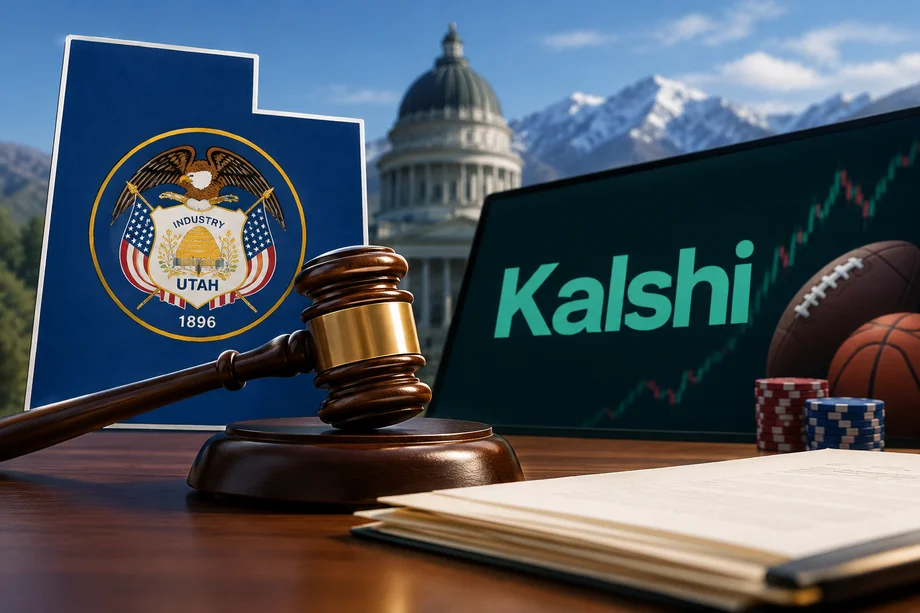
Attorney General Derek Brown seeks injunctions and recovery of up to $61.2 million in fees, alleging the platform and trading firms facilitated unlawful wagers for Utah residents since 2024
Utah Attorney General Derek Brown filed a civil lawsuit on October 20, 2026, against prediction market operator Kalshi, five affiliated entities, and two Susquehanna trading firms. The complaint, filed in Utah’s Third District Court in Salt Lake City, accuses the defendants of operating an illegal gambling business in the state through event contracts on sports, elections, politics, culture, and mentions.
The state argues the activity violates Utah’s constitutional ban on gambling and constitutes a public nuisance. Brown declared the operation a public nuisance causing significant ongoing harm to residents. The lawsuit seeks preliminary and permanent injunctions to block the challenged contracts, court-approved geolocation technology to restrict access by Utah users, restitution, damages, and disgorgement of alleged profits.
Financial Claims and Alleged Scale of Activity
Utah estimates that Kalshi collected between $30.6 million and $61.2 million in fees from accounts linked to the state through October 19, 2026. The figure derives from an extrapolation based on more than three billion wagers associated with Utah accounts, with the platform retaining roughly one to two cents per transaction. The state also alleges residents lost approximately $5.5 million on individual wagers.
As of February 25, 2026, Kalshi reported 32,940 fully signed-up accounts with Utah addresses. Officials believe the number has grown since then. The complaint describes the estimates as general and subject to refinement once financial records are examined.
The lawsuit names Kalshi Inc., KalshiEX LLC, Kalshi Klear Inc., Kalshi Klear LLC, and Kalshi Trading LLC, along with Susquehanna International Group and Susquehanna Government Products. It alleges Kalshi Trading and the Susquehanna firms acted as counterparties to customer positions, receiving money when users lost. The complaint compares KalshiEX’s role to that of “the manager of a back-alley gambling den” that hosts events and takes a percentage fee, or rake, of amounts wagered.
Prior Court Rulings Shape the Dispute
The new action follows earlier litigation initiated by Kalshi. In February 2026, the company sued Utah officials after state lawmakers classified betting on prediction markets as gambling. On August 4, 2026, U.S. District Judge Robert J. Shelby granted summary judgment to Utah, holding that federal commodities law under the Commodity Futures Trading Commission does not preempt the state’s gambling statutes.
In September 2026, the U.S. Court of Appeals for the Tenth Circuit denied Kalshi’s request for an injunction pending appeal, allowing Utah to enforce its restrictions while the appeal continues. The October civil complaint is a separate state-court proceeding seeking monetary remedies and operational limits.
Utah Governor Spencer Cox voiced support for the lawsuit.
Kalshi’s Federal Oversight Argument
Kalshi maintains that it operates as a federally regulated derivatives exchange overseen by the Commodity Futures Trading Commission. Spokesperson Jacki McGavick stated that customers trade with one another and set prices, and that the platform answers to federal law rather than individual state directives.
The company has indicated that the state-court case will not alter its federal litigation strategy. Legal observers have noted the possibility that Kalshi may seek to remove the matter to federal court.
Broader Multi-State Scrutiny of Prediction Markets
Utah’s lawsuit forms part of a wider series of state actions against prediction market platforms, including Kalshi and Polymarket. Arizona remains the only state to have pursued criminal charges against Kalshi. Civil suits have been filed by authorities in Michigan, Ohio, Kentucky, Nevada, Massachusetts, Wisconsin, New York, and other jurisdictions, often centered on sports-related event contracts.
The jurisdictional conflict—whether event contracts fall under the CFTC’s exclusive authority or remain subject to state gambling laws—also appears in a New Jersey dispute. State officials there have petitioned the U.S. Supreme Court to review a federal appeals court ruling favorable to Kalshi at the preliminary stage. The National Football League has supported New Jersey’s petition. Kalshi’s response to the Supreme Court petition is due in November 2026. The high court has not yet decided whether to hear the case.
Utah’s complaint requests that any injunction require use of a court-approved geolocation provider to prevent residents from accessing the disputed markets. The state seeks both an immediate halt to the alleged activity and financial remedies after review of the defendants’ records.
Disclaimer
This article was generated by AI using information from multiple industry sources. It has not been reviewed or verified by a human editor and may contain inaccuracies, omissions, or misinformation. Readers are encouraged to independently verify any information before making decisions based on its content.Tired of the noise?
Let the bots trade for you.
Trade 24/7, without emotion, with data-driven strategies.
Associated articles

Connecticut Sues Kalshi Over Sports Event Contracts in Escalating Regulatory Fight

CFTC Warns Prediction Markets Against American-Style Gambling Odds
New Jersey Petitions Supreme Court Over Regulation of Sports Contracts on Prediction Markets

New York Sues Kalshi Seeking $36 Billion Over Alleged Illegal Gambling

Baltimore Sues Kalshi and Polymarket Over Unlicensed Sports Contracts
Latest articles

Mastercard Launches Early Access to AI Agent Payments Following Successful Demo

Injective Partners with BDACS to Launch KRW1 Won Stablecoin for Tokenized Asset Settlement

Stellar Schedules November 23 Vote on Protocol 30 Bell Upgrade for Smart Contracts

SpaceX Reports Record $14.6 Billion Revenue in Q3 as AI Division Surges Past Starlink