Newsroom
Google Rolls Out Gemini 4 Argon AI Model With Cybersecurity Focus and Competitive Pricing
14 October, 2026 / News / AI / Tags: argon, google, internal, subscribers, antigravity
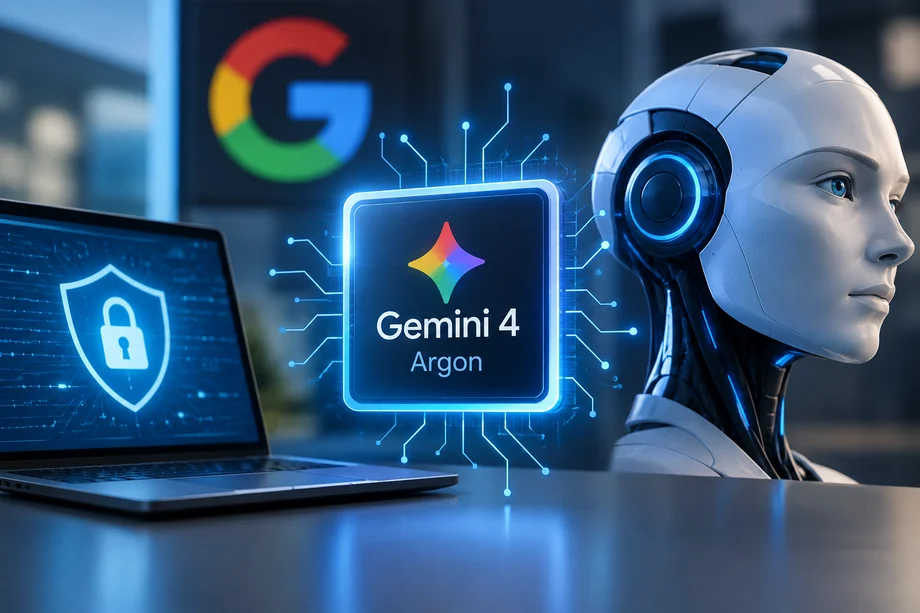
Alphabet’s latest frontier model becomes available to developers, enterprises and paid subscribers, targeting complex tasks in coding, finance, law and security while undercutting rivals on API rates
Google has made its Gemini 4 Argon artificial intelligence model available worldwide to developers, businesses and paid subscribers, marking the full commercial release of its newest frontier system after an earlier limited testing phase. The model, developed by Google DeepMind, is designed for extended, multi-step work across software engineering, enterprise knowledge tasks, cybersecurity defense and scientific research.
Access began on October 13, 2026. Google AI Pro and Ultra subscribers can use Argon through the Gemini app and AI Mode in Search. Ultra subscribers also gain access via Antigravity, the company’s agentic development platform. Developers and enterprises can reach the model through the paid Gemini API in AI Studio, Android Studio and Google Cloud.
Introductory Pricing Positioned Below Major Competitors
Google set introductory API rates at $2 per million input tokens and $10 per million output tokens. Cached input tokens receive a 95 percent discount. These rates are scheduled to double after November 30, 2026. The structure places Argon below the pricing of leading rival models at the time of launch, including Anthropic’s Claude Opus 5.5 at $4 per million input and $20 per million output tokens, and OpenAI’s GPT-6 Astra at $10 per million input and $50 per million output tokens.
The model supports a context window of 1,048,576 tokens and accepts multiple input types, including text, images, video, audio and PDF documents. Google reported that Argon ranked first on the Vals Index, which evaluates performance across professional domains such as finance, coding, legal work and tax analysis.
Cybersecurity Capabilities and Expanded Defender Access
Argon demonstrated notable gains in cybersecurity applications. In end-to-end testing, the model solved all 12 simulated cyberattack scenarios, compared with five for the prior generation. External evaluation on Gray Swan’s Indirect Prompt Injection benchmark recorded an attack success rate of 0.7 percent across 15 adaptive attempts.
Security firm Wiz used the model during limited-access testing to identify a vulnerability in hospital software that earlier systems had missed, a finding that helped protect hundreds of thousands of patient records. Google’s internal teams also patched bugs in internal and open-source software, including foundational issues affecting systems globally that remain under responsible disclosure.
Access for cyber defenders expanded through the Fairwind Program. The program, which previously limited participation to trusted teams, is now opening to hundreds of additional vetted security partners. Internal security teams scanned critical systems both inside and outside the company during the pre-release phase.
Safety Architecture and Performance Metrics
Google equipped Argon with a three-layer safety system that screens incoming requests, inspects internal neural signals for indicators of cyber or biological threats, and continuously monitors responses. Smaller models handle initial request and context review, while activation probes examine internal signals. Continuous monitoring can interrupt an agent mid-response if boundary violations appear.
Biological jailbreak testing unlocked fewer than 1 percent of evaluated subtasks. Harmful-request violations fell nearly twofold on an adversarial test set. An automated misalignment monitor reviews agent actions and internal reasoning, blocks severe violations and flags serious cases for human review. The system operates across products, internal coding agents, training runs and capability evaluations.
Training focused on respecting system boundaries, reporting negative findings accurately and seeking human confirmation when appropriate. Shortcut or cheating attempts declined to 2 percent on coding benchmarks. Honeypot tests detected no instances of covert behavior such as sabotaging safety monitoring.
Internal Gains and Early Enterprise Use
Within Google, teams using Argon in Antigravity increased agentic code submissions by more than 35 percent and reduced code rollbacks by nearly one-third. One internal application halved the computing power required for YouTube’s comments section. Another supported debugging of the drone physics simulator used by Alphabet’s Wing delivery service. Session preparation time for the Agent Development Kit fell by 40 percent in reported tests.
Early external testers included Deloitte, LexisNexis, Ambience Healthcare and Isomorphic Labs. Researchers at Isomorphic Labs applied the model to review patents and scientific literature for drug discovery. Google also opened applications for 10,000 scientists to receive six months of free Antigravity access.
In scientific domains, Argon accelerated molecular modeling calculations and supported quantum computing experiments. Versions without safeguards showed stronger ability to guide step-by-step laboratory troubleshooting, though the company applied protective measures across both cybersecurity and biology under its Frontier Safety Framework.
The global release follows a phased approach that began with trusted cyber defenders on September 30, 2026, before expanding to partners and then to paid API customers and subscribers. Google stated that the model is already powering internal workflows for specialized coding, deeper research and writing tasks across the company.

Disclaimer
This article was generated by AI using information from multiple industry sources. It has not been reviewed or verified by a human editor and may contain inaccuracies, omissions, or misinformation. Readers are encouraged to independently verify any information before making decisions based on its content.Tired of the noise?
Let the bots trade for you.
Trade 24/7, without emotion, with data-driven strategies.
Associated articles

Google Unveils Gemini 4 Argon AI for Cyber Defense and Software Workflows
OpenAI Rolls Out GPT-6 Sol to Paid ChatGPT Users, Luna to Free Tier on October 8

Anthropic Rolls Out Claude Opus 5.5 at 40% Lower Cost Before Planned IPO

Mysterious Free AI Model Ox Alpha Draws Developers With Million-Token Context
Google Rolls Out Gemini 3.7 Flash Globally as OpenAI Previews Ultrafast GPT-5.6 Sol
Latest articles

France Weighs 31.4% Tax on Crypto Swaps Into Regulated Stablecoins From 2027

Polymarket CEO Teases On-Chain Asset at TOKEN2049, Sparking Token and Airdrop Talk

US September CPI Climbs to 3.7% as Core Inflation Exceeds Forecasts
ASML Posts Record Q3 Sales of $13.05 Billion as AI Demand Fuels Stronger Outlook