Newsroom
Bank of Korea Study Links Dollar Stablecoin Demand to Local Currency Weakness
6 September, 2026 / News / AI / Tags: local, stablecoin, binance, korea, premium
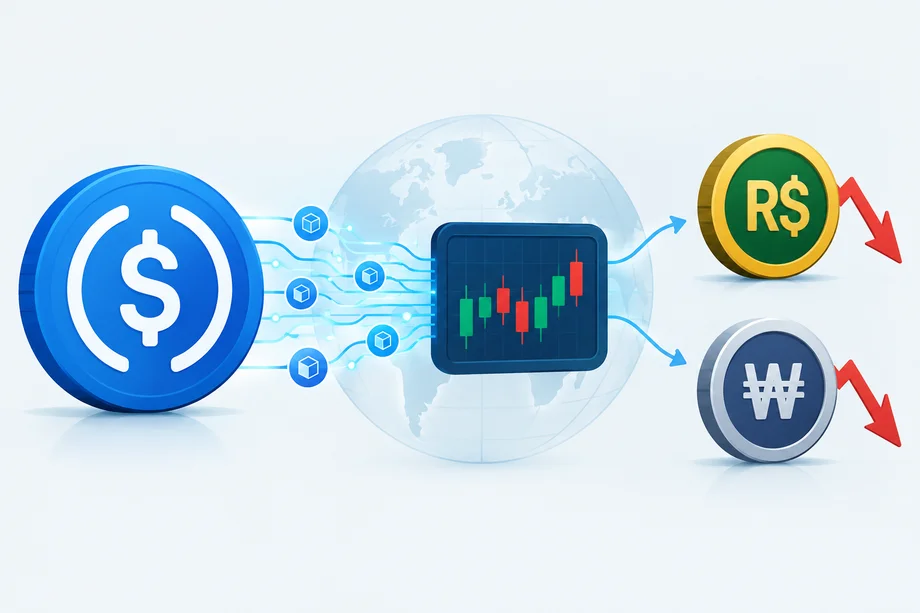
Research shows Binance fiat pairs create channels where rising demand for tokens such as USDT and USDC can depreciate national currencies through market-maker hedging
Demand for dollar-backed stablecoins can exert downward pressure on local currencies when global exchanges permit direct purchases with national fiat, according to a Bank of Korea study. Researchers Jihyun Kim and Sangheum Cho analyzed the introduction of trading pairs between currencies such as the Brazilian real and dollar-pegged tokens including USDT and USDC on Binance.
The listings enable investors to acquire stablecoins using local currency while professional market makers provide the tokens. Those market makers then face an incentive to sell the local currency and buy dollars in foreign-exchange markets to rebalance positions. This process creates a transmission channel from stablecoin demand into exchange rates.
Premium Compression and Cross-Exchange Flows
The study found that local stablecoin premiums declined by roughly 0.33 to 0.38 percentage points after Binance launched the fiat-stablecoin pairs. When prices on local platforms rose above those on Binance, stablecoins tended to move from the global exchange toward domestic venues, consistent with arbitrage activity.
The analysis covered 12 currencies that offered sufficient cross-exchange data, with pairing dates ranging from 2019 to 2025. For currencies that received direct Binance support, stronger buying pressure on stablecoins was associated with depreciation of the local currency against the dollar.
Contrasting Outcomes in Brazil and South Korea
Brazil, which has a Binance real-stablecoin pair, illustrated the FX channel clearly. Using weekly data, a one-standard-deviation increase in Google searches for bitcoin—a proxy for crypto investment demand—was linked to a 0.118 percent depreciation of the Brazilian real. The same shock also lifted Brazil’s stablecoin premium by 0.109 percentage points.
South Korea presents a different picture because Binance does not offer a direct won-stablecoin pair. In the Korean market the same demand proxy raised the local stablecoin premium by about 0.85 percentage points, yet the won-dollar exchange rate showed no statistically significant response. Buying pressure primarily widened the domestic premium rather than feeding into the foreign-exchange market.
Implications for Korean Markets
Stablecoin activity in South Korea has expanded rapidly. Won-denominated purchases of the tokens reached $64 billion in the 12 months through June 2025, making the country the largest local-currency stablecoin market in the Asia-Pacific region.
The researchers noted that the links between stablecoin markets and traditional foreign-exchange trading could strengthen if regulations later permit greater corporate and foreign participation. They suggested that deeper foreign-exchange liquidity and broader international use of the won would help the market absorb related shocks.
The findings indicate that the presence of global intermediaries and direct fiat-stablecoin trading pairs determines how closely dollar-stablecoin demand transmits into currency markets. Where such pairs exist, elevated demand can translate into selling pressure on the local currency; where they do not, the effects remain largely confined to domestic premium adjustments.
Disclaimer
This article was generated by AI using information from multiple industry sources. It has not been reviewed or verified by a human editor and may contain inaccuracies, omissions, or misinformation. Readers are encouraged to independently verify any information before making decisions based on its content.Tired of the noise?
Let the bots trade for you.
Trade 24/7, without emotion, with data-driven strategies.
Associated articles
Higher Bank Deposit Rates Linked to Slower Stablecoin Expansion, BIS Research Shows
Injective Partners with BDACS to Launch KRW1 Won Stablecoin for Tokenized Asset Settlement

Bank of Italy Study Finds No Consistent Cost Edge for Stablecoin Remittances

IMF Examines Stablecoins in Fixed Exchange Rate Systems

South Korea Records 18 Months of Stablecoin Outflows as $367 Million Leaves Local Exchanges
Latest articles

SpaceX and Tesla Set Up Committees to Explore Merger That Would Combine Holdings of Over 30,000 Bitcoins
UK Banks Face Thousands of Complaints Over Crypto Transfer Restrictions
Ripple Backs SEC Proposed Crypto Asset Rules After $150 Million Legal Battle
Blockchain.com Introduces Options Trading on Seven Major Crypto Assets