Newsroom
Tether Partners With Kazakhstan Central Bank on Tenge Stablecoin and Tokenization Study
7 October, 2026 / News / AI / Tags: kazakhstan, alatau, tokenization, tenge, tether
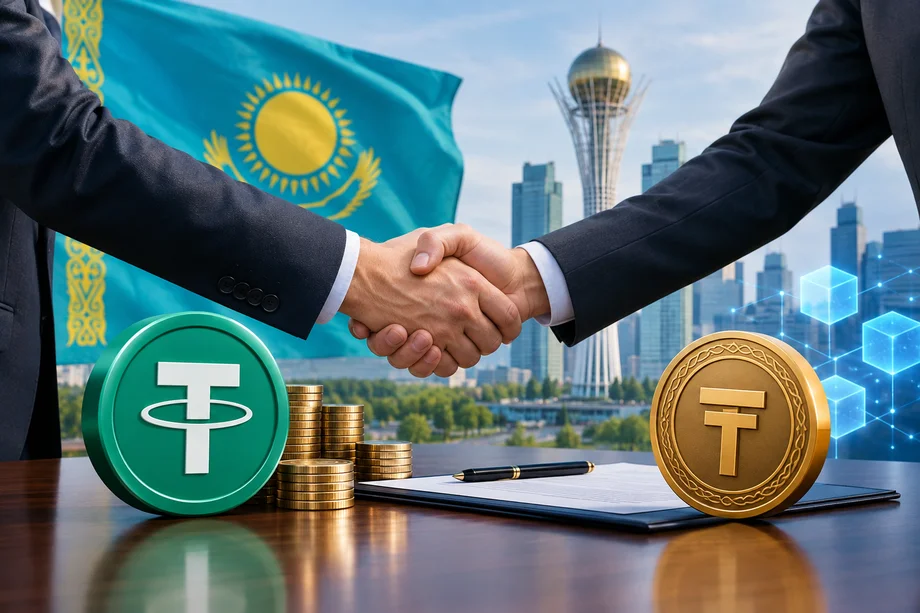
The National Bank of Kazakhstan, Tether and Alatau City Authority signed an MoU on October 7 to examine a local-currency stablecoin pilot and real-world asset tokenization
Tether has entered a memorandum of understanding with the National Bank of Kazakhstan and the Alatau City Authority to jointly explore a stablecoin linked to the national currency, the tenge, along with frameworks for tokenizing real-world assets and related digital-finance applications. The agreement, confirmed on October 7, remains exploratory and does not authorize issuance or set any launch timeline.
Scope of the Memorandum
Under the MoU the parties will review international models for stablecoin issuance, identify potential domestic use cases and prepare a concept plus pilot proposal for a tenge-pegged token. Parallel work will focus on asset tokenization, including selection of suitable asset categories and design of a possible pilot project. Tether’s Hadron platform, which supports issuance and lifecycle management of tokenized assets such as bonds, equities, funds and commodity-backed tokens, is under consideration for the tokenization component.
The collaboration also includes workshops and training sessions for central-bank staff and other government agencies covering reserve management, distributed-ledger technology, stablecoin markets and real-world asset tokenization models. Decentralized-finance applications form an additional area of joint study.
Zhalenov added that financial stability, transaction transparency and robust investor protection will remain priorities throughout any pilots.
Ardoino noted that Kazakhstan is examining tokenization alongside a strategic reserve framework.
Regulatory Context in Kazakhstan
Kazakhstan already maintains a legal framework for digital financial assets. Comprehensive rules that took effect on May 1, 2026 recognize money-backed stablecoins, tokenized real assets and digital versions of traditional financial instruments. Outside the Astana International Financial Centre the National Bank licenses and supervises providers of unsecured digital assets, while the broader financial-market regulator oversees other categories.
In September 2025 the central bank conducted its first tenge-denominated stablecoin pilot inside its regulatory sandbox. The project, known as Evo or KZTE and issued by Intebix in partnership with Solana, Mastercard and Eurasian Bank, aimed to link digital assets with existing payment infrastructure, including crypto-fiat conversions and card transactions. The new MoU does not specify whether any future Tether-related pilot would replace, expand or run alongside that earlier initiative.
Policy documents issued in July further outlined plans to test stablecoins in cross-border payments and money transfers and to develop tokenized government-bond projects. Authorities also indicated they would refine regulatory approaches to decentralized finance and pay particular attention to digital infrastructure in Alatau City.
Role of Alatau City
Alatau operates under a special legal regime established through constitutional changes that became effective on July 1. The framework designates accelerated-development cities focused on investment, technology and new economic models; Alatau is the first such zone. Kazakhstan’s National Bank has previously presented the city to international investors as a testing ground for digital finance and tokenization. Any tokenization pilot contemplated under the MoU would take place within Alatau’s jurisdiction.
Tether’s Broader Tokenization Activity
Tether is the issuer of USDT, the largest U.S. dollar stablecoin with roughly $140 billion in circulation, and of XAUT, a gold-backed token valued at approximately $3.3 billion and secured by physical bullion held in Swiss vaults. The company has expanded beyond pure stablecoin issuance into energy, payments, commodities and tokenization infrastructure.
Hadron has already been deployed in other institutional settings. In August Tether announced a collaboration with First Data and BKN301 to advance tokenization of institutional real-estate assets in Saudi Arabia. In July the firm signed an agreement with the Nairobi Securities Exchange to study tokenized securities and blockchain infrastructure, though specific assets and chains had not yet been selected at that time.
The October 7 memorandum with Kazakhstan authorities does not commit any party to issuing a tenge stablecoin, adopting Hadron, or finalizing commercial terms. The next concrete steps remain the preparation of concepts, pilot proposals and the scheduled educational workshops.
Disclaimer
This article was generated by AI using information from multiple industry sources. It has not been reviewed or verified by a human editor and may contain inaccuracies, omissions, or misinformation. Readers are encouraged to independently verify any information before making decisions based on its content.Tired of the noise?
Let the bots trade for you.
Trade 24/7, without emotion, with data-driven strategies.
Associated articles

Tether Partners for Institutional Real Estate Tokenization in Saudi Arabia

Tether and Nairobi Securities Exchange Sign MoU on Tokenized Securities and Blockchain Infrastructure

BlackRock, SBI Holdings and Startale Explore Link Between Tokenized Funds and Yen Stablecoin

Shinhan Financial Partners With Visa to Build Stablecoin Payment Infrastructure

Ripple Appoints LME Treasury Executive to Drive Institutional Trading and Tokenization
Latest articles

Zcash Co-Founder Proposes Redirecting 8% of Block Subsidies to Network Reserve

Bitcoin Monte Carlo Simulations Point to Median Value of $1.03 Million in 2033

S&P Global Completes Acquisition of OpenZeppelin Smart Contract Security Firm

Franklin Templeton Files Two ETFs to Convert US Stock Dividends into Bitcoin