Newsroom
SpaceX Seeks $40 Billion Debt Package for Nvidia AI Chips Amid Orbital Compute Push
7 October, 2026 / News / AI / Tags: orbital, spacex, nvidia, starmind, package
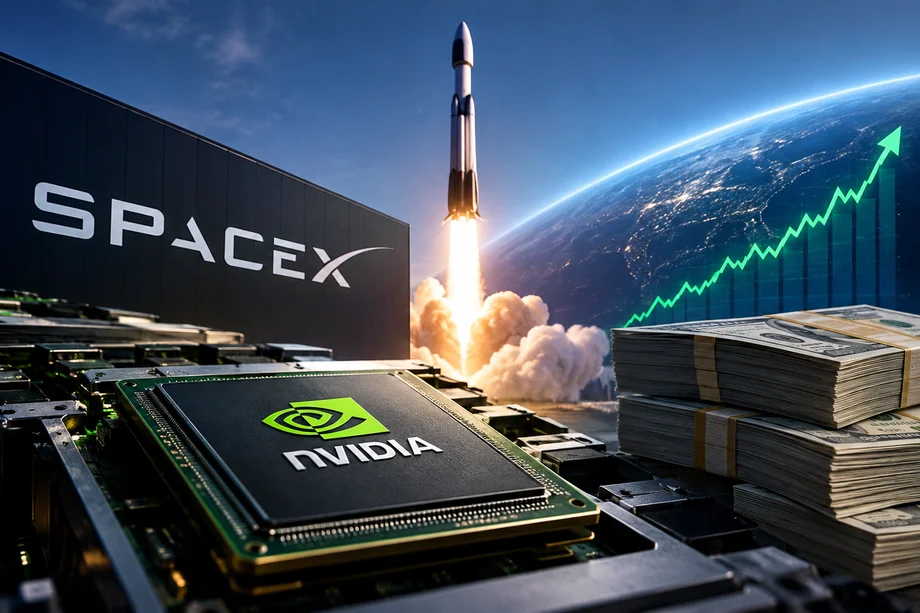
SpaceX is pursuing roughly $40 billion in bank loans and investment-grade debt, led by Apollo Global Management, to acquire Nvidia processors for terrestrial data centers and planned orbital systems, with a potential 2027 close
SpaceX is in advanced discussions to raise approximately $40 billion in financing dedicated to purchasing Nvidia artificial intelligence chips. The package would consist of about $10 billion in bank loans and $30 billion in investment-grade bonds. Apollo Global Management is expected to lead the effort, with Pimco among the institutions in talks to participate. The transaction remains at an early stage and is not expected to close before 2027 if finalized.
The proceeds would support both existing ground-based AI infrastructure and SpaceX’s longer-term plans for orbital computing capacity. The company has already committed to deploying Nvidia’s Vera CPUs and Vera Rubin systems for workloads tied to its AI initiatives, including support for Grok processing and the development of Starmind satellites. Each planned Starmind satellite is designed for a peak processing capacity of 250 kilowatts, relying on solar power in sun-synchronous orbit and radiative cooling into space.
Financing Structure and Market Context
The proposed raise builds on SpaceX’s earlier entry into public debt markets. In June the company completed a $25 billion senior-notes offering, with proceeds earmarked for refinancing bridge loans, covering associated costs, and general corporate purposes. Existing SpaceX bonds have traded with yields above 6.5 percent on shorter maturities and near 8 percent on longer-dated paper, establishing a reference point for the pricing of any new issuance.
Apollo’s involvement aligns with its existing collaboration with Nvidia. In August the two firms, together with other partners, outlined platforms intended to channel more than $500 billion of third-party capital into AI infrastructure over time. The SpaceX package would represent one of the larger single transactions within that broader financing environment.
Across the U.S. leveraged-finance market, AI-related borrowing has expanded sharply, rising from roughly $20 billion in early 2025 to $88 billion in 2026. SpaceX’s contemplated investment-grade package sits outside that leveraged-finance total yet illustrates the same pattern of external capital funding large-scale chip deployments.
AI Infrastructure Ambitions and Revenue Backing
SpaceX has already secured substantial multi-year compute contracts that provide a revenue foundation for additional hardware purchases. One agreement grants Google access to approximately 110,000 Nvidia GPUs at a monthly rate of $920 million. A subsequent contract is valued at about $1.11 billion per month. Management has cited these deals in support of a target for a $100 billion annualized revenue run rate.
On the technology side, Nvidia has confirmed that SpaceXAI will utilize Vera CPUs and the Vera Rubin platform. Vera, Nvidia’s first CPU designed specifically for AI agents, features 88 Olympus cores and up to 1.2 terabytes per second of memory bandwidth. SpaceXAI President Mike Nicolls described the processor’s role as enabling large-scale orchestration and data processing while freeing GPUs for their core computational tasks.
The first-generation Starmind satellite is expected to incorporate an optimized Vera Rubin NVL72 configuration. Parallel efforts by other companies, including Google’s Project Suncatcher prototype carrying four TPUs and Starcloud’s successful launch of an Nvidia H100 into orbit, indicate that orbital AI experimentation is progressing beyond pure research.
Technical and Economic Challenges of Orbital Computing
Deploying data-center-scale computing in space introduces significant engineering and cost hurdles. Independent estimates suggest orbital facilities could cost 2.5 to 3 times more than equivalent terrestrial installations. Cooling requirements are substantial; one analysis calculated that a single orbital data center might need 2.15 million square feet of radiators. Radiation exposure further complicates hardware reliability, prompting increased industry activity around radiation-hardened fabrication processes.
Despite these obstacles, SpaceX continues to advance both its ground and orbital roadmaps. The company has stated intentions to more than double its Nvidia GPU count by the end of the year in connection with its Colossus 2 supercomputer project, relying exclusively on Nvidia hardware for its data-center builds.
Equity Market Reaction and Valuation Backdrop
Shares of SpaceX closed near $171.92 on the most recent session, representing a gain of roughly 15 to 16 percent over the preceding five trading days. The stock remains approximately 24 percent below its June peak of $225.64 and well above its June IPO price of $135. Market capitalization has fluctuated in a range near $2.16 trillion to $2.27 trillion. After-hours trading following the financing reports showed a modest decline of about 1 percent in some sessions.
Trading volume has exceeded recent averages, and the shares carry elevated volatility metrics, including a one-year beta near 4.93. The next scheduled earnings update is expected in early November and may provide additional detail on capital spending plans and existing debt levels.
The scale of the contemplated $40 billion package equates to roughly 1.8 percent of the company’s current market value. Whether equity investors ultimately view the added leverage as supportive of growth or as an incremental risk factor will depend on the speed with which the newly acquired chips generate contracted revenue and on the final terms of the debt.


Disclaimer
This article was generated by AI using information from multiple industry sources. It has not been reviewed or verified by a human editor and may contain inaccuracies, omissions, or misinformation. Readers are encouraged to independently verify any information before making decisions based on its content.Tired of the noise?
Let the bots trade for you.
Trade 24/7, without emotion, with data-driven strategies.
Associated articles
Nvidia Reveals $21 Billion SpaceX Holding Amid Deepening AI Chip Alliance

Bullish Extends $100 Million Stablecoin Facility to USD.AI for GPU-Backed AI Loans
Musk Warns Over 200 AI Neoclouds Face Failure and Consolidation as Financing Tightens
Nvidia Lifts AI Server Prices Over 15% Amid Memory Cost Surge
Nvidia Expands Buyback to $235 Billion as It Rolls Out AI Safety Platform
Latest articles

Zcash Co-Founder Proposes Redirecting 8% of Block Subsidies to Network Reserve

Bitcoin Monte Carlo Simulations Point to Median Value of $1.03 Million in 2033

S&P Global Completes Acquisition of OpenZeppelin Smart Contract Security Firm

Franklin Templeton Files Two ETFs to Convert US Stock Dividends into Bitcoin