Newsroom
Shinhan Asset Management Partners with Solana for KRW Tokenized Fund Pilot
21 August, 2026 / News / AI / Tags: shinhan, tokenized, etherfuse, orca, solana
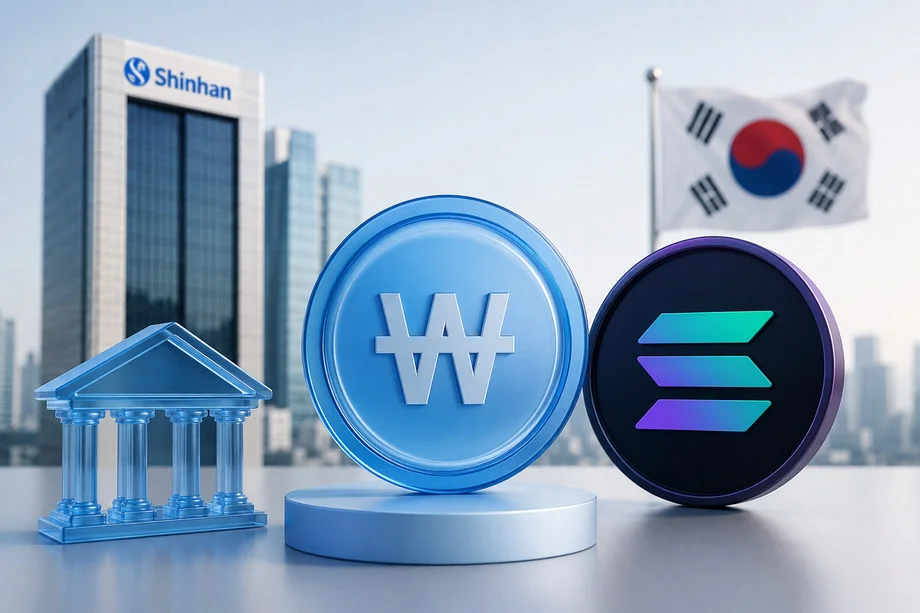
South Korea’s Shinhan Asset Management has signed a four-party agreement with the Solana Foundation, Etherfuse and Orca to test a won-denominated tokenized fund aimed at overseas institutions
Shinhan Asset Management, one of South Korea’s largest institutional managers, entered a four-party memorandum of understanding on August 21 to develop a proof-of-concept for a Korean won-denominated tokenized investment fund. The collaboration involves the Solana Foundation, tokenization platform Etherfuse and decentralized exchange Orca.
The initiative will examine the complete workflow for issuing and circulating a regulated tokenized fund. Steps under review include investor verification, anti-money laundering controls, token creation, distribution and on-chain liquidity arrangements. Etherfuse will provide the infrastructure for creating and managing the tokenized assets, while Orca will support the design of liquidity mechanisms for distribution and exchange on the Solana network.
Fund Structure and Target Investors
Under the planned structure, Shinhan would supply a won-denominated ultra-short-term bond fund as the underlying asset. The tokenized version is intended for overseas institutional investors. Participants have not disclosed the prospective fund size, expected yield or any commercial launch timeline.
The model draws inspiration from BlackRock’s BUIDL tokenized money-market product in its approach to blockchain-based distribution. The comparison relates solely to the distribution method and does not indicate identical assets or legal rights. BlackRock’s product primarily holds U.S. Treasury bills, cash and repurchase agreements, whereas Shinhan’s test focuses on short-term domestic Korean won bonds.
Parallel Blockchain Experiments
The Solana agreement is not Shinhan’s only recent move in this area. On August 14 the asset manager signed a separate memorandum with RWA platform Plume for a comparable KRW tokenized fund demonstration. The parallel projects indicate that Shinhan is evaluating multiple technical and distribution approaches rather than committing exclusively to one network at this exploratory stage.
Both efforts remain non-binding proof-of-concept work. Neither memorandum commits Shinhan to a live, commercially distributed product.
Regulatory Timeline in South Korea
Any potential commercial launch will depend on South Korea’s evolving regulatory framework for tokenized securities. The National Assembly passed supporting amendments on January 15. The legislation recognizes distributed ledgers as valid securities registries and allows qualifying investment contract securities to circulate through licensed securities companies.
The Financial Services Commission has stated that issuers must continue to meet existing securities registration and disclosure requirements. Unlicensed entities will not be permitted to broker tokenized securities. The amendments are expected to take effect approximately one year after promulgation, with implementation anticipated in early 2027. Regulators are currently preparing account management infrastructure and investor protection rules.
Broader Context for Tokenized Assets
Solana has previously attracted institutional activity in Asia. In July, SBI Global Asset Management launched a tokenized Japanese equity fund on the network through regulated platform DigiFT, targeting institutional and accredited investors.
Current estimates place the tokenized real-world asset market at approximately $36 billion. A Boston Consulting Group projection cited in connection with the announcement suggested the sector could reach as much as $30 trillion by 2030. More recent BCG scenarios present a middle estimate of $14 trillion by 2030 and $55 trillion by 2035, with a faster-growth case reaching higher figures. These remain forecasts rather than expected outcomes. Publicly visible on-chain assets stood near $30 billion by mid-2026, led by private credit and tokenized government debt.
The next phase for the Shinhan project involves completing the proof-of-concept and aligning the fund structure with South Korea’s final rules. Commercial availability will require regulatory approval, successful operational testing and demonstrated demand from eligible overseas institutions.


Disclaimer
This article was generated by AI using information from multiple industry sources. It has not been reviewed or verified by a human editor and may contain inaccuracies, omissions, or misinformation. Readers are encouraged to independently verify any information before making decisions based on its content.Tired of the noise?
Let the bots trade for you.
Trade 24/7, without emotion, with data-driven strategies.
Associated articles

Shinhan Asset Management and Plume Launch Offshore Proof of Concept for KRW Tokenized Fund
Shinhan Financial Partners With Visa to Build Stablecoin Payment Infrastructure
Meritz Securities Teams With Ripple on Digital Asset Custody and Tokenization Review in South Korea
SBI Group and Kyobo Life Complete Direct Yen-Won Stablecoin Cross-Border Pilot
KakaoPay Securities Partners With Dinari and Ondo to Tokenize Korean Stocks
Latest articles
SpaceX and Tesla Set Up Committees to Explore Merger That Would Combine Holdings of Over 30,000 Bitcoins
UK Banks Face Thousands of Complaints Over Crypto Transfer Restrictions
Ripple Backs SEC Proposed Crypto Asset Rules After $150 Million Legal Battle
Blockchain.com Introduces Options Trading on Seven Major Crypto Assets