Newsroom
KakaoPay Securities Partners With Dinari and Ondo to Tokenize Korean Stocks
30 September, 2026 / News / AI / Tags: dinari, kakaopay, korean, ondo, dshares
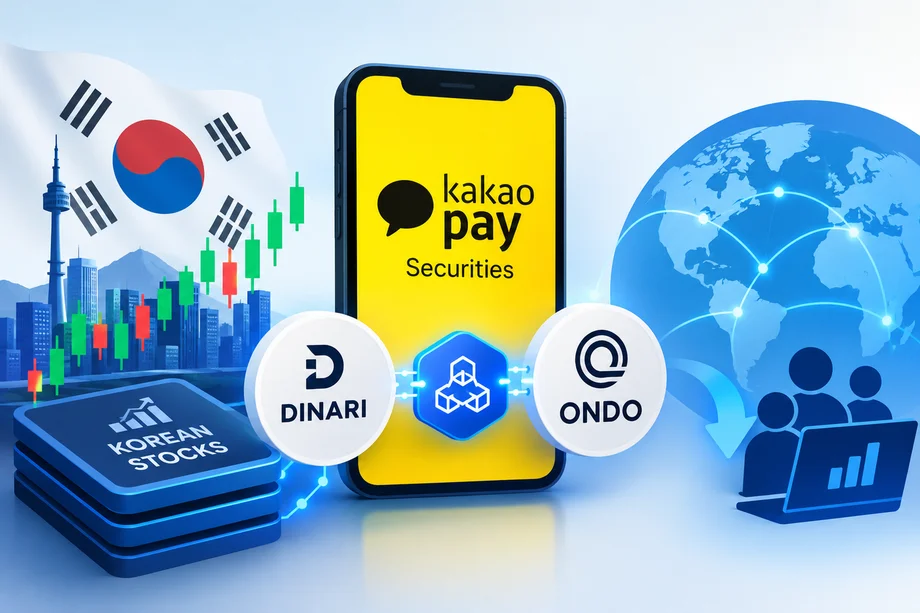
South Korean brokerage KakaoPay Securities has partnered with Dinari and Ondo Finance to explore tokenizing Korean-listed equities, potentially opening direct blockchain access to global investors
Partnerships Target Rights-Preserving Tokenization
KakaoPay Securities signed separate agreements with Dinari and Ondo Finance on September 29 to develop frameworks for sourcing Korean-listed shares, establishing custody arrangements and testing token issuance and redemption processes.
The initiative focuses on real underlying shares rather than price-tracking instruments, with Dinari’s dShares model designed to maintain shareholder rights including dividends, voting and corporate actions. Ondo’s work centers initially on operational mechanics such as a foreign investor omnibus account for holding and administering the shares before any tokenization occurs.
Both partners emphasized that any commercial rollout will depend on legal and regulatory approvals in South Korea and overseas markets. No specific Korean companies have been selected for the proof of concept, and no timeline for international distribution has been set.
KakaoPay Executive Vice President Inyoung Chung stated the collaboration aims to create new pathways for distributing leading Korean companies to international markets through a structure that does not rely on depositary receipts.
Dinari’s Model Extended to Korean Equities
Dinari currently provides 724 tokenized U.S. stocks and exchange-traded funds through its dShares infrastructure, which uses one-to-one custodial backing held with licensed custodians. Eligible investors in the United States and more than 85 jurisdictions can access these products, often via self-custody wallets.
The proof-of-concept phase with KakaoPay will examine technical requirements for applying the same one-to-one model to Korean-listed shares, including issuance, redemption and reconciliation between tokens and underlying securities. Distribution would leverage Dinari’s existing partner network once operational and regulatory hurdles are cleared.
Tokenized equities have shown strong growth, with total distributed value reaching approximately $3.2 billion as of late September according to RWA.xyz data. The market remains concentrated on U.S. listings, including major indices and individual stocks such as those tied to Nvidia, Tesla and the S&P 500.
Ondo Focuses on Custody and Operational Framework
Under the Ondo agreement, KakaoPay will build infrastructure for sourcing and holding Korean-listed shares through a foreign investor omnibus account. The parties will also research token issuance and redemption mechanisms as a foundation for future tokenization.
This approach supports cross-border distribution while aligning with existing custody practices. Commercialization of any tokenized products remains tied to compliance in both South Korea and target markets.
South Korea’s Tokenized-Securities Framework
The partnerships occur as South Korea advances its regulatory framework for tokenized securities. Amendments passed by the National Assembly in January recognize distributed ledgers as valid securities registries and permit issuance and circulation of token securities.
The Financial Services Commission has linked tokenization infrastructure to a broader capital-market overhaul. The framework is scheduled to take effect in February 2027, with the Korea Securities Depository developing systems to connect legacy account structures with blockchain data.
First-phase applications are expected to cover selected privately pooled products, institutional bonds and certain unlisted stocks, with potential expansion to public equities later.
Broader Market Context and Outlook
Tokenized stocks represent a growing segment within real-world assets, though non-U.S. listings have lagged behind domestic U.S. exposure. Initiatives like this one could diversify access for international investors seeking exposure to Korean companies without traditional depositary receipt limitations.
KakaoPay has explored other routes for overseas access, including partnerships with U.S. brokers for potential 24-hour trading structures. The Dinari collaboration operates as a separate workstream focused on blockchain-based distribution.
Key uncertainties include final regulatory interpretations and the operational integration of rights-handling mechanisms once South Korea’s framework activates. The next steps involve the planned joint task force to assess technical feasibility and infrastructure requirements.

Disclaimer
This article was generated by AI using information from multiple industry sources. It has not been reviewed or verified by a human editor and may contain inaccuracies, omissions, or misinformation. Readers are encouraged to independently verify any information before making decisions based on its content.Tired of the noise?
Let the bots trade for you.
Trade 24/7, without emotion, with data-driven strategies.
Associated articles
Shinhan Asset Management Partners with Solana for KRW Tokenized Fund Pilot

Hanwha Completes Avalanche-Supported Tokenized Securities Platform Ahead of South Korea Rules
KB Securities Partners With Securitize and Optimism to Tokenize Korean Funds on OP Mainnet
Securitize Partners with LG CNS on Tokenized Assets as South Korea Prepares 2027 Framework

South Korea Prepares Tokenized Stocks, Bonds and Funds for 2027 Launch
Latest articles
Blockchain Association Urges Clarity on DeFi and Stablecoin Rules Under GENIUS Act
XRP Launches Official X Account, Jointly Managed by Ripple and XRPL Foundation
ESMA Expands MiCA Register to 375 Providers as BingX, YouHodler and Openbank Join
France Narrowly Approves Crypto-to-Stablecoin Tax from 2027