Newsroom
Senate Republicans Release Revised Clarity Act Targeting Controlled DeFi Ahead of Key Vote
11 September, 2026 / News / AI / Tags: vote, provisions, revised, ethics, cloture

Updated 630-page draft adds registration rules for non-decentralized protocols and limits DeFi scope, but bipartisan hurdles remain before the September 15 cloture vote
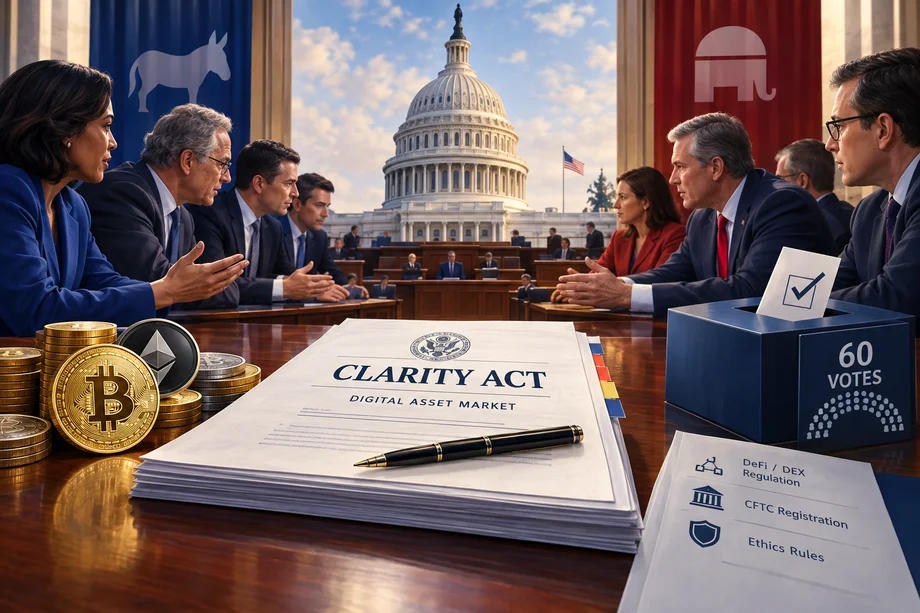
Senate Republicans circulated a revised version of the Digital Asset Market Clarity Act on September 10, incorporating more than 100 changes sought by Democratic colleagues in an effort to advance the long-negotiated crypto market structure bill. The 630-page text arrives days before a scheduled procedural vote that will test whether the legislation can clear the 60-vote threshold needed to proceed.
The update focuses in part on decentralized finance, directing regulators to apply registration, conduct, disclosure and anti-money laundering requirements to trading protocols that are decentralized in name only. It also narrows the application of certain DeFi provisions and clarifies rules for credit unions.
New Rules for Controlled DeFi Protocols
The revised draft requires what it describes as non-decentralized finance trading protocols to register with the Commodity Futures Trading Commission. These are defined as systems whose functionality, operation or rules can be materially altered by a person or coordinated group, or where controllers can restrict users, or where transactions are not governed solely by transparent, pre-established code.
The Securities and Exchange Commission and Commodity Futures Trading Commission would develop activity-based rules covering registration, conduct, disclosure, recordkeeping and supervision. The Treasury Department would determine how existing Bank Secrecy Act obligations apply to the relevant controllers. Software and distributed ledger systems themselves would not be required to register, and participation in an incident-response or security council alone would not establish control.
Language limits the DeFi provisions to spot and cash digital commodity transactions. This change responds to concerns raised by tribal governments about potential effects on prediction markets. Additional clarifications address how credit unions may conduct crypto-related activities.
Senator Cynthia Lummis, a primary Republican negotiator, stated that the updated text reflects bipartisan work over the August recess and provides lasting statutory certainty rather than relying solely on agency rulemaking.
Ethics Provisions and Other Unresolved Issues
The ethics section remains largely unchanged from earlier drafts. It prohibits covered federal officials, including the president and vice president, members of Congress and their spouses, from issuing or sponsoring digital assets in exchange for consideration while in office. Enforcement authority rests with the Department of Justice, and the restrictions carry a sunset of noon on January 20, 2029.
Democrats have consistently sought stronger ethics language and broader enforcement mechanisms. Key senators who supported earlier committee versions have indicated they will not back the current text without further progress on this front. A separate dispute has emerged over vertical integration standards that would require regulators to set minimum conflict-of-interest rules for crypto firms operating multiple related businesses under one corporate umbrella.
Banking trade groups continue to press for tighter limits on stablecoin rewards and yield programs, arguing that such features risk drawing deposits away from traditional lenders. Crypto industry representatives counter that the provisions already distinguish transactional rewards from interest-like products.
Path to the September 15 Vote
A cloture vote is scheduled for September 15. With Republicans holding 53 seats, the bill requires support from at least seven Democrats or independents assuming unified Republican backing. Reports indicate no Democratic senators currently support the revised text. Only two Democrats voted for earlier committee versions, and both have conditioned further support on additional negotiations.
Treasury Secretary Scott Bessent and White House crypto adviser Patrick Witt have urged senators of both parties to support the motion to proceed so that negotiations can continue. Coinbase Chief Executive Brian Armstrong described the legislation as ready for a yes vote and said previously raised industry concerns had been addressed, though ethics talks remain active.
Even if cloture succeeds, the measure would still face floor amendments, reconciliation with the House-passed version and a final Senate vote before any conference process. The legislative calendar is compressed by the midterm election schedule, leaving limited time for further action this year.
Prediction markets currently assign low probabilities to the bill becoming law in 2026. Industry groups have argued that regulatory clarity would proceed through agency rulemaking even if the legislation stalls, though they maintain that a statutory framework offers greater permanence.
Disclaimer
This article was generated by AI using information from multiple industry sources. It has not been reviewed or verified by a human editor and may contain inaccuracies, omissions, or misinformation. Readers are encouraged to independently verify any information before making decisions based on its content.Tired of the noise?
Let the bots trade for you.
Trade 24/7, without emotion, with data-driven strategies.
Associated articles
Senate Republicans Release Final Clarity Act Draft With Trump-Backed Ethics Rules Ahead of Tuesday Vote

Senate Delays CLARITY Act Vote Until September Amid Ethics Deadlock

Clarity Act Faces Senate Roadblock Over Ethics and Consumer Safeguards

Senate Democrats Intensify Fight Against CLARITY Act Over Trump Crypto Earnings

Senate Races Against Clock on Crypto Market Structure Bill Ahead of August Break
Latest articles

CoinDCX Confirms Losses After Suspicious $16M Transfers From 2025 Hack Wallets

Robinhood Secures Dubai License for Crypto and Stock Trading, Middle East Launch Delayed to 2027

CZ Warns Crypto Users Over Two Critical PHP Vulnerabilities

Bybit Fintech FZE Receives VARA Licence for Dubai Spot Trading