Newsroom
Samsung and SK Hynix Upgrade China NAND Factories Amid AI Demand and Local Rivalry
22 October, 2026 / News / AI / Tags: nand, hynix, samsung, china, chips
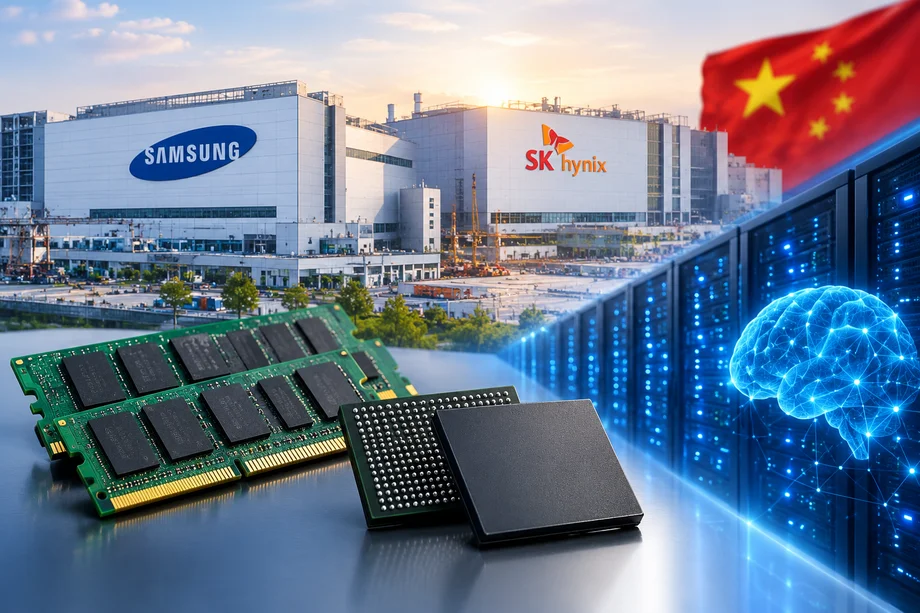
South Korean memory leaders convert Chinese plants to higher-layer chips to match domestic output and counter YMTC gains in the local market
Samsung Electronics and SK Hynix are advancing plans to produce more sophisticated NAND flash memory at their factories in China. The moves aim to address surging demand from artificial intelligence data centers and respond to the rising market position of Chinese producer Yangtze Memory Technologies.
People familiar with the efforts said the companies are shifting production at the sites toward chips with more than 200 layers. That change would align the China-based output more closely with technology already in use at their main facilities in South Korea.
Samsung Targets 286-Layer Production at Xi'an
Samsung’s plant in Xi’an, northwestern China, currently manufactures NAND chips with roughly 200 layers and represents about 40 percent of the company’s total global NAND capacity. Under an internal project called Monami, the facility is being converted to produce 286-layer V9 NAND.
Monthly wafer output is scheduled to reach 5,000 by December 2026 and climb to 40,000 by December 2027. Samsung has stated that the work complies with U.S. rules, serves customers worldwide including those in the United States, and does not involve expanding overall capacity or constructing new buildings.
SK Hynix Advances Dalian Operations
SK Hynix is preparing its Dalian facility in northeastern China to move beyond the 192-layer chips made there today. The company is targeting production of NAND products with 240 layers or more. It has received authorization for chips up to that level and may later request U.S. permission to conduct research on technology above 300 layers.
The Dalian site came under SK Hynix control through its 2021 acquisition of Intel’s NAND business, now operated as Solidigm. The plant remains the sole manufacturing location for that unit.
Market Share Shifts and Competitive Pressure
Yangtze Memory Technologies held 38.5 percent of China’s NAND market in the second quarter of 2026. Samsung’s share stood at 33.5 percent and SK Hynix’s at 17 percent. The Chinese firm has been expanding its lineup, with products centered on 160- and 232-layer chips and limited volumes of 294-layer devices already in production.
Higher layer counts increase storage density and reduce costs per bit, making them particularly suitable for solid-state drives used in AI data centers as well as for smartphones and personal computers.
U.S. Export Controls Shape the Upgrades
U.S. export restrictions introduced in 2022 require the South Korean firms to obtain annual licenses for certain American-made equipment used at the China plants. Washington has indicated it does not intend to approve licenses that would expand capacity or enable major technology leaps beyond existing levels. The current upgrades are proceeding under the annual licensing framework granted for 2026.
China accounts for a substantial portion of both companies’ NAND output—approximately 30 to 35 percent for Samsung and a higher share for SK Hynix according to industry estimates—making the performance of these facilities material to their global supply positions.
The two firms continue to produce more advanced nodes at their South Korean plants, where Samsung already manufactures 286-layer chips and SK Hynix has moved into mass production of 321-layer devices. The China upgrades are intended to narrow the gap between the two production bases while meeting worldwide customer requirements.

Disclaimer
This article was generated by AI using information from multiple industry sources. It has not been reviewed or verified by a human editor and may contain inaccuracies, omissions, or misinformation. Readers are encouraged to independently verify any information before making decisions based on its content.Tired of the noise?
Let the bots trade for you.
Trade 24/7, without emotion, with data-driven strategies.
Associated articles

Samsung Weighs Over 100 Trillion Won Shareholder Return on AI Memory Gains

China Weighs Approving Nvidia RTX Pro 5500 Purchases for Alibaba and ByteDance
SK Hynix Shares Surge After Record $29 Billion Buyback as Bond Yields Ease

HIVE Stock Surges Over 35% on Plans for Massive $2.55B Toronto AI Data Center

Google Secures 3.6 GW Power Deal with Constellation, Adding 890 MW Nuclear Capacity
Latest articles

China Prosecutors Move to Confiscate $5.1 Billion Bitcoin Haul Seized in UK Fraud Case

Bank of Korea Holds Rate at 3% After Consecutive Hikes, Eyes Data for Next Move

Starknet Community Approves Research Into Independent Post-Quantum Layer 1

Bybit Eyes U.S. Broker Deals and European App Launch Amid Regulatory Wait