Newsroom
China Weighs Approving Nvidia RTX Pro 5500 Purchases for Alibaba and ByteDance
27 September, 2026 / News / AI / Tags: nvidia, rtx, chinese, china, alibaba
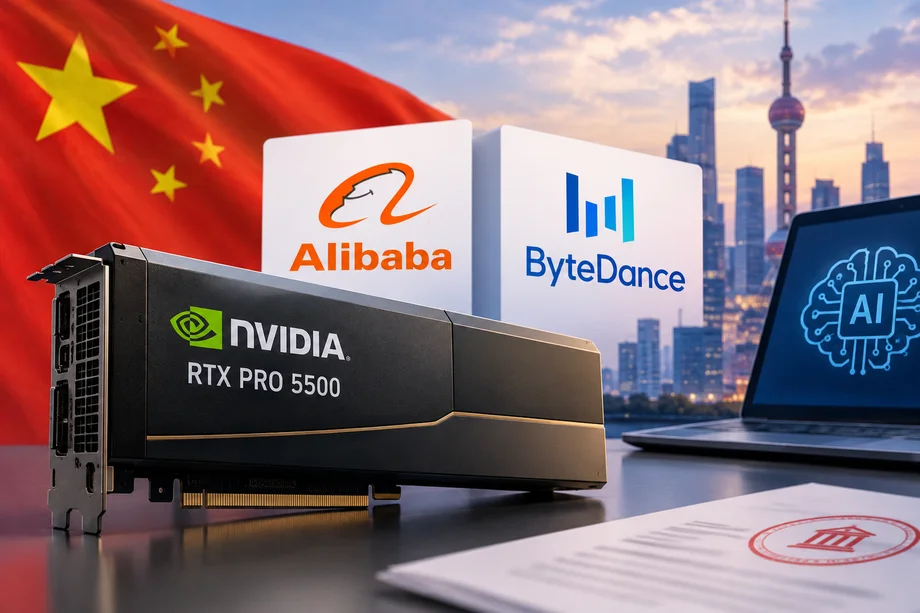
Beijing’s industry ministry has sought purchase plans from major tech firms for the newly released workstation chip, signaling a possible partial reopening of Nvidia access amid ongoing export limit
China’s Ministry of Industry and Information Technology has asked companies including Alibaba and ByteDance to detail how many Nvidia RTX Pro 5500 chips they intend to buy and for what purposes, according to reports citing people familiar with the matter. Officials have indicated to some firms that the purchases are likely to receive approval, though timing, volume limits and exact conditions remain unclear.
The RTX Pro 5500, released this month, is a high-end graphics processor designed primarily for professional workstations rather than Nvidia’s top-tier data-center AI accelerators. Built on the company’s Blackwell architecture, it features 84GB of memory but lacks certain high-speed networking and advanced memory capabilities found in flagship GPUs. Chinese companies are nonetheless interested because the chip can still support AI inference workloads when deployed in servers.
Potential Demand and Production Targets
ByteDance is reportedly considering an order on the scale of roughly one million RTX Pro 5500 units to power AI applications. Nvidia is targeting production of about 500,000 of the chips per quarter for the Chinese market. A single large order of that magnitude could therefore absorb multiple quarters of planned supply.
Alibaba and other major Chinese technology firms are also among those approached by the ministry. Any eventual approvals would come against a backdrop in which Chinese companies have been guided to reduce reliance on foreign chips while domestic alternatives from suppliers such as Huawei continue to develop.
Context of Restricted Market Access
Nvidia’s business in China has faced pressure from both U.S. export controls on advanced semiconductors and Beijing’s own restrictions aimed at fostering local industry. The company’s share of China’s advanced AI chip market has fallen sharply, with executives previously describing a drop from around 95 percent to effectively zero under tightened rules. Sales of the H200 chip in China have remained below 1 percent of Nvidia’s data-center revenue even after certain U.S. licenses were granted.
Some industry executives expect the RTX Pro 5500 to fall outside the strictest current U.S. export restrictions, given its primary design for professional computing rather than high-performance data-center training. However, final clearance would still depend on both Chinese regulatory decisions and compliance with American rules.
Neither Alibaba, ByteDance nor Chinese authorities have issued public comments on the reports. The ministry’s inquiries and signals of intent do not yet constitute formal approval, and key details such as approved quantities and any attached conditions have not been disclosed.
Implications for Supply Chains
If purchases proceed, the move could provide Nvidia with a renewed channel into a strategically important market at a time when the company anticipates broader acceleration in chip sales. It could also affect shipment volumes for Taiwanese server and component suppliers that support Nvidia’s hardware. Chinese firms rank among the largest global spenders on artificial-intelligence infrastructure, so even limited access to additional computing capacity would carry commercial significance.
The situation remains fluid. Approvals, if granted, would represent a measured adjustment rather than a full reversal of existing restrictions on both sides of the U.S.-China technology relationship.


Disclaimer
This article was generated by AI using information from multiple industry sources. It has not been reviewed or verified by a human editor and may contain inaccuracies, omissions, or misinformation. Readers are encouraged to independently verify any information before making decisions based on its content.Tired of the noise?
Let the bots trade for you.
Trade 24/7, without emotion, with data-driven strategies.
Associated articles

Tech Giants Urge U.S. to Preserve Open-Weight AI Models Amid China Competition
Nvidia’s $92 Billion Earnings Test AI Infrastructure Boom Amid Rising Costs
Nvidia Lifts AI Server Prices Over 15% Amid Memory Cost Surge

Tencent-Backed Enflame Shares Surge Nearly 180% in Shanghai STAR Market Debut
SK Hynix Shares Surge After Record $29 Billion Buyback as Bond Yields Ease
Latest articles
Scammer Loses $4.8 Million in Bitcoin on Tampered Ledger Devices

Visa Moves USDC Prefunding for Cross-Border Payouts into Commercial Production

Schwab Rolls Out Bitcoin and Ether Trading to Millions of Retail Clients

U.S. Fiscal 2026 Deficit Climbs to $1.99 Trillion as Interest Payments Surge