Newsroom
SK Hynix Shares Surge After Record $29 Billion Buyback as Bond Yields Ease
20 August, 2026 / News / AI / Tags: hynix, yields, memory, percent, samsung
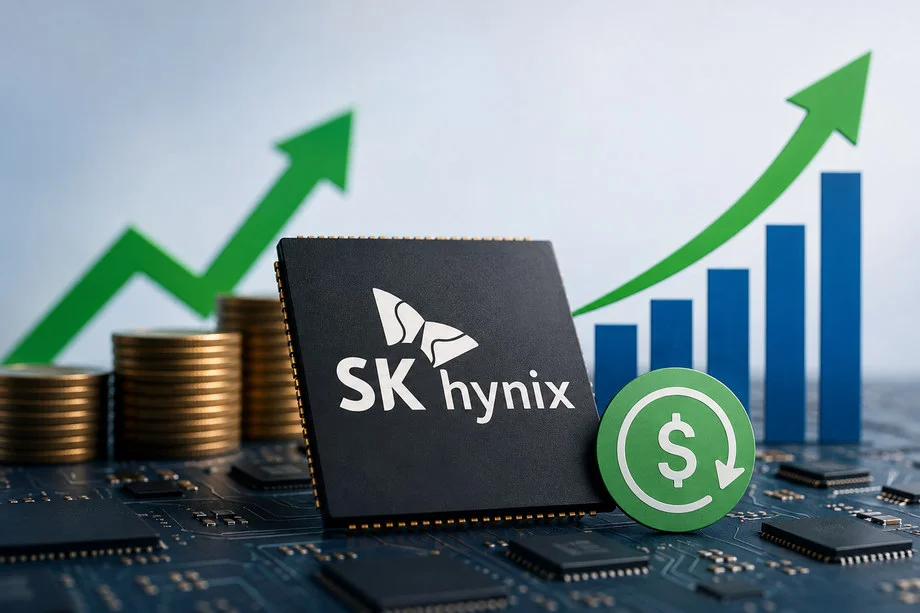
South Korean chipmaker posts double-digit gains following history-making share repurchase plan, while Samsung also rallies amid falling US Treasury yields
SK Hynix shares advanced sharply on Thursday after the memory-chip producer unveiled the largest share cancellation program ever undertaken by a listed South Korean company. The move, combined with a decline in long-term US Treasury yields, lifted the broader Korean market and supported peer Samsung Electronics.
Record Buyback and Cancellation Plan
SK Hynix’s board approved a 40 trillion won plan, equivalent to roughly $29 billion, to repurchase and permanently cancel approximately 24.07 million shares. The amount represents about 3.3 percent of the company’s outstanding stock. Purchases are scheduled to begin on August 20 and continue for around three months, after which the acquired shares will be retired.
The company framed the decision as a response to what management regards as an undervaluation of its AI memory business. It also raised its shareholder-return target for cumulative free cash flow generated between 2025 and 2027 from “within 50 percent” to “over 50 percent.” Returns will combine buybacks, cancellations and dividends, with both fixed and special dividends under consideration. Further details are expected at the third-quarter earnings release.
At the end of the second quarter, SK Hynix held nearly 69 trillion won in net cash. The firm posted record quarterly revenue of 79.3 trillion won and operating profit of 60.5 trillion won in that period, driven by strong demand for high-bandwidth memory used in artificial-intelligence systems. Mass shipments of its HBM4 products began in the second quarter, with production set to increase in the second half of the year.
Market Reaction Across Listings
In Seoul, SK Hynix shares closed 9.75 percent lower on the day of the announcement, finishing at 1,500,000 won. The following session, however, produced a sharp reversal. On Thursday the stock climbed 12.3 percent. Samsung Electronics, which did not announce a comparable buyback, advanced 8.9 percent. The Kospi index rose 6.13 percent, reversing the previous day’s decline.
US-listed American depositary receipts of SK Hynix showed a different pattern. After falling 9.2 percent to $155.62 in the prior session, the ADRs traded higher in premarket activity the next day, at one point rising as much as 6 percent before settling around a 3.8 percent gain near $161.53.
US Bond Market Influence
The rebound in Korean chip stocks coincided with a drop in US Treasury yields. The US Treasury announced it would double buybacks of long-dated government bonds, prompting the 30-year yield to fall roughly ten basis points. Lower yields reduce the discount rate applied to future earnings, a factor that tends to support growth-oriented equities whose valuations rest on multi-year demand expectations.
Chipmakers such as SK Hynix and Samsung derive a substantial portion of their valuations from anticipated AI-related capital spending. Hyperscale data-center operators often finance large construction projects through corporate bonds. When Treasury yields ease, that borrowing becomes relatively less expensive, which can reinforce confidence in the spending cycle that drives demand for advanced memory chips.
Analysts have previously noted that sustained rises in the US 10-year yield toward the 5 to 5.3 percent range could raise questions about the durability of AI infrastructure financing. The recent easing in yields therefore provided an additional tailwind for the sector on Thursday.
SK Hynix’s decision accelerates a shareholder-return framework first outlined in late 2024 and arrives as the company continues to expand production of high-bandwidth memory products central to AI accelerators. The scale of the repurchase program and the concurrent improvement in bond-market conditions together produced one of the strongest single-day performances for Korean technology shares in recent sessions.

Disclaimer
This article was generated by AI using information from multiple industry sources. It has not been reviewed or verified by a human editor and may contain inaccuracies, omissions, or misinformation. Readers are encouraged to independently verify any information before making decisions based on its content.Tired of the noise?
Let the bots trade for you.
Trade 24/7, without emotion, with data-driven strategies.
Associated articles
Samsung Weighs Over 100 Trillion Won Shareholder Return on AI Memory Gains
Samsung Forecasts Record $80 Billion Quarterly Profit on AI Memory Demand

KOSPI Plunges Nearly 11% as Samsung and SK Hynix Lead Sharp Chip Selloff

Metaplanet to Raise $329 Million via Zero-Coupon Convertible Bonds for Debt Repayment and Buybacks
Amazon Posts $62.6 Billion Profit, AWS Growth Hits Fastest Pace in Years on AI Demand
Latest articles
CoinDCX Confirms Losses After Suspicious $16M Transfers From 2025 Hack Wallets
Robinhood Secures Dubai License for Crypto and Stock Trading, Middle East Launch Delayed to 2027
CZ Warns Crypto Users Over Two Critical PHP Vulnerabilities
Bybit Fintech FZE Receives VARA Licence for Dubai Spot Trading