Newsroom
Ondo Finance Opens Direct Share-to-Token Pathway for Institutions
22 September, 2026 / News / AI / Tags: ondo, alpaca, conversion, tokenized, stocks
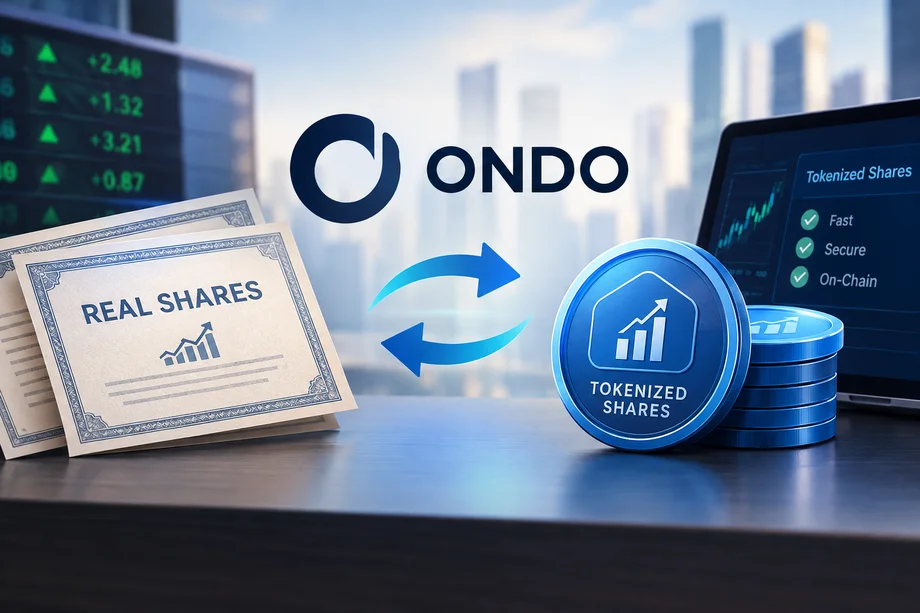
Approved institutions can now convert existing stocks and ETFs into Ondo Stocks tokens or redeem them through Alpaca’s network on Ethereum and BNB Chain, reducing the need for separate cash funding
New In-Kind Conversion Service Goes Live
Ondo Finance has introduced an in-kind conversion service that allows approved institutions to mint and redeem its tokenized stocks and exchange-traded funds using the underlying securities themselves rather than cash. The feature, launched around September 21, operates through Alpaca’s Instant Tokenization Network and is currently available on Ethereum and BNB Chain.
Under the previous cash-funded model, institutions that already held the relevant shares still needed to provide separate capital to create matching tokenized positions. The new route removes that extra step by letting participants contribute shares they already own.
How the Conversion Process Operates
For a mint, an approved institution moves the underlying stock or ETF from its own Alpaca brokerage account to Ondo’s Alpaca account via an internal book transfer. Once the shares arrive, Ondo issues the corresponding Ondo Stocks tokens on a supported blockchain. Redemption works in reverse: the institution returns the tokens, and the underlying shares are transferred back to its Alpaca account.
The integration is designed to eliminate manual approval for each individual conversion. Access remains limited. Institutions must hold active accounts with both Ondo and Alpaca, complete the required onboarding, and receive case-by-case approval from Alpaca before the service can be activated.
Capital Efficiency and Market Implications
Ondo stated that the in-kind model can lower financing costs and reduce timing mismatches that arise when market makers need additional tokenized inventory. By allowing existing share holdings to back token creation, the approach aims to support tighter spreads and deeper liquidity in secondary markets for the tokenized assets.
The change does not alter the general terms that apply to ordinary holders of Ondo Stocks. Those tokens continue to offer economic exposure to the referenced securities but are not themselves stocks, ETFs or ADRs, and they do not automatically confer rights to the underlying assets. The institutional conversion program creates a specific pathway for approved participants to move between tokenized positions and the actual shares held in brokerage accounts.
Ondo’s Position in Tokenized Assets
Data from RWA.xyz shows Ondo managing approximately $3.63 billion in distributed asset value across 441 products as of September 22, with monthly transfer volume of $1.58 billion and more than 485,000 holder addresses. The platform ranks second by onchain value behind Securitize. Network breakdowns indicate roughly $2 billion of Ondo assets on Ethereum, $407.1 million on BNB Chain and $300.6 million on Solana, with additional holdings on other networks.
Ondo’s broader tokenized stock offering includes more than 450 U.S. stocks and ETFs available across multiple chains, though the new in-kind conversion is limited to Ethereum and BNB Chain for now. The tokens remain unavailable to U.S. persons through the main product platform unless a separate registration or exemption applies.
| Metric | Figure |
|---|---|
| Distributed asset value | $3.63 billion |
| Tracked products | 441 |
| Holder addresses | 485,296 |
| Monthly transfer volume | $1.58 billion |
Regulatory and Infrastructure Backdrop
The launch occurs against a backdrop of evolving U.S. regulatory frameworks for tokenized securities. A recent Securities and Exchange Commission order created temporary, conditional exemptions for certain tokenized securities venues, requiring among other things that tokenized National Market System stocks carry the same rights as their traditional counterparts. Ondo has not indicated that the Alpaca in-kind service operates under that exemption.
Separately, Ondo’s subsidiary Oasis Pro Markets recently joined DTCC’s Fund/SERV platform as its first tokenization-platform member. Oasis Pro Markets is a U.S.-registered broker-dealer and FINRA member. Ondo has also pursued a no-action request with the SEC concerning a model in which Ethereum records tokenized security entitlements while Alpaca’s offchain books remain the official ledger.
Institutions interested in the conversion service must maintain the required accounts, complete onboarding with both firms and request activation. No timetable has been given for expanding network support or widening eligibility beyond the current approved institutional cohort.


Disclaimer
This article was generated by AI using information from multiple industry sources. It has not been reviewed or verified by a human editor and may contain inaccuracies, omissions, or misinformation. Readers are encouraged to independently verify any information before making decisions based on its content.Tired of the noise?
Let the bots trade for you.
Trade 24/7, without emotion, with data-driven strategies.
Associated articles
BNB Chain Dominates Franklin Templeton's $1.5 Billion Benji Tokenized Platform

NEAR Partners with Ondo Finance to Offer Tokenized U.S. Stocks and ETFs
Ondo Launches BlackRock-Powered Tokenized Portfolios for Non-U.S. Investors

Tokenized Stock Holders Surge Past 1.3 Million as On-Chain Volume Hits $23 Billion
KakaoPay Securities Partners With Dinari and Ondo to Tokenize Korean Stocks
Latest articles

Microsoft Launches Maia 300 AI Chip With 2027 Production Rollout

BitMine Holds Nearly 5% of Ethereum With $16.2 Billion Treasury

Strategy Expands Bitcoin Treasury to 848,250 Coins With $21.5 Million Purchase

Morgan Stanley Delays Tokenized Stock Trading to First Quarter of 2027