Newsroom
Microsoft Launches Maia 300 AI Chip With 2027 Production Rollout
12 October, 2026 / News / AI / Tags: maia, microsoft, bandwidth, chip, accelerator
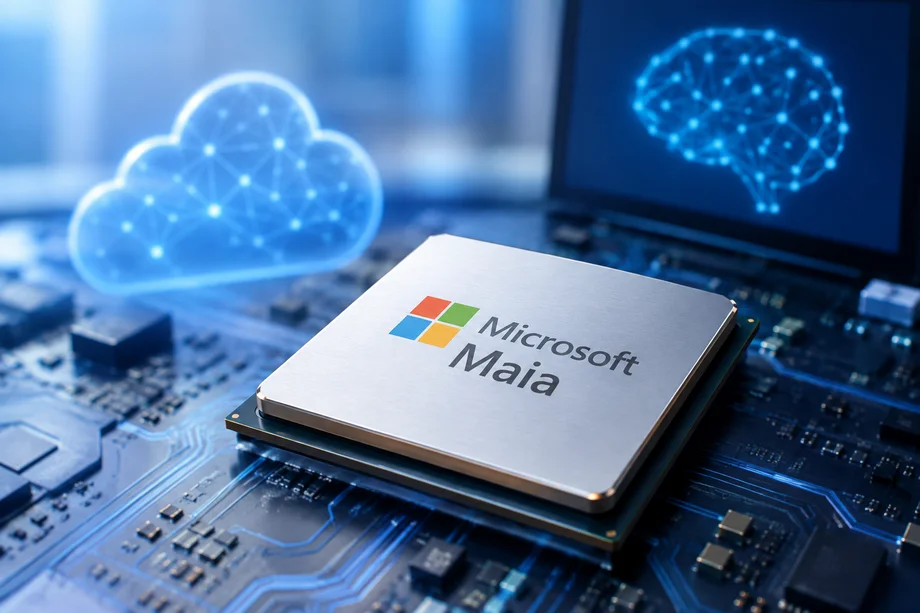
Microsoft unveiled its third-generation AI accelerator on October 12, 2026, as part of a push to strengthen its in-house chip program and improve performance in cloud-based AI services
Maia 300 Unveiled as Third-Generation Accelerator
Microsoft introduced the Maia 300 AI accelerator on October 12, 2026, marking the third generation in its proprietary lineup. The new chip is engineered to enhance throughput in AI systems and lower the company’s dependence on external graphics processing units over the long term. Production is scheduled to start in 2027, with initial deployments focused on Microsoft’s internal infrastructure.
The accelerator will integrate into data-center racks, where each will contain 96 Maia 300 chips. This setup is projected to deliver seven times the token throughput of the prior Maia 200 configuration and achieve 40 percent higher token efficiency per megawatt. Microsoft aims to scale these clusters across multiple gigawatts to support expanding AI operations.
Key Performance Improvements Over Predecessor
Compared with Maia 200, the new chip offers a 36 percent increase in compute performance, 2.5 times the memory bandwidth and 14 percent higher scale-up bandwidth. It also provides more than 2.5 times the performance per watt. Each accelerator pairs eight high-bandwidth memory stacks, delivering 288 gigabytes of memory capacity and 18 terabytes per second of bandwidth per chip.
Microsoft plans to deploy the full rack configuration, which draws 167 kilowatts and includes 27.6 terabytes of high-bandwidth memory with an aggregate memory bandwidth of 1.7 petabytes per second. The design targets long-context reasoning tasks, latency-sensitive conversational applications and sustained multi-step agentic workflows.
Role in Azure and Microsoft Products
The Azure Maia family is positioned as the primary inference system for Microsoft services. The first benefits are expected in Microsoft 365 Copilot, with GitHub Copilot and Microsoft Foundry following by the end of 2026. Maia 200 is already supporting some production workloads, including Copilot experiences, and has demonstrated up to 1.7 times more tokens per watt for certain Teams and Coworker features than leading GPU alternatives.
Maia accelerators will initially remain dedicated to Microsoft’s internal use rather than being offered externally. The company continues to partner with Nvidia and AMD for model-training workloads, keeping the new chips focused on inference tasks. Analysts from Evercore ISI estimate that Maia chips could represent about 10 percent of Microsoft’s AI chip spending by the first quarter of 2027.
Co-Design Approach for Custom AI Models
Microsoft has emphasized co-designing its models and hardware as a core element of the Maia strategy. This integrated approach allows the company to own more of the stack and align silicon directly with its AI requirements. The chip is built on a chiplet architecture using Taiwan Semiconductor Manufacturing Company’s N2P process node, which separates compute, memory-controller and input-output functions to optimize efficiency.
Production deployments of Maia 300 are set to begin in 2027, with the company targeting multi-gigawatt clusters for its expanding AI infrastructure. While Nvidia and AMD will continue supporting training operations, the focus on Maia remains on inference to enhance overall performance and cost efficiency in cloud services.

Disclaimer
This article was generated by AI using information from multiple industry sources. It has not been reviewed or verified by a human editor and may contain inaccuracies, omissions, or misinformation. Readers are encouraged to independently verify any information before making decisions based on its content.Tired of the noise?
Let the bots trade for you.
Trade 24/7, without emotion, with data-driven strategies.
Associated articles

Chinese AI Lab Z.ai Launches GLM-5.3 as Leading Open-Weight Coding Model

IREN Completes First AI Cloud Phase for Microsoft in $9.7 Billion Deal

HIVE Stock Surges Over 35% on Plans for Massive $2.55B Toronto AI Data Center
SpaceX Seeks $40 Billion Debt Package for Nvidia AI Chips Amid Orbital Compute Push
SK Hynix Shares Surge After Record $29 Billion Buyback as Bond Yields Ease
Latest articles

FLOP Testnet Set to Launch in Weeks as Arthur Hayes Advances AI Blockchain Project

SkyAI Plans $201 Million Cash Tender Offer After Rejecting Forward Industries Bid

BitMine Holds Nearly 5% of Ethereum With $16.2 Billion Treasury

Strategy Expands Bitcoin Treasury to 848,250 Coins With $21.5 Million Purchase