Newsroom
Morgan Stanley Delays Tokenized Stock Trading to First Quarter of 2027
12 October, 2026 / News / AI / Tags: stanley, tokenized, oldenburg, morgan, equities
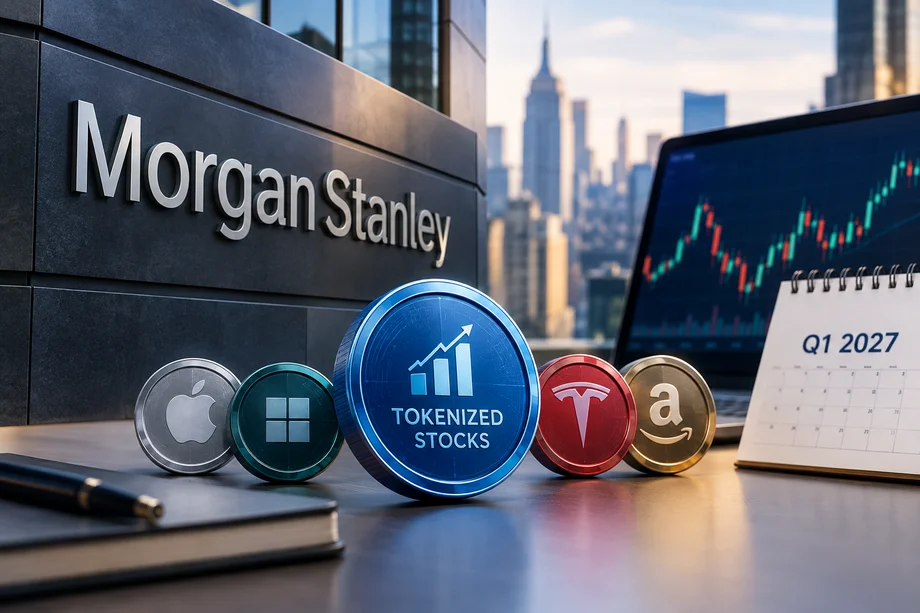
Morgan Stanley has shifted its timeline for enabling tokenized equities on its alternative trading system, citing the need for greater product availability and institutional interest
Morgan Stanley has revised its plans for supporting tokenized stocks on its existing platform, moving the anticipated start from the second half of 2026 to the first quarter of 2027. The adjustment comes as the firm continues to build the necessary infrastructure for blockchain-based securities trading while monitoring developments across the broader ecosystem.
Updated Timeline for Tokenized Equities Support
Amy Oldenburg, Morgan Stanley’s head of digital asset strategy, announced the change during a recent conference in Singapore. The bank now targets early 2027 for integrating tokenized equities into its Trajectory Cross alternative trading system, an established venue that already handles traditional stocks, exchange-traded funds and American Depositary Receipts.
Previously, the firm had outlined a second-half 2026 rollout during its Digital Asset Summit in March. Oldenburg described the new date as more realistic given ongoing work on the required technology. The service would extend existing trading operations to blockchain-based versions of selected U.S. stocks and ETFs, without creating a separate cryptocurrency exchange.
No specific launch date, list of eligible securities or confirmation that the service is already operational has been provided. Oldenburg noted that institutional demand for tokenized equities remains limited primarily because suitable products have not yet become widely available.
The executive emphasized that the bank is actively developing capabilities and will only proceed once appropriate securities and client interest are present. She added that the team continues to track activity among custodians, trading venues, regulators and other market participants.
Industry-Wide Momentum on Tokenization
Morgan Stanley’s revised target aligns with parallel efforts by other key players. The Depository Trust & Clearing Corporation has maintained its planned launch of a new tokenization service for October 2026. This service would represent eligible securities currently held at the Depository Trust Company through blockchain records while preserving traditional ownership rights and investor protections.
DTCC completed production transactions involving tokenized U.S. Treasuries and equities in July, with approximately 40 firms participating. Eligible assets under consideration include stocks, Treasury securities and major exchange-traded funds. The firm has over 50 companies involved in an industry working group advancing the project.
Separately, the U.S. Securities and Exchange Commission issued temporary exemptions in September 2026 for platforms trading tokenized stocks. These provisions allow qualifying venues to operate under automated market maker arrangements under specified conditions, while ensuring holders receive equivalent rights to traditional securities.
Broader Digital Asset Infrastructure Expansion
In addition to tokenized equities, Morgan Stanley is advancing other blockchain initiatives. The firm is developing proprietary wallet infrastructure that would enable customers to hold digital assets and tokenized products within an integrated experience. The wallet is designed to pair with institutional custody arrangements, with much of the underlying technology handled by the bank itself.
A new Digital Asset Lab serves as an internal testing environment for blockchain applications, including stablecoins, decentralized finance systems and tokenized assets. This lab focuses on evaluating technical capabilities and operational risks ahead of broader rollout.
These efforts build on Morgan Stanley’s existing digital asset offerings, such as the July introduction of Bitcoin, Ethereum and Solana trading through its E*TRADE brokerage platform. The firm has also pursued federal authorization for a dedicated digital asset custody trust bank, which received a conditional charter decision in June 2026.
Longer-Term Vision for Tokenized Real-World Assets
Oldenburg outlined a broader outlook for tokenization beyond publicly traded equities. She identified private shares, structured financial products and private fund interests as areas where blockchain could reduce administrative burdens related to ownership records, investor eligibility and transaction processing.
The executive described the firm’s objective as raising, allocating and managing capital onchain, while maintaining support for both traditional and tokenized instruments within the same client relationships. She characterized the trend as the eventual “securitization of everything,” with tokenized assets potentially used as collateral in future applications.
Oldenburg forecasted that the market for tokenized real-world assets could reach between $3 trillion and $10 trillion by 2030, expressing strong confidence in that range. These projections reflect her assessment of ongoing industry developments rather than a formal regulatory forecast.
| Key Milestone | Date | Details |
|---|---|---|
| Morgan Stanley Revised Timeline | First Quarter 2027 | Support for tokenized equities on Trajectory Cross ATS |
| DTCC Tokenization Service | October 2026 | Blockchain representation of securities held at DTC |
| SEC Temporary Exemptions | September 2026 | Trading tokenized stocks under automated market makers |
| Production Transactions | July 2026 | Tokenized Treasuries and equities with 40 firms |
| Digital Asset Lab | September 2026 | Internal testing of stablecoins, DeFi and tokenized assets |
Morgan Stanley has not disclosed any specific technical challenges, additional project costs or exact blockchain networks that would be used. The firm’s preparations remain conditional on the availability of suitable products, sufficient institutional demand and completion of the required operational infrastructure.
Disclaimer
This article was generated by AI using information from multiple industry sources. It has not been reviewed or verified by a human editor and may contain inaccuracies, omissions, or misinformation. Readers are encouraged to independently verify any information before making decisions based on its content.Tired of the noise?
Let the bots trade for you.
Trade 24/7, without emotion, with data-driven strategies.
Associated articles
Morgan Stanley Debuts Ether and Solana ETPs at Market-Low 0.14% Fee With Staking

Blockchain.com and NYSE Explore 24/7 Tokenized U.S. Stocks Trading

Morgan Stanley Launches Digital Asset Lab to Test Stablecoins, Tokenization and DeFi
Uniswap Founder Says Tokenization Will Test Automated Market Makers as On-Chain Assets Grow

SEC Moves to Enable Trading of Tokenized Stocks on Crypto Platforms
Latest articles

BitMine Holds Nearly 5% of Ethereum With $16.2 Billion Treasury

Strategy Expands Bitcoin Treasury to 848,250 Coins With $21.5 Million Purchase
SWI Group Secures €800 Million to Repurpose Genesis Digital Assets for AI Expansion

Payward Secures Full Dubai VARA License for Kraken UAE Launch