Newsroom
OCC Finalizes GENIUS Act Stablecoin Rules with January 2027 Start Date
22 October, 2026 / News / AI / Tags: issuers, occ, genius, reserves, stablecoin
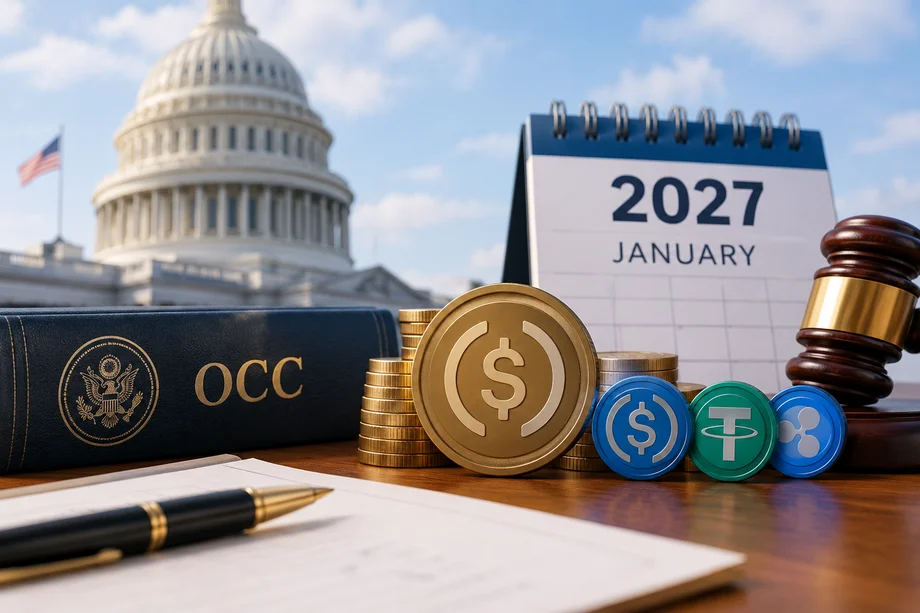
The Office of the Comptroller of the Currency released final regulations implementing the GENIUS Act, establishing federal standards for payment stablecoin reserves, redemptions, custody and risk management. The rules take effect on January 18, 2027, while anti-money-laundering and sanctions requirements will be handled separately
Issuers Face New Federal Standards for Reserves and Operations
The U.S. Office of the Comptroller of the Currency finalized rules that bring clearer oversight to payment stablecoin issuers under its supervision. These include national banks, federal savings associations, nonbank firms that receive federal qualified issuer status and certain foreign issuers. The framework also extends to some custody activities conducted by supervised institutions.
Issuers must hold reserves valued at least equal to the outstanding stablecoins they have issued. Eligible assets include cash, certain demand deposits, specified Treasury securities, repurchase agreements and qualifying government money market funds. The rules require monthly disclosures of reserve composition and establish expectations for timely processing of customer redemption requests, generally within two business days.
A 24-hour notice requirement applies if redemption requests exceed 10 percent of the total circulating supply on any single day. The OCC will review each such request individually to assess whether an extension is warranted. These provisions aim to maintain liquidity and prevent sudden disruptions in the market.
Stablecoin Yield Restrictions and Third-Party Rewards
The GENIUS Act prohibits stablecoin issuers from paying direct interest or yield solely because a holder retains, uses or trades the tokens. The final OCC rule maintains this ban on issuer-paid interest. However, it removes a proposed presumption that would automatically classify certain affiliate or third-party arrangements as violations.
Arrangements involving third parties, such as crypto exchanges or fintech platforms offering rewards, will now receive case-by-case review. The OCC retains authority to intervene if it identifies attempts to evade the prohibition or structures that effectively function as hidden interest. This approach leaves room for platforms like Coinbase and Kraken to continue incentive programs, provided they comply with individual supervisory scrutiny.
Traditional banks had lobbied for a complete ban on all stablecoin rewards, arguing that attractive yields could drain deposits from conventional accounts. The final rule does not adopt that position, instead favoring targeted review over a blanket prohibition.
Flexibility Granted to Issuers on Reserve Management
The OCC relaxed several constraints from the earlier proposal. Issuers may now invest reserves in longer-term Treasury securities and higher-yielding options beyond short-term instruments. Surplus reserves may be withdrawn at any time without the previous monthly limit, as long as the one-to-one backing requirement is preserved.
The agency also removed a proposed seven-day extension window during periods of elevated redemption activity. Issuers must still comply with the standard two-business-day timeline unless they obtain explicit approval for an extension after notifying regulators of a significant surge.
Transition and Application Process
Existing issuers that have submitted substantially complete applications by January 18, 2027, may request temporary waivers from certain prior-approval requirements. The OCC will evaluate each waiver on its merits, with a maximum duration of 12 months from the effective date. The regulator has not yet opened the formal application process and will announce a separate timeline once the Office of Management and Budget clears the related information-collection forms.
State-qualified issuers with consolidated issuance below $10 billion may continue under approved state regimes that mirror federal standards. Larger issuers above that threshold can seek a waiver to remain solely state-supervised if they demonstrate equivalence.
The OCC emphasized that the rule provides only the initial stage of broader stablecoin regulation. Anti-money-laundering, Bank Secrecy Act and sanctions compliance requirements will be addressed in separate rulemaking coordinated with the Treasury Department.
Statements from Key Officials
Treasury Secretary Scott Bessent described the GENIUS Act as a watershed moment for American finance, drawing parallels to the National Currency Act of 1863 for its role in establishing a national framework for currency. He noted that the OCC rule advances the administration’s vision for private-sector innovation and competition in digital assets.
Industry and Banking Perspectives
Crypto firms and community bankers submitted hundreds of comments during the proposal stage, reflecting the sector’s ongoing push for clarity. The American Bankers Association criticized the final rule for preserving the status quo on third-party rewards, warning that it undermines congressional intent by allowing yields to continue drawing funds away from traditional deposits.
The OCC will continue monitoring the developing market and stands ready to adjust the framework as needed. Applications and related guidance will follow in due course, giving issuers time to align operations with the new requirements ahead of the January 2027 effective date.
Disclaimer
This article was generated by AI using information from multiple industry sources. It has not been reviewed or verified by a human editor and may contain inaccuracies, omissions, or misinformation. Readers are encouraged to independently verify any information before making decisions based on its content.Tired of the noise?
Let the bots trade for you.
Trade 24/7, without emotion, with data-driven strategies.
Associated articles
Federal Reserve Proposes Capital and Redemption Rules for Stablecoin Issuers Under GENIUS Act

US Regulators Miss GENIUS Act Deadline, Leaving Stablecoin Framework Incomplete

US Treasury Proposes Rules Clarifying Stablecoin Issuance Under GENIUS Act

OCC Aims for November Finish on GENIUS Act Stablecoin Rules

Singapore Proposes Full Reserves and Interest Ban for Stablecoin Issuers
Latest articles

French 10-Year Bond Yield Surpasses 5% for First Time Since 2002

Ledger Rolls Out Bitcoin-Backed Stablecoin Loans in Wallet App via Morpho

Malaysia Central Bank Unveils Tokenized Bond Platform Enabling Round-the-Clock Settlement

Securitize Partners with Anchorage Digital Bank for Direct Stablecoin Minting